
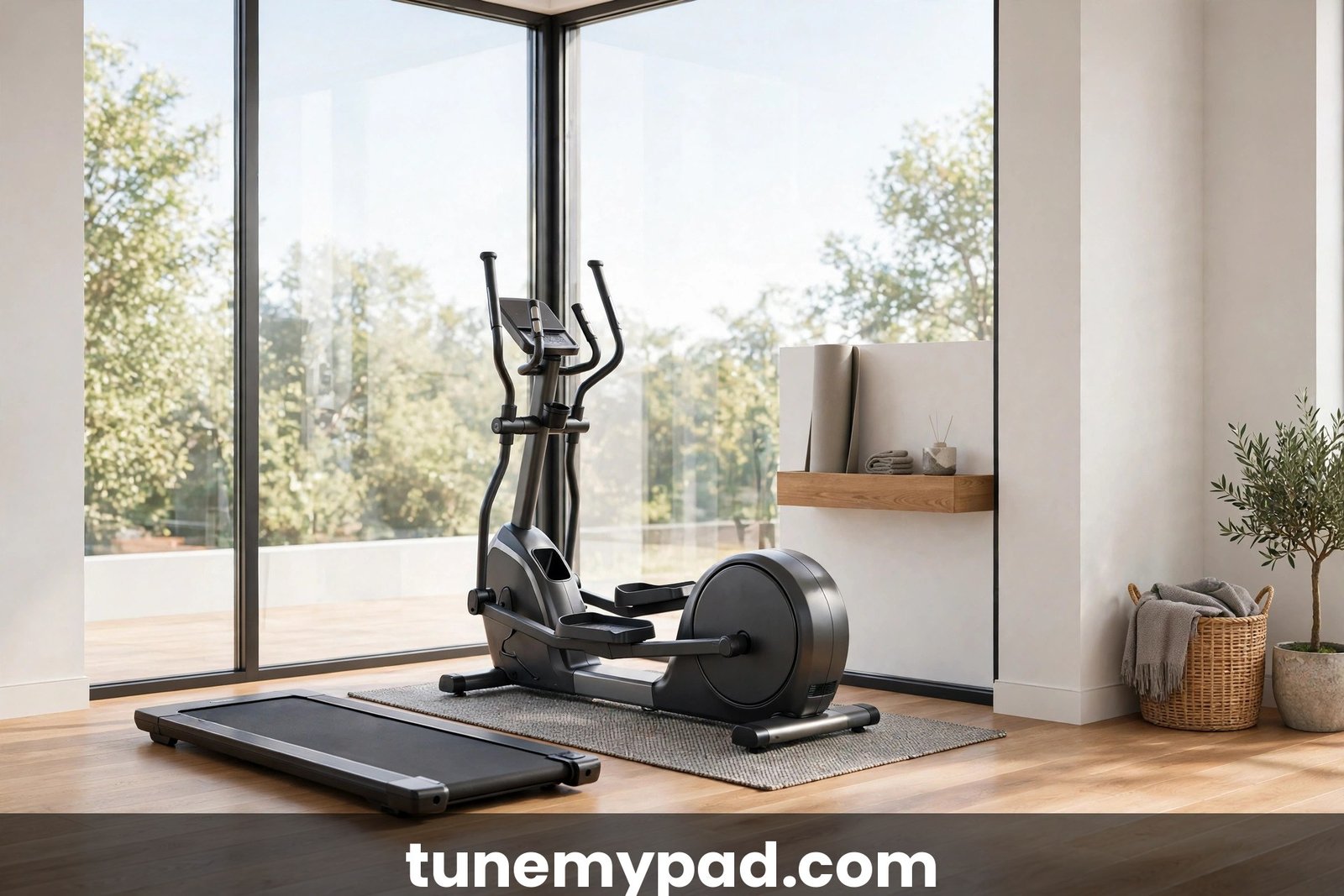
If you are stuck choosing a walking pad vs elliptical for home workouts, you are really choosing between two different philosophies of staying active at home. One is a slim belt that slides under your desk and keeps you moving while you work. The other is a full-size machine that gives you a sweaty, heart-pumping cardio session. Both can work beautifully, but they solve different problems, and buying the wrong one is an expensive mistake.
This guide breaks down the walking pad vs elliptical for home decision into 7 honest differences: footprint, price, calorie burn, joint impact, noise, multitasking, and maintenance. By the end, you will know exactly which machine fits your space, your budget, and the way you actually live. If quiet apartment cardio is your priority, our guide to how loud a walking pad really is will help you set expectations before you buy.
There is no universal winner in the walking pad vs elliptical for home debate. The right answer depends on whether you want fitness woven into your workday or a dedicated workout that replaces the gym. Let us compare them side by side so you can decide with confidence.
Quick Answer: Walking Pad vs Elliptical for Home
If you want low-effort daily movement while you work, a walking pad wins. If you want intense cardio workouts that burn maximum calories in minimum time, an elliptical wins. That is the short version of the walking pad vs elliptical for home question, and for most people it is enough to decide.
Choose a walking pad if you work from home, have limited space, want something quiet for an apartment, or prefer gentle low-impact movement spread across the day. Choose an elliptical if you want a dedicated 30-minute workout, need higher calorie burn per session, or miss the feel of gym cardio. The rest of this guide digs into the numbers behind that advice, because the walking pad vs elliptical for home choice gets clearer once you see the real trade-offs.
Table of Contents
The table below summarizes the 7 differences covered in this guide. If you are short on time, it gives you the whole walking pad vs elliptical for home comparison in one glance.
| Factor | Walking Pad | Elliptical |
|---|---|---|
| Typical footprint | 50 x 20 inches, stores flat under a bed or sofa | 70 x 25 inches, needs a permanent spot |
| Price range | $150 to $500 | $300 to $2,500+ |
| Calories per 30 minutes | 90 to 150 at 2 mph | 270 to 400 at moderate effort |
| Joint impact | Very low | Very low |
| Noise level | 40 to 55 decibels | 50 to 65 decibels |
| Multitasking | Excellent for desk work | Poor, needs full attention |
| Maintenance | Belt lube every few months | More moving parts, more upkeep |
Keep in mind that these are typical ranges. Budget models on both sides cut corners, and premium models on both sides perform better. The walking pad vs elliptical for home decision should always start with your space and your schedule, not with the spec sheet.
Difference 1: Footprint and Storage
The biggest practical gap in the walking pad vs elliptical for home comparison is size. A walking pad is roughly the size of a yoga mat with a motor. Most models measure about 50 inches long and 20 inches wide, stand only 5 to 6 inches tall, and weigh 40 to 60 pounds. When you are done, you tip it up and slide it under a bed, lean it against a wall, or tuck it behind a sofa. In a studio apartment, that disappearing act is the whole point.
An elliptical is a piece of furniture. Even compact front-drive models need about 6 feet by 2.5 feet of floor space, plus clearance around the moving arms. Rear-drive models need even more. You do not store an elliptical under the bed. It lives in a corner of the room, permanently, and in a small apartment it becomes the room’s personality. When people compare a walking pad vs elliptical for home use in tight quarters, the walking pad wins this round almost every time.
When space decides for you
Measure your space before you shop. If you cannot dedicate a permanent 15+ square feet to fitness equipment, the walking pad vs elliptical for home question answers itself. Walking pads also win for renters who move often, since a 50-pound pad is easy to carry down stairs, while a 150-pound elliptical is a two-person job with a dolly.
That said, if you have a spare room or a garage corner, an elliptical’s footprint stops mattering. Plenty of people happily give an elliptical a permanent home and never think about storage again. The walking pad vs elliptical for home footprint debate only matters when square footage is scarce, which, for most apartment dwellers, it is.
Difference 2: Price and Value
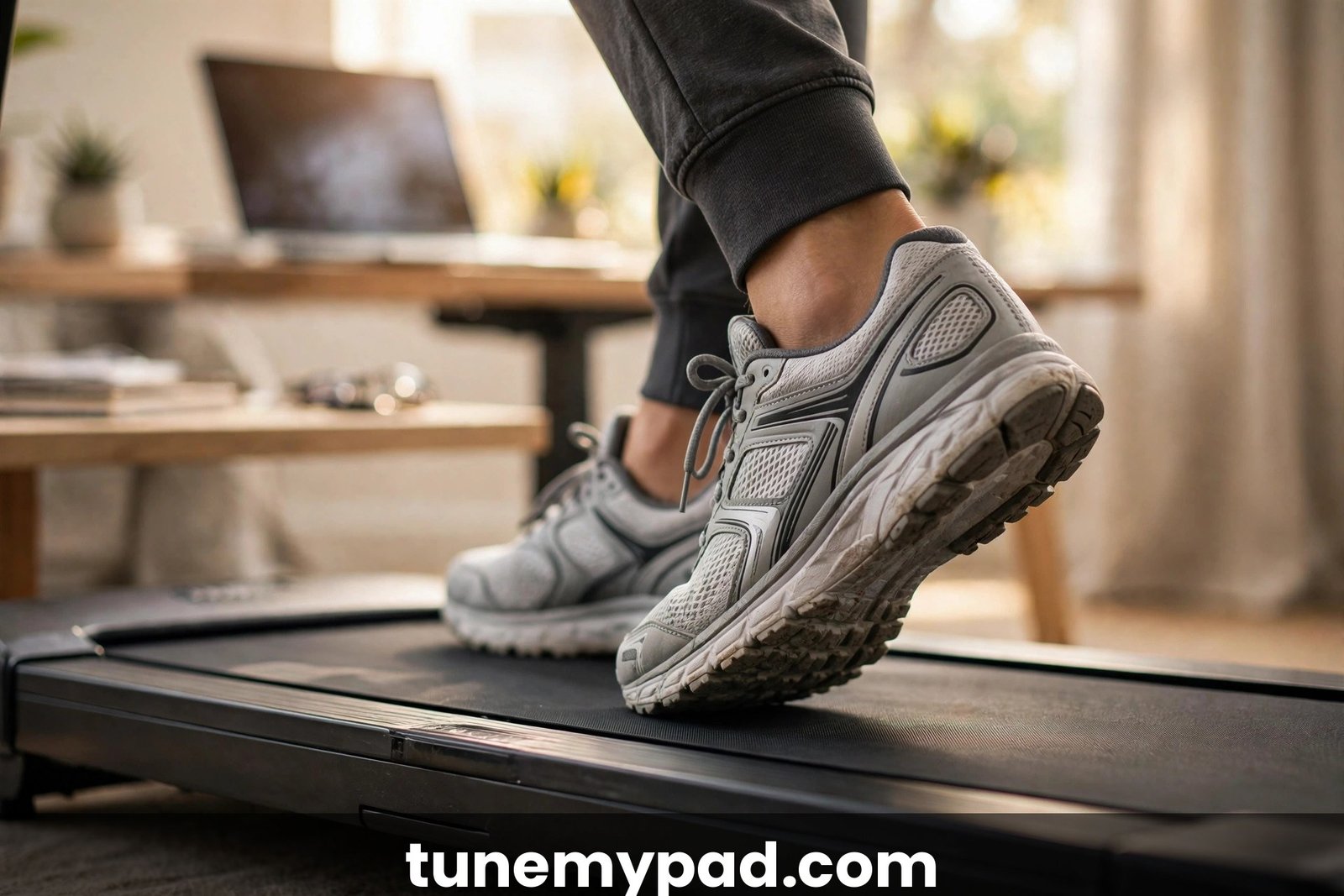
Price is the second major split in the walking pad vs elliptical for home math. A decent walking pad costs $150 to $500, with the sweet spot around $250 to $350. At that price you get a reliable motor, a usable remote, and a belt that does not drift. There is almost nothing to assemble, no subscription, and no ongoing cost beyond electricity that amounts to pennies per walk.
Ellipticals start around $300 for basic models and climb past $2,500 for gym-grade machines with screens, incline, and connected fitness programs. The mid-range $600 to $1,200 models are where most home buyers land. Assembly takes one to three hours, and many models push monthly subscriptions for their workout content. When you total the first-year cost, a walking pad vs elliptical for home comparison often shows the elliptical costing three to five times more.
Value, though, is not just the sticker price. A $300 walking pad you use for two hours every workday delivers more health value than a $1,500 elliptical that becomes a clothes rack. Be honest about which machine you will actually use. In the walking pad vs elliptical for home value debate, consistency beats specifications every time.
Hidden costs to count
Walking pads have almost no hidden costs. You might buy a mat for noise and floor protection, which runs $30 to $60, and belt lubricant at $10 a bottle that lasts a year. That is it. Ellipticals can need replacement pedals, drive belts, and professional servicing over time, especially cheaper models with plastic bushings. If your budget is tight, the walking pad vs elliptical for home cost question is not close.
Difference 3: Calorie Burn and Workout Intensity
Here the elliptical pulls ahead clearly. A 160-pound person burns roughly 90 to 150 calories walking at 2 mph on a pad for 30 minutes. The same person burns 270 to 400 calories on an elliptical at moderate effort for 30 minutes, because the elliptical engages the arms and legs together and lets you push much harder. If your goal is maximum calorie burn in minimum time, the walking pad vs elliptical for home intensity round goes to the elliptical without a contest.
But that comparison misses how walking pads are actually used. Nobody buys a walking pad for one intense 30-minute session. They buy it to walk for two to four hours a day at their desk. Four hours at 2 mph burns 700 to 1,200 calories for a 160-pound person, which beats the elliptical session easily. The walking pad vs elliptical for home calorie question has two answers: per minute, the elliptical wins; per day, the walking pad often wins because it is effortless to accumulate hours.
Your fitness goal decides which answer matters. For weight loss driven by diet plus steady daily activity, the walking pad’s slow accumulation is ideal. For cardiovascular fitness, heart health, and the endorphin rush of a hard workout, the elliptical’s intensity is better. Many fitness experts suggest that the walking pad vs elliptical for home choice should follow the 80/20 rule: most of your health gains come from simply moving more throughout the day, which is exactly what the pad delivers.
Difference 4: Joint Impact
Both machines are kind to joints, which is a big reason the walking pad vs elliptical for home debate exists at all. Runners with bad knees often land on one of these two options. The elliptical is the classic low-impact cardio machine: your feet never leave the pedals, so there is no pounding at all. Physical therapists have recommended ellipticals for decades for people with knee or hip issues.
Walking pads are also very low impact. Walking at 1 to 2.5 mph produces far less joint stress than running, and the cushioned belt absorbs more shock than pavement. For most people with mild knee sensitivity, a walking pad feels completely comfortable. Our guide on whether walking pads are bad for knees digs into the research and the red flags to watch for.
The edge case is significant joint disease. If you have advanced arthritis or are recovering from joint surgery, the elliptical’s zero-impact gliding motion is gentler than even slow walking. But for the average person with creaky knees, both are fine, and the walking pad vs elliptical for home joint-impact difference is too small to decide on. Choose based on the other factors.
Related: Is a Walking Pad Bad for Your Knees? 7 Best Answers
Difference 5: Noise Levels
Noise matters more than most buyers expect, especially in apartments. In the walking pad vs elliptical for home noise test, walking pads are generally quieter. A walking pad at 2 mph produces about 40 to 55 decibels, roughly the level of a quiet conversation. The motor hum is steady and easy to ignore, and most of the sound is soft footfalls that a mat absorbs well.
Ellipticals run 50 to 65 decibels, with cheaper models squeaking and clunking as linkages wear. The rhythmic whoosh of the flywheel is fine during the day but can travel through floors in a way that annoys downstairs neighbors. If you exercise early in the morning or late at night, the walking pad vs elliptical for home noise difference is a genuine quality-of-life factor.
Neither machine is silent, and neither should get you evicted. But if you share walls or floors, the walking pad’s lower, steadier sound profile is the safer bet. A good mat under either machine cuts transmitted noise substantially.
Difference 6: Multitasking While Working
This is where the walking pad runs away with it. A walking pad was born for multitasking: you walk at 1 to 2 mph under a standing desk while answering email, taking calls, or writing reports. Your hands are free, your screen is steady, and your brain barely notices the movement after the first week. Remote workers routinely log 10,000 to 15,000 steps before lunch without scheduling a single workout.
An elliptical demands your attention. The moving handlebars, the bouncing motion, and the higher intensity make typing or reading impractical. You can watch a show, but you cannot work. In the walking pad vs elliptical for home productivity comparison, the pad turns dead work hours into exercise time, while the elliptical competes with your schedule for a dedicated slot.
If your main problem is “I sit for 9 hours a day,” the walking pad solves it directly. If your main problem is “I need a real workout,” the elliptical solves that instead. Many remote workers who frame the walking pad vs elliptical for home choice as productivity versus fitness find the answer obvious once they phrase it that way.
Related: Walking Pad Morning Routine Work From Home: Best Start (2026)
Difference 7: Maintenance and Durability
Walking pads are simple machines: a motor, a belt, and a frame. Maintenance means lubricating the belt every 3 to 6 months, keeping dust out of the motor cover, and checking belt alignment occasionally. Total annual effort is under an hour, and most pads last 3 to 5 years of daily use. When something breaks, it is usually the belt or the motor, both of which are cheap relative to the machine.
Ellipticals have flywheels, drive belts, pivot arms, bearings, and electronic consoles. More moving parts means more things to wear out, squeak, or loosen. Budget ellipticals are notorious for developing wobbles and noises within a year. Quality models last 7 to 10 years but may need professional servicing. In the walking pad vs elliptical for home maintenance comparison, the pad’s simplicity is a real advantage for people who do not want another thing to fix.
Who Should Buy a Walking Pad
Buy a walking pad if you work from home and want movement built into your day, live in a small apartment, need the quietest option, are recovering from inactivity and want to start gently, or want fitness for the lowest possible price. The walking pad vs elliptical for home decision favors the pad whenever convenience and consistency matter more than intensity.
Who Should Buy an Elliptical
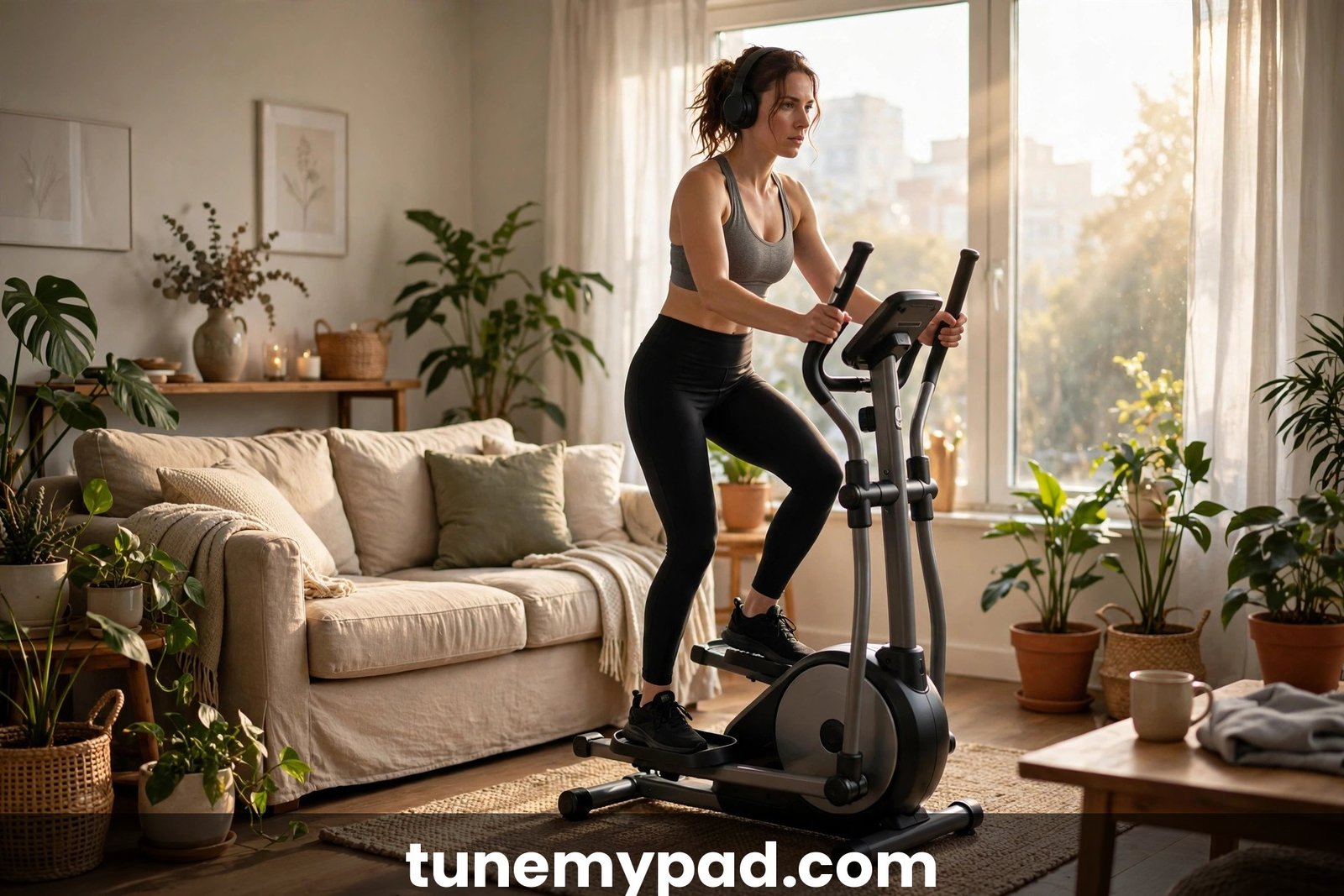
Buy an elliptical if you want challenging cardio workouts, need high calorie burn per session, have a dedicated space for equipment, enjoy following workout programs, or have joint issues that make even walking uncomfortable. When the walking pad vs elliptical for home question is really “which gives me a better workout,” the elliptical is the honest answer.
How to Make the Final Decision
Still torn on the walking pad vs elliptical for home question? Run through this five-minute checklist. Answer honestly, because the best machine is the one that survives contact with your real life.
First, measure your space and be realistic about storage. If the machine cannot live somewhere permanently, the walking pad wins by default. Second, look at your calendar. If you have 30 free minutes most days for a dedicated workout, an elliptical can work. If your exercise time has to come from hours you are already spending at a desk, only the walking pad fits. Third, set your budget including the first year of extras: mats, subscriptions, and maintenance. Fourth, think about noise tolerance in your building. Fifth, consider your joints and any injuries.
Score each factor from 1 to 5 for how much it matters to you, then see which machine wins more categories. Most people find the walking pad vs elliptical for home decision becomes obvious once they weight space and schedule heavily, because those two factors dominate daily use. A machine that is slightly less effective but used daily beats a superior machine used twice a month.
One more angle worth considering: you do not have to choose forever. Many people start with a walking pad because it is cheap and easy, build a daily movement habit over six months, and later add an elliptical or gym membership for intensity. Others do the reverse. The walking pad vs elliptical for home debate is not a lifetime commitment. Start with the machine that removes the most friction right now.
Related: What Speed on a Walking Pad to Lose Weight? 7 Fat-Burn Zones
Frequently Asked Questions
Can I lose weight with just a walking pad?
Yes. Weight loss comes from a sustained calorie deficit, and a walking pad makes it easy to burn an extra 300 to 700 calories a day without scheduling workouts. Pair it with sensible eating and the pounds come off steadily.
Is an elliptical better cardio than walking?
Per minute, yes. An elliptical raises your heart rate higher and works more muscle groups. But total weekly activity matters more than any single session, and walking pad users often accumulate more total movement.
Which is better for bad knees, a walking pad or an elliptical?
Both are low impact. The elliptical’s gliding motion is gentlest, but slow walking on a cushioned pad is comfortable for most people with mild knee issues. If walking itself hurts, choose the elliptical.
Can you use a walking pad every day?
Yes, daily use is the entire point. Walking at 1 to 2.5 mph is gentle enough for every day, unlike intense elliptical sessions that need rest days. Most users walk 5 to 7 days a week.
Do ellipticals need more space than walking pads?
Much more. An elliptical needs a permanent 6-by-2.5-foot spot plus clearance. A walking pad slides under a bed or stands in a closet when you are done.
Which is quieter for an apartment?
Walking pads are quieter on average, especially at desk-walking speeds. Ellipticals are fine too, but cheap models develop squeaks that carry through floors.
Can I work on my laptop while using an elliptical?
Not practically. The motion is too bouncy for typing or reading. If working while exercising is the goal, the walking pad is the only real option of the two.
Can I own both a walking pad and an elliptical?
Absolutely, and many home gym owners do. Use the walking pad for daily background movement at your desk and the elliptical for focused cardio sessions. If your budget and space allow both, the walking pad vs elliptical for home debate ends in a draw, and you get the best of both worlds.
Is a walking pad enough exercise on its own?
For general health, yes. Health authorities recommend 150 minutes of moderate activity per week, and daily walking pad sessions easily exceed that. You will miss out on vigorous cardio and upper-body work, so add bodyweight exercises or resistance bands twice a week for a complete routine.
The Bottom Line
The walking pad vs elliptical for home decision comes down to one question: do you want fitness that fits into your life, or a workout you fit your life around? Walking pads win on convenience, price, space, noise, and multitasking. Ellipticals win on intensity, calorie burn per minute, and workout variety. Both are excellent low-impact choices, and honestly, the best machine is the one you will actually use every week. Measure your space, be honest about your schedule, and pick the machine that matches the life you already live today.
Related: How Long Can a Walking Pad Run Continuously? 7 Facts
Related: Walking Pad Beginner Workout Plan Week 1: 7 Best Days