
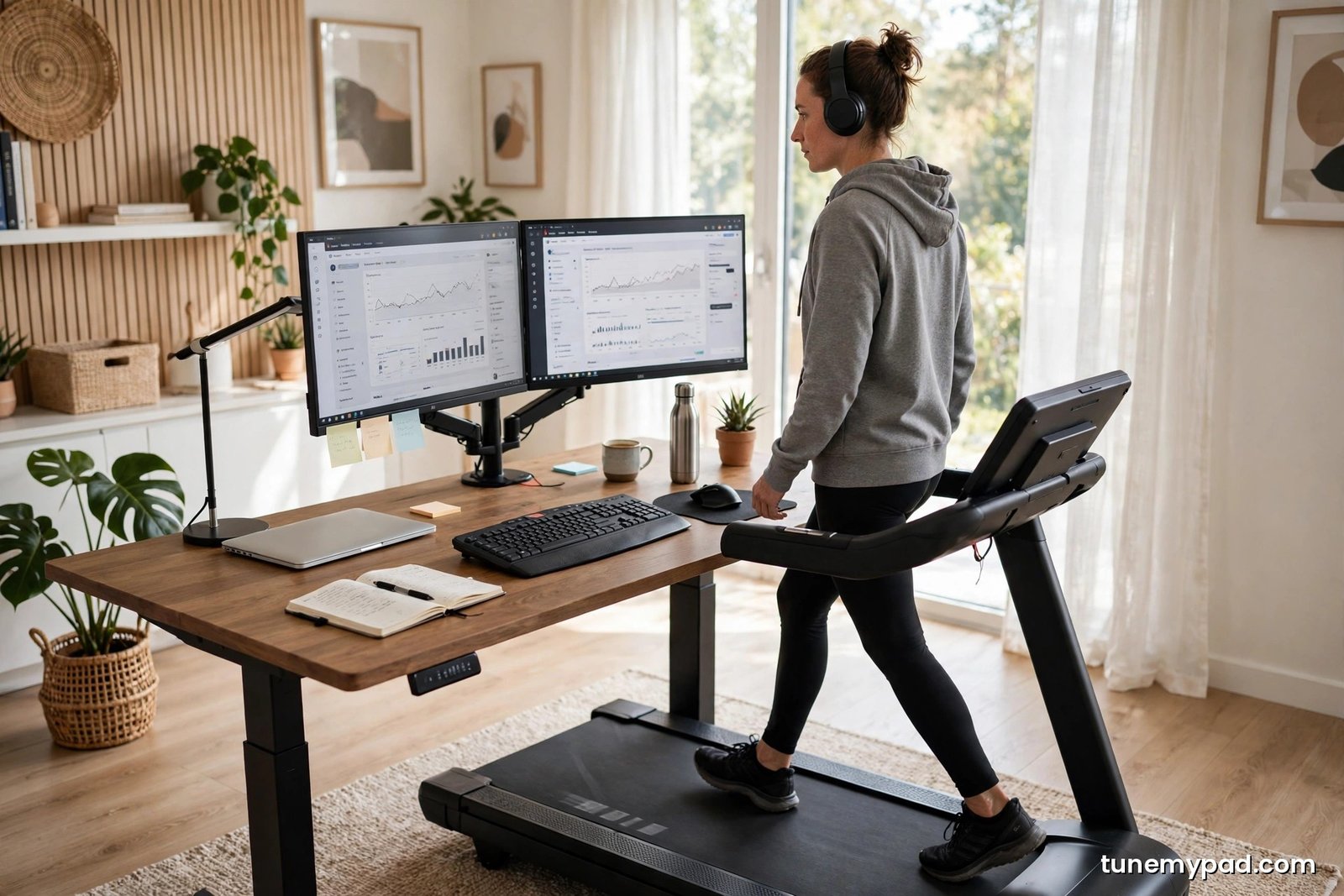
You have the standing desk. You have the treadmill underneath it. But most days you either sit all day and feel guilty, or walk for an hour and end up with sore feet and zero focus. The missing piece is not motivation; it is structure. A proper sit stand walk routine with a treadmill desk tells you exactly when to sit, when to stand, and when to walk, so you get the benefits of all three without the downsides of any one.
Most treadmill desk owners wing it, and winging it is why so many of these setups end up as expensive clothes racks. Research on sedentary behavior consistently shows that breaking up sitting time matters more than one heroic exercise session, a message echoed by organizations like the American Heart Association, which is exactly what a sit stand walk routine with a treadmill desk is designed to do. The CDC’s adult physical activity guidelines recommend 150 minutes of moderate activity weekly, and a structured routine turns that target into an automatic part of your workday.
In this guide you will get 7 proven plans for a sit stand walk routine with a treadmill desk, matched to different work styles and fitness levels, plus the transition rules, posture setup, and troubleshooting tips that make the routine stick.
Quick Answer: Sit Stand Walk Routine with a Treadmill Desk
What does a good sit stand walk routine with a treadmill desk look like? A proven starting pattern is 30 minutes sitting, 20 minutes standing, and 10 minutes walking each hour, repeated through the workday. This 30-20-10 rhythm gives you about 80 minutes of walking across an 8-hour day without fatigue or focus loss. Match walking to low-concentration tasks (email, calls, reading) and sitting to deep-focus work. Build up gradually: start with 2 to 3 walking blocks per day and add one block every few days until the full sit stand walk routine with a treadmill desk feels automatic.
Table of Contents
Why a Sit Stand Walk Routine with a Treadmill Desk Beats Just Walking
It is tempting to think more walking is always better, but the research and owner experience point the other way. Walking all day at a treadmill desk causes its own problems: foot fatigue, reduced typing accuracy on demanding tasks, and mental fatigue from the constant low-level effort of balancing. Sitting all day has the well-known downsides. Standing all day brings leg and back complaints.
A sit stand walk routine with a treadmill desk works because it rotates the stress. Each posture rests the tissues stressed by the others: sitting rests your feet, standing rests your hip flexors from sitting, and walking activates the large leg muscles that go dormant in a chair. The rotation also keeps your brain fresher than any single static posture, because subtle position changes maintain alertness.
The other advantage is task matching. Not all work is equal, and a sit stand walk routine with a treadmill desk lets you assign each posture to the work it suits best:
| Posture | Best tasks | Why |
|---|---|---|
| Sitting | Deep writing, coding, detailed spreadsheets | Maximum precision and focus |
| Standing | Meetings, brainstorming, reviewing documents | Energy and presence without fatigue |
| Walking | Email triage, phone calls, reading, admin | Light movement boosts alertness for routine tasks |
This task matching is the real productivity secret. People who report that a treadmill desk hurt their work were usually trying to do precision tasks while walking. The routine fixes that by design.
The 7 Proven Sit Stand Walk Routine Plans
Plan 1: The 30-20-10 Starter (Beginners)
This is the default sit stand walk routine with a treadmill desk for anyone just starting out. Each hour: 30 minutes sitting, 20 minutes standing, 10 minutes walking at 1.5 to 2 mph. Set a timer or use an app reminder for the transitions; without a cue, you will forget to switch.
Over an 8-hour day this yields roughly 80 minutes of walking and 2.5 hours of standing, which is a massive upgrade from full-time sitting without shocking your body. Stay on this plan for 2 to 3 weeks before progressing. Sore feet in week one are normal; sharp pain is not, and means you should shorten the walking blocks.
Plan 2: The Meeting Walker (Call-Heavy Schedules)
If your day is full of video calls, build your sit stand walk routine with a treadmill desk around them. Walk during every internal call and audio-only meeting at 1 to 1.5 mph, sit for client-facing video calls where you want to look perfectly still, and stand between meetings. Many people discover their meeting schedule already contains 2 to 3 hours of walkable time.
The key rule: keep walking speed low on calls. At 1 mph your voice and camera presence are essentially normal; at 2.5 mph colleagues will notice the bounce. Test your setup with a trusted coworker before doing it on an important call.
Plan 3: The Pomodoro Hybrid (Focus Workers)
Combine the Pomodoro technique with your sit stand walk routine with a treadmill desk: 25 minutes of seated deep work, 5-minute walking break at 2 mph, repeat. Every fourth break, take 15 minutes walking. This plan is ideal for programmers, writers, and analysts who need long focus stretches but want movement woven in.
The walking breaks serve as genuine cognitive resets. Owners report returning to hard problems with fresh eyes after even a 5-minute walk, which more than repays the time. Keep a notepad handy during walking breaks; solutions have a habit of arriving mid-stride.
Plan 4: The Morning Loader (Front-Load Your Steps)
Do the bulk of your walking before lunch: walk 20 minutes of every hour from 9 AM to noon, then switch to a mostly sit-stand pattern for the afternoon. This sit stand walk routine with a treadmill desk banks 60 to 80 minutes of movement early, so afternoon slumps and meeting overloads cannot steal your activity.
Morning loading works especially well for people whose afternoons fill with unpredictable meetings. It also aligns with natural energy rhythms: most people have their best walking tolerance in the morning and want to sit more as the day wears on.
Plan 5: The Gradual Builder (From Zero Activity)
Coming from a fully sedentary routine? This sit stand walk routine with a treadmill desk starts almost embarrassingly small: one 10-minute walking block per day in week one, two blocks in week two, three in week three, adding one block per week until you reach 6 to 8 blocks daily. Standing blocks start at 10 minutes and grow similarly.
This plan feels slow, but it has the highest long-term adherence of any approach. The number one reason treadmill desks get abandoned is doing too much in week one, getting sore and discouraged, and quitting. Slow building avoids that entirely.
Plan 6: The Active Afternoon (Beating the Slump)
The post-lunch energy dip is real, and walking is one of the best counters. In this sit stand walk routine with a treadmill desk, mornings are sit-stand focused for deep work, and 1 PM to 4 PM becomes walking-heavy: 20 minutes walking, 20 minutes standing, 20 minutes sitting each hour. The movement keeps you alert through the hours when you would otherwise be fighting drowsiness.
Pair this with a light lunch; heavy meals plus walking can cause discomfort. Many owners say this plan alone justified their treadmill desk purchase, because it reclaimed three previously useless afternoon hours.
Plan 7: The Weekend Warrior Catch-Up (Busy Weeks)
Some weeks the schedule explodes and weekday walking collapses. This backup sit stand walk routine with a treadmill desk accepts that: on chaotic days, just do 3 walking blocks of 15 minutes whenever they fit, with no guilt about the rest. Then add a longer weekend session, like a 60-minute easy walk while watching something, to keep the weekly total healthy.
The principle: a flexible routine you actually follow beats a perfect routine you abandon. Having an explicit fallback plan prevents the all-or-nothing thinking that kills treadmill desk habits.
Related: Walking Pad Desk Workout Schedule While Working: 7 Plans
Setting Up Your Desk for a Sit Stand Walk Routine with a Treadmill Desk
The routine only works if transitions are frictionless. If switching from sitting to walking takes five minutes of rearranging, you will stop switching. Optimize the physical setup first.
Desk height is the critical variable. Your standing desk needs preset heights for sitting and walking; walking posture typically needs the desk 1 to 2 inches higher than standing still, because your body rises slightly with each step. Program three presets if your desk supports it: sit, stand, and walk. One button press should move you between postures.
Monitor position matters too. The top of the screen should be at or slightly below eye level in each posture, which means the monitor may need to move with the desk. A monitor arm makes this automatic. Keyboard and mouse should sit at elbow height with relaxed shoulders. Get the ergonomics wrong and a sit stand walk routine with a treadmill desk will trade sitting-related back pain for walking-related neck pain, which defeats the purpose.
Keep walking shoes at the desk, not in the closet. The two-minute shoe hunt is a proven routine-killer. A small mat beside the treadmill for the shoes, and you are ready to step on in seconds.
Adapting the Routine for Hybrid and Office Days
Not everyone works from home five days a week. If you split time between home and an office, your treadmill desk routine needs a portable version for office days. The core idea survives the move: keep the rotation, drop the walking.
On office days, alternate 45 minutes sitting with 15 minutes standing, using a standing desk, a desk converter, or even a high counter for the standing blocks. Take a 10-minute walk at lunch and another mid-afternoon. You will not match home-day step counts, but you will preserve the habit of breaking up sitting time, which is the health behavior that matters most.
The weekly math still works out. Three home days on the full routine plus two office days on the adapted pattern keeps most people well above recommended activity levels. The routine bends; it does not break.
Transition Rules That Make the Routine Stick
The plans above are the what; these rules are the how. Owners with multi-year treadmill desk habits almost all follow versions of these:
- Never skip the first walking block of the day; it sets the pattern
- Cap any single walking block at 30 minutes until month two; fatigue accumulates invisibly
- If your feet hurt, you walked too much yesterday, not too little today; cut back rather than pushing through
- Keep water at the desk; walking dehydrates more than sitting and you will not notice
- End the day with a sitting block so you leave work feeling fresh, not drained
- Track blocks with tally marks for the first month; what gets counted gets done
The most important rule is the last one about tracking. A sit stand walk routine with a treadmill desk becomes automatic around week 4 to 6 for most people, but only if the first weeks are deliberate. Tally marks on a sticky note are enough; you do not need an app.

Troubleshooting Common Routine Problems
Sore feet and legs
The most common complaint in the first two weeks of any sit stand walk routine with a treadmill desk. Solutions: better cushioned shoes, a treadmill mat with some give, shorter blocks, and calf stretches between blocks. If soreness lasts beyond week three, you are progressing too fast; drop back one plan level.
Typing accuracy drops while walking
Normal at first, and task matching is the fix: move precision work to sitting blocks. Accuracy also improves with practice; most people return to near-normal typing at 1.5 mph within a month. If accuracy matters for your job, keep walking blocks to low-precision tasks permanently. There is no prize for typing code at 3 mph.
The treadmill becomes a clothes rack
This happens when the routine has too much friction. Audit your setup: are shoes at the desk? Are desk presets programmed? Is the treadmill already unfolded? Every 30 seconds of setup friction measurably reduces usage. Also recommit to Plan 5’s gradual approach; the clothes-rack phase usually follows an overambitious start.
Afternoon fatigue despite walking
If a sit stand walk routine with a treadmill desk leaves you more tired, check sleep, lunch size, and total walking volume. Paradoxically, walking too much early in the adaptation period causes fatigue rather than preventing it. Cut total walking by a third for a week and see if energy rebounds.
Knee or back pain
Stop and assess rather than pushing through. Knee pain often means too much speed or too long blocks; back pain often means desk height is wrong for the walking posture. A sit stand walk routine with a treadmill desk should never cause joint pain, and persistent pain deserves a professional assessment, not tougher resolve.
Related: How Long Should You Walk on a Walking Pad Per Day? 7 Answers
How Much Walking Does the Routine Add Up To
It helps to see the weekly math, because the numbers are what make a sit stand walk routine with a treadmill desk so powerful compared to gym sessions.
| Plan | Daily walking | Weekly (5 days) | Steps estimate |
|---|---|---|---|
| 30-20-10 starter | ~80 min | ~400 min | ~40,000 |
| Meeting walker | ~120 min | ~600 min | ~60,000 |
| Pomodoro hybrid | ~70 min | ~350 min | ~35,000 |
| Morning loader | ~80 min | ~400 min | ~40,000 |
| Gradual builder (full) | ~75 min | ~375 min | ~37,500 |
For reference, 150 minutes of moderate activity per week is the widely cited baseline for health benefits, and even the lightest of these plans more than doubles it without a single dedicated workout. That is the quiet superpower of a sit stand walk routine with a treadmill desk: the exercise happens inside hours you were already spending at work.
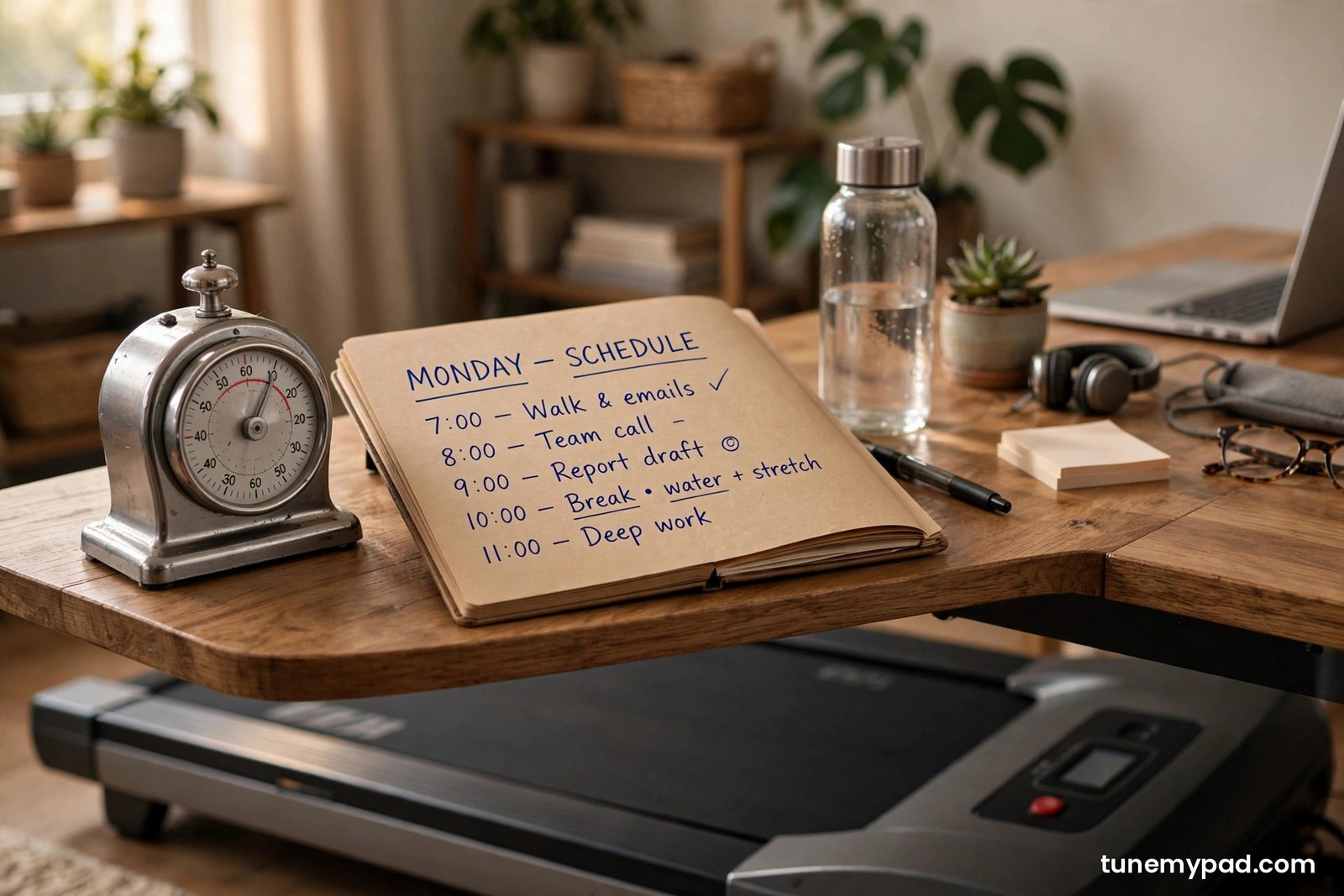
Frequently Asked Questions About a Sit Stand Walk Routine with a Treadmill Desk
How do I start a sit stand walk routine with a treadmill desk as a beginner?
Start with Plan 1 (30-20-10) or Plan 5 (gradual builder). Begin with just 2 to 3 ten-minute walking blocks per day, keep speed at 1.5 mph, and add one block every few days. A sustainable sit stand walk routine with a treadmill desk builds over 4 to 6 weeks, not 4 to 6 days.
How many hours a day should I walk at my treadmill desk?
Most long-term owners settle at 1.5 to 3 hours of walking daily within their sit stand walk routine with a treadmill desk. More than 4 hours tends to cause foot fatigue and focus issues for most people. Remember the routine includes sitting and standing too; walking is one posture among three.
Is it better to sit, stand, or walk at a treadmill desk?
All three, rotated. That rotation is the entire point of a sit stand walk routine with a treadmill desk. Sitting suits deep focus, standing suits meetings and energy, walking suits routine tasks and alertness. No single posture wins; the combination does.
Will a sit stand walk routine with a treadmill desk help me lose weight?
It can contribute meaningfully. The weekly walking volumes in these plans burn substantial calories over time, and the routine also reduces the long sedentary stretches associated with metabolic slowdown. But weight loss still depends on overall diet and activity; think of the sit stand walk routine with a treadmill desk as a powerful foundation, not a complete program.
What speed should I walk during work hours?
1 to 2 mph for most tasks, up to 2.5 mph for easy reading or calls. In a sit stand walk routine with a treadmill desk, speed is a tool: slower for anything requiring precision, faster for passive consumption. Never sacrifice work quality for speed.
How long until a sit stand walk routine with a treadmill desk feels normal?
Most people report the routine feeling automatic around week 4 to 6. The first two weeks require deliberate timers and tracking; by week three the transitions start feeling natural. Foot and leg adaptation follows a similar timeline.
Can I do a sit stand walk routine with a treadmill desk with a regular desk?
You need a height-adjustable desk (or a desk converter) plus the treadmill; a fixed-height desk cannot work because sitting and walking need different surface heights. The desk is as important as the treadmill in a sit stand walk routine with a treadmill desk setup.
What should I do on days I cannot walk much?
Use Plan 7’s fallback: 3 short walking blocks whenever they fit, no guilt. A sit stand walk routine with a treadmill desk survives imperfect weeks; what kills it is the all-or-nothing mindset after a bad week. Just resume the normal pattern the next day.
Do I need special shoes for walking while working?
Cushioned walking or running shoes make a large comfort difference over a full day. Keep them at the desk to remove friction. Avoid hard-soled dress shoes for walking blocks; your feet will remind you why by 3 PM.
Is standing or walking better for afternoon energy?
Walking wins for alertness; the rhythmic movement is more stimulating than static standing. That is why Plan 6 loads walking into the afternoon. If you only change one thing about your workday, a 20-minute early-afternoon walk within your sit stand walk routine with a treadmill desk is the highest-leverage option.
Conclusion
A sit stand walk routine with a treadmill desk turns an expensive gadget into a daily health habit by answering the only question that matters: what should I be doing right now? Pick the plan that matches your work style, set up your desk so transitions take seconds, track your blocks for the first month, and progress gradually.
The goal was never to walk a marathon at your desk. It is to never again spend eight straight hours in a chair. A thoughtful sit stand walk routine with a treadmill desk gets you there almost without noticing, one well-timed ten-minute walk at a time.