
So how loud is a walking pad, really? If you are picturing a roaring gym treadmill shaking the walls, relax. Most walking pads are far quieter than people expect, roughly on par with a normal conversation or a humming refrigerator. But “quiet” depends on speed, flooring, maintenance, and what you compare it to, which is why the question how loud is a walking pad deserves a proper answer with real numbers.
In this guide we break down how loud is a walking pad in decibels, what those numbers mean in everyday terms, how different brands compare, and the difference between motor hum and footstep thump. You will also learn how to measure your own pad with a free phone app and when extra noise means something needs fixing.
By the end, you will know exactly what to expect before you buy, and how to answer anyone who asks how loud is a walking pad in your home.
Quick Answer: How Loud Is a Walking Pad
How loud is a walking pad? Most models produce 42 to 55 decibels at walking speeds of 1 to 3 mph, measured from 3 feet away. That is quieter than a normal conversation (60 dB) and about the same as a quiet office. The motor itself is usually the quieter part; footstep impact on hard floors adds the most perceived noise. So when people ask how loud is a walking pad, the honest answer is: the pad is quiet, your footsteps are the variable.
Table of Contents
The Short Answer in Decibels
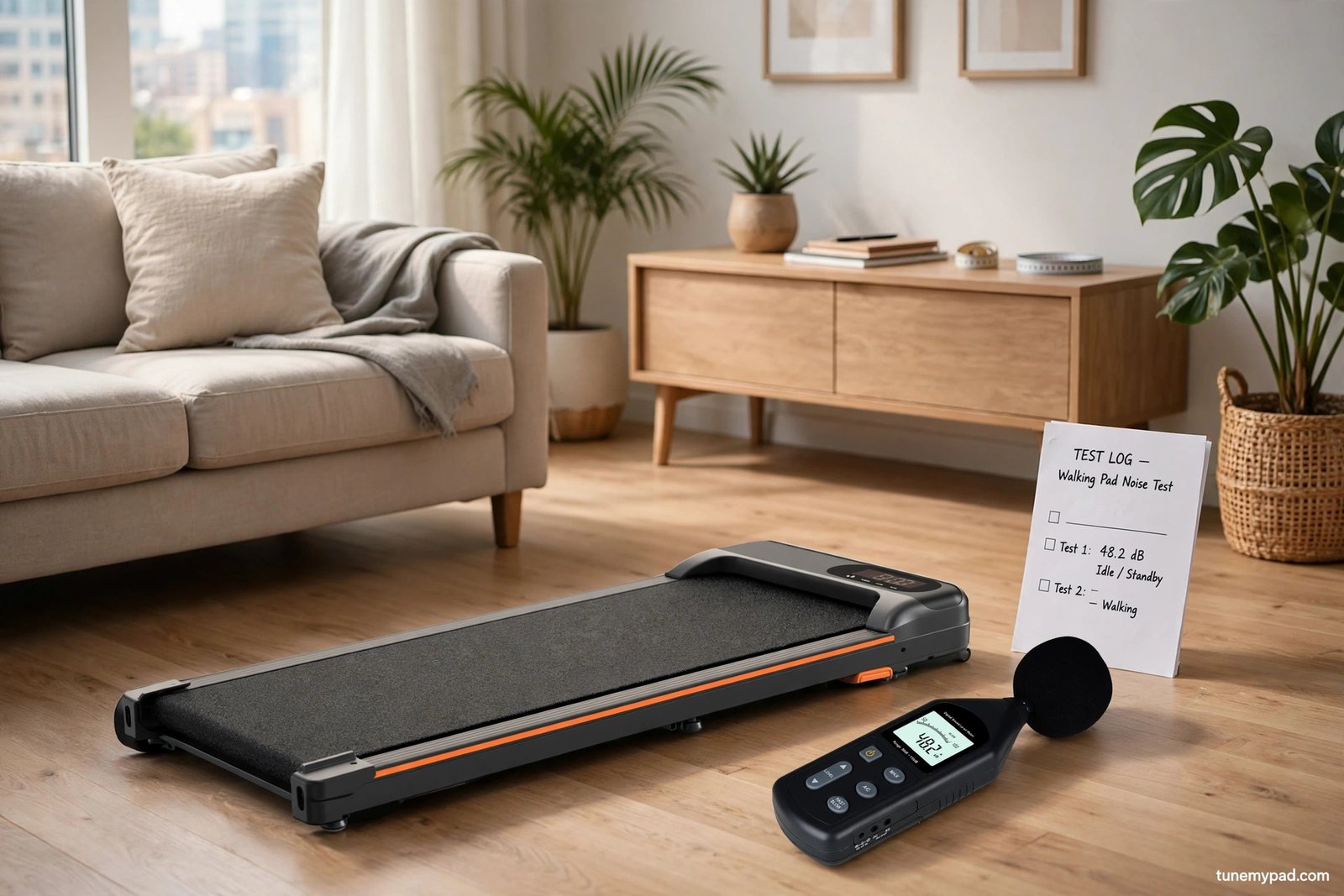
Let us put numbers on how loud is a walking pad. Independent testers and reviewers consistently measure popular walking pads between 42 and 55 dB at typical walking speeds. At a slow 1 mph stroll, many pads sit around 42 to 46 dB. At 2.5 to 3 mph, the range climbs to 50 to 55 dB. For context, a whisper is about 30 dB, a quiet library is 40 dB, and normal conversation is 60 dB.
These numbers answer how loud is a walking pad for the person in the same room. What neighbors or family in other rooms hear is a different story, because impact vibration travels through floors and walls in ways a decibel meter in your room does not capture. A pad measuring 48 dB beside you can still produce an audible thump downstairs if the floor is bare wood.
Maximum speed matters too. Many walking pads top out at 3.7 to 4 mph, and at full speed some reach 58 to 62 dB, which is conversation level. But almost nobody walks that fast on a pad for long. For the slow walking most people actually do, how loud is a walking pad stays firmly in the “background hum” zone.
What Those Decibel Numbers Mean in Real Life
Decibels are logarithmic, which makes them confusing. A 10 dB increase sounds roughly twice as loud to human ears. So the jump from a 45 dB pad to a 55 dB pad is significant, even though both numbers look small. When evaluating how loud is a walking pad, compare against sounds you know.
| Sound | Decibels | Comparison |
|---|---|---|
| Whisper | 30 dB | Quieter than any walking pad |
| Quiet library | 40 dB | Like a pad at 1 mph |
| Refrigerator hum | 40-45 dB | Similar to a slow walking pad |
| Quiet office | 50 dB | Like a pad at 2.5 mph |
| Normal conversation | 60 dB | Louder than most walking pads |
| Vacuum cleaner | 70 dB | Much louder than any walking pad |
The takeaway is simple: if you can hold a phone call next to your refrigerator, you can hold one next to your walking pad. That is the practical meaning of how loud is a walking pad for daily life.
Related: Walking Pad in an Upstairs Bedroom? 7 Best Noise Fixes
Motor Noise vs Footstep Noise
Here is the distinction that matters most when people ask how loud is a walking pad. There are two completely different sounds: the motor’s steady hum and the rhythmic thump of your feet. The motor hum is constant, low, and easy for the brain to tune out. The footstep thump is intermittent, percussive, and much more noticeable, especially through floors.
On a decibel meter, the motor alone often reads under 45 dB. Add a 180-pound walker at 3 mph on a bare hardwood floor, and the combined reading can jump 8 to 12 dB. That jump is nearly all footsteps. This is why two people can disagree about how loud is a walking pad: one walked slowly in socks on carpet, the other jogged in hard shoes on laminate.
The practical takeaway: when shopping, motor noise specs tell you less than you think. Reviews that mention how loud is a walking pad in real homes, with real walkers, are far more useful than the manufacturer’s claimed decibel rating, which is always measured under ideal lab conditions.
Which bothers people more?
- Motor hum: steady, low-frequency, easy to ignore, rarely travels through walls
- Footstep thump: rhythmic, percussive, travels through floors, the main complaint source
- Belt squeak: high-pitched, intermittent, usually means the belt needs lubrication
- Rattling: metallic, irregular, usually means loose bolts or an uneven floor

How Loud Is a Walking Pad by Brand and Model
Shoppers often want a brand-by-brand answer to how loud is a walking pad. The honest truth is that most popular models cluster in the same range, because they use similar small DC motors. Reviewer measurements for well-known walking pad brands typically fall between 45 and 55 dB at 2 to 3 mph. Differences of 2 to 3 dB between brands are barely noticeable in practice.
What varies more is build quality over time. A pad that starts at 46 dB can creep to 55 dB after a year without belt lubrication or with loosening frame bolts. So when someone asks how loud is a walking pad after long-term use, the answer depends heavily on maintenance. The quietest pad on paper becomes a noisy one if neglected.
Instead of chasing the absolute quietest spec, look for models with good long-term reviews mentioning stable noise levels. A pad that stays at 50 dB for two years beats one that starts at 44 dB and rattles at 58 dB after six months. For how loud is a walking pad over its whole life, maintenance matters more than the motor.
| Walking speed | Typical dB range | Feels like |
|---|---|---|
| 1 mph (slow stroll) | 42-46 dB | Quiet library |
| 2 mph (easy walk) | 46-50 dB | Quiet office |
| 3 mph (brisk walk) | 50-55 dB | Soft conversation |
| 4 mph (fast) | 55-62 dB | Normal conversation |
What Makes One Pad Louder Than Another
Several factors decide how loud is a walking pad in your specific home. Motor size plays a role, but a smaller, underpowered motor straining under a heavy walker can actually be louder than a larger motor cruising comfortably. Belt condition matters enormously: a dry, misaligned belt squeaks and slaps, while a lubricated, centered belt glides quietly.
Floor type is the biggest environmental factor. The same pad can sound twice as loud on bare tile as on carpet with padding. Frame design matters too: folding models with more joints have more places to develop rattles over time. And user weight and walking style affect how loud is a walking pad more than any spec sheet admits, because heavier footstrikes mean more impact energy.
Age is the final factor. Bearings wear, belts stretch, and bolts loosen. A two-year-old pad that has never been serviced will always be louder than a new one. The good news is that most age-related noise is reversible with the basic maintenance described later in this guide.
Noise factors ranked by impact
- Walking speed and footstrike force (biggest factor)
- Floor type and room acoustics
- Belt lubrication and alignment
- Frame tightness and build quality
- Motor size relative to user weight
- Age and maintenance history
Related: How to Make a Treadmill Desk Quieter: 8 Fixes That Actually Work
How to Measure Your Own Pad
You do not need professional equipment to answer how loud is a walking pad in your home. Free smartphone apps like NIOSH SLM (iOS) or Sound Meter (Android) give readings accurate enough for this purpose. They will not match a calibrated meter exactly, but they are consistent enough to compare before-and-after fixes.
To measure how loud is a walking pad properly, place the phone 3 feet from the pad at belt height. Take three readings: motor running with nobody walking, you walking at your normal pace, and the room silent for a baseline. The difference between the walking reading and the baseline is the number that matters. Repeat the test after each fix you try.
For the full picture, have someone take a reading in the room below or next door while you walk. Airborne decibels in your room and perceived thump downstairs are different phenomena. When people worry about how loud is a walking pad for their neighbors, the downstairs reading is the one that counts. If you want context on safe exposure levels, OSHA’s noise guidance explains when sound becomes a health concern, though walking pads never approach those levels.
DIY measurement steps
- Download a free sound level meter app
- Measure the silent room baseline first
- Measure at 3 feet, belt height, at your normal speed
- Measure in adjacent rooms and below if possible
- Re-measure after each noise fix to track progress
When Loud Means Something Is Wrong
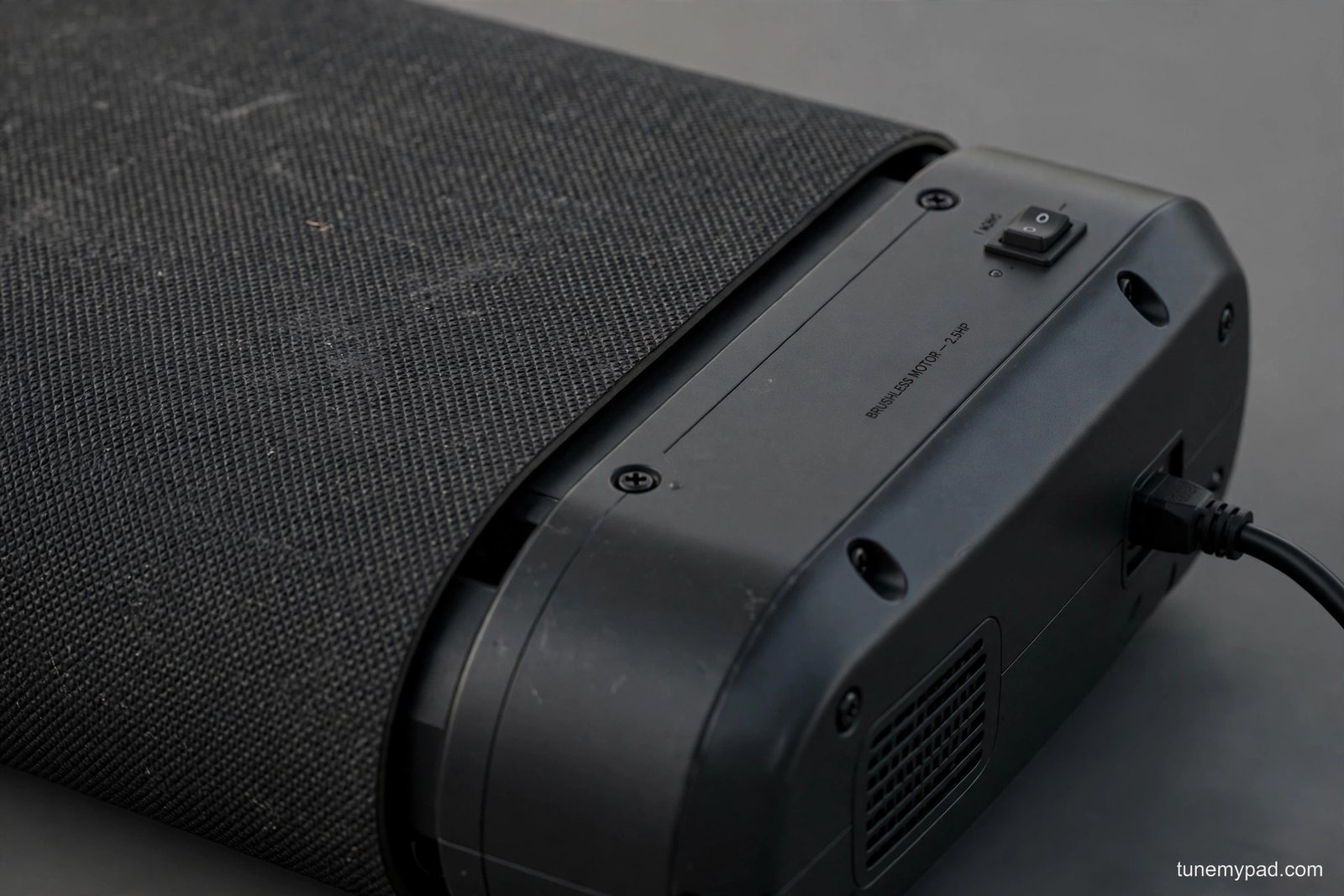
Most answers to how loud is a walking pad fall in the normal 42 to 55 dB range. But certain sounds signal problems. A high-pitched squeal that appears suddenly usually means a dry belt or a foreign object caught underneath. A rhythmic clunk once per belt revolution suggests a seam issue or something stuck to the belt. Grinding or growling from the motor area can mean worn bearings.
Rattling that gets worse over weeks points to loosening hardware. Stop and tighten everything before a small rattle becomes a cracked frame. And any burning smell alongside increased noise means the motor is overheating: stop immediately, let it cool, and check for blocked ventilation. The CPSC reminds users to keep treadmill vents clear and to stop using equipment that smells hot.
The rule of thumb: if your answer to how loud is a walking pad suddenly changes, investigate. Gradual changes are usually maintenance issues. Sudden changes deserve a full inspection before your next walk.
Warning sounds and what they mean
| Sound | Likely cause | Action |
|---|---|---|
| Sudden squeal | Dry belt or debris | Lubricate, clean under belt |
| Rhythmic clunk | Belt seam or stuck object | Inspect belt, remove object |
| Growing rattle | Loose bolts | Tighten all hardware |
| Grinding | Worn bearings | Contact manufacturer support |
| Burning smell | Overheating motor | Stop, cool, check vents |
Does Room Size Change How Loud a Walking Pad Feels?
Yes, and this surprises a lot of buyers. The same pad can feel noticeably louder in a small, bare home office than in a large, furnished living room. Hard parallel walls bounce sound back and forth, and small rooms reinforce low frequencies. So part of the answer to how loud is a walking pad is the room itself, not just the machine.
Soft furnishings are free acoustic treatment. A rug under and around the pad, curtains on the windows, a bookshelf against the wall, even a fabric couch nearby all absorb sound that would otherwise reflect. If your walking space is a tiny box room with bare walls, adding soft materials can cut perceived noise as much as any equipment upgrade. When people complain about how loud is a walking pad in a spare bedroom, the empty room is often half the problem.
Corners deserve special attention. Placing the pad deep in a corner can amplify low-frequency hum because corners collect bass energy. Pulling the pad even 2 feet out from the corner usually sounds better. And closing the door while you walk keeps the hum from traveling down hallways, which matters more than most people expect in open-plan homes.
Quick room tweaks
- Add a rug or carpet remnant around the pad area
- Hang curtains or add soft wall hangings
- Keep the pad out of tight corners
- Close doors to contain sound
- Add a bookshelf or upholstered furniture nearby as a sound absorber
- Place a folded towel under the front feet on hard floors
- Keep the belt clean; grit underfoot adds scratchy noise
One last room factor people forget is ceiling height. Tall ceilings let sound dissipate upward and feel quieter, while low basement-style ceilings bounce everything back at you. You cannot change your ceiling, but knowing this helps set expectations when comparing your setup to a friend’s.
Quiet-Hours Etiquette for Shared Homes
Even a quiet pad can strain relationships if it runs at the wrong time. The social side of how loud is a walking pad matters as much as the decibels. A 48 dB hum at 2 pm is background; the same hum at 6 am feels like an alarm clock to a sleeping partner or roommate.
Set explicit quiet hours and stick to them. In most shared homes, that means no walking before 7 am or after 10 pm unless everyone agrees. If your schedule demands early sessions, keep them short and slow, and use every noise fix in this guide. People forgive noise they agreed to far more easily than noise that surprises them.
Do a listening test together when you first set up. Walk for 5 minutes while your partner or roommate sits where they usually sit. Ask what they hear. Then try your fixes one at a time and repeat. This turns how loud is a walking pad from a vague worry into a solved problem you handled together, which is worth more than any mat.
Frequently Asked Questions
How loud is a walking pad compared to a regular treadmill?
How loud is a walking pad compared to a full-size treadmill? Walking pads are noticeably quieter, typically 42 to 55 dB versus 60 to 70 dB for full-size treadmills. Full treadmills have bigger motors, run faster, and invite running, all of which add noise. If quiet matters, a walking pad wins easily.
How loud is a walking pad at night in an apartment?
At slow speeds with a mat, how loud is a walking pad at night is usually not the issue; the issue is footstep vibration through the floor. Keep speeds under 2 mph, use a dense mat, wear soft shoes, and respect quiet hours. Many apartment walkers use their pads daily without a single complaint by following these basics.
Can I take phone calls while walking?
Yes. Since how loud is a walking pad stays around 46 to 50 dB at easy speeds, callers generally cannot hear it, especially with a noise-canceling headset. Footstep noise does not transmit through microphones the way it transmits through floors. Test with a friend on a call to confirm your setup.
How loud is a walking pad for downstairs neighbors?
What you measure beside the pad is not what they hear. How loud is a walking pad for downstairs neighbors depends on floor construction, your weight, speed, and footwear. On wood floors without a mat, they may clearly hear thumping. With a dense mat and slow walking, most neighbors hear little or nothing.
Do walking pads get louder over time?
They can, but it is preventable. The most common reason how loud is a walking pad increases with age is a dry belt, followed by loose hardware. Quarterly lubrication and bolt checks keep noise stable for years. A pad that gets suddenly louder deserves inspection for stuck objects or belt damage.
What is the quietest walking pad speed?
Around 1.5 to 2 mph is the sweet spot where the belt runs smoothly and footstrikes stay soft. Below 1 mph some belts run unevenly, which can add noise. So the practical answer to how loud is a walking pad at its quietest is about 42 to 45 dB at 1.5 to 2 mph on a mat.
Are more expensive walking pads quieter?
Not necessarily. Price correlates with features, weight capacity, and warranty more than with noise. A well-maintained budget pad is quieter than a neglected premium one. When comparing, the question how loud is a walking pad is better answered by long-term owner reviews than by price tags.
Should I worry about hearing damage?
No. Hearing damage concerns start at 85 dB over 8 hours according to CDC and OSHA guidance. Since how loud is a walking pad maxes out around 60 dB even at full speed, there is no hearing risk. Noise is purely a comfort and courtesy issue.
Will a walking pad disturb a sleeping baby?
It depends on distance and flooring. In the same room, the rhythmic sound may actually soothe some babies, like white noise. Through a wall, how loud is a walking pad is rarely enough to wake a sleeping baby if you walk slowly on a mat. But footstep thump through a shared floor can travel, so keep speeds low and avoid nap-time walks directly above the nursery.
How loud is a walking pad on carpet versus hardwood?
On carpet with padding, how loud is a walking pad for the rest of the house drops dramatically, often to a faint hum. On bare hardwood, the same pad can sound twice as loud downstairs because of impact transmission. Carpet does not change the motor noise much, but it transforms the footstep component, which is the part people actually complain about.
The Bottom Line on Walking Pad Noise
How loud is a walking pad? For the person walking, it is a background hum between 42 and 55 dB, quieter than conversation and easy to live with. For people in other rooms, the answer depends on your floor, speed, shoes, and maintenance. The motor is rarely the problem; footsteps are.
The fixes are simple and cheap: a dense mat, slower speeds, soft shoes, and regular belt lubrication. Measure your own setup with a free app, fix what the numbers point to, and you will likely find that the noise was never something to worry about in the first place.
If you are still on the fence about buying, borrow a page from experienced owners: start with a mat, walk slow for the first week, and do the downstairs listening test early. Small adjustments in the first days prevent most noise complaints before they start, and they cost almost nothing.
And remember that some sound is normal and healthy. A gentle hum means the motor is working; soft rhythmic steps mean you are moving. The goal was never absolute silence. It was a home that stays peaceful while you quietly bank thousands of extra steps every single day.
2 thoughts on “How Loud Is a Walking Pad? 7 Honest Answers in Decibels”