
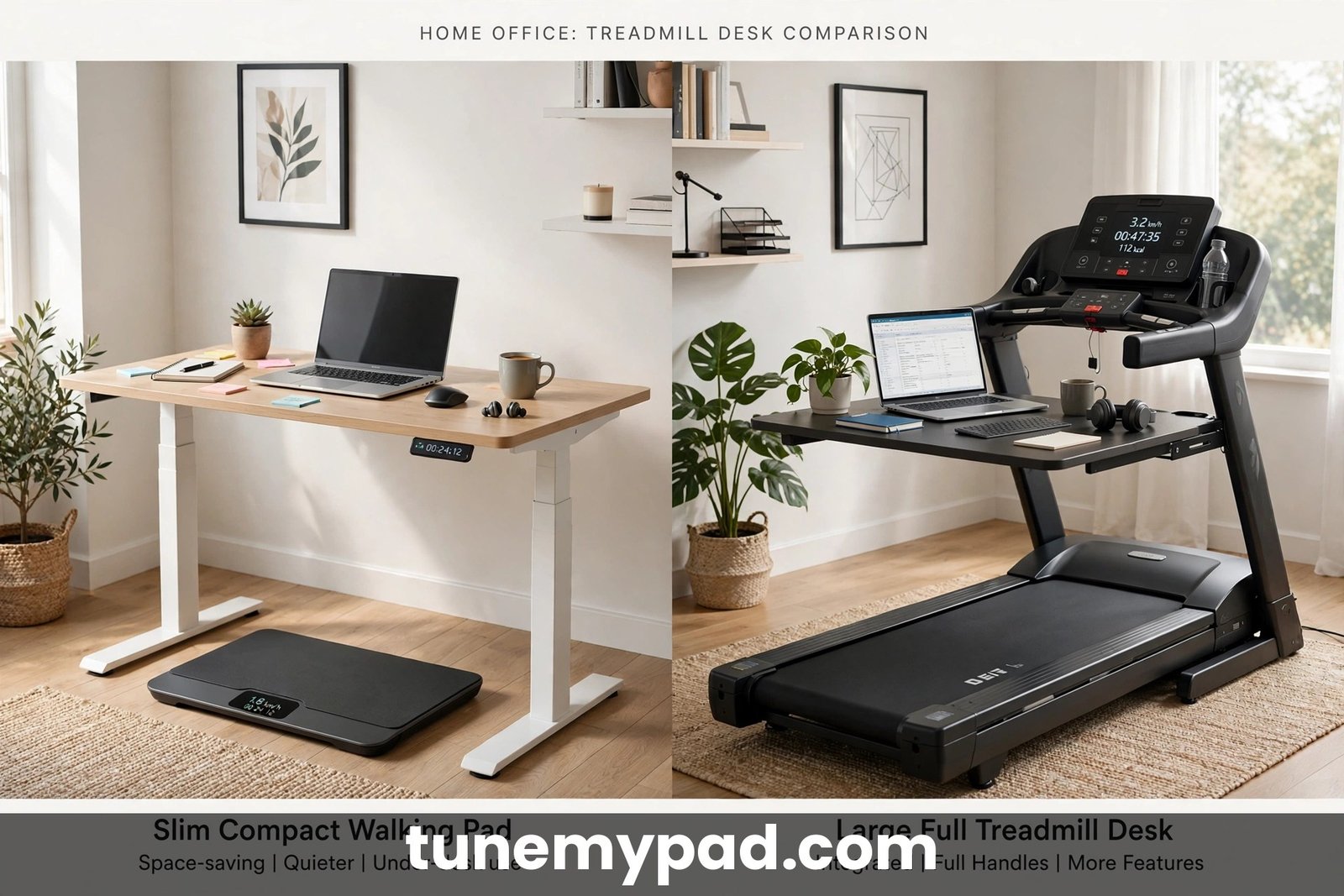
Shopping for a walking workstation, you will hit the same fork everyone hits: a slim walking pad that slides under your existing standing desk, or a full treadmill desk with the integrated console and rails? This walking pad vs treadmill desk home office comparison breaks down the seven differences that actually matter: cost, space, noise, work compatibility, safety, workout quality, and who each suits.
The confusion is understandable because the terms overlap. A “walking pad” is the flat, railless (usually) belt unit designed to live under a standing desk. A “treadmill desk” is typically a complete workstation: treadmill base plus an attached height-adjustable desk surface, often with handrails and a console. In this guide, those are the two setups being compared.
Table of Contents
Quick Answer: Walking Pad vs Treadmill Desk Home Office
| Factor | Walking pad | Treadmill desk |
|---|---|---|
| Typical cost | $250-$600 | $700-$2,500+ |
| Footprint | ~50″ x 20″, stores flat | ~60″ x 30″, permanent |
| Noise | Quieter (smaller motor) | Louder (bigger motor) |
| Top speed | 3-4 mph (some 7.5) | 4 mph (desk models) |
| Best for | Small spaces, budgets | Dedicated offices, heavy use |
| Work compatibility | Excellent with standing desk | Excellent, integrated |
The core decision: pads win on price, space, and flexibility; integrated treadmill desks win on stability, features, and all-day durability. Most home-office buyers are happier with a pad.
Difference 1: Cost, and What the Extra Money Buys
Price is the starkest walking pad vs treadmill desk home office difference. Quality walking pads run $250 to $600. Integrated treadmill desks start around $700 and climb past $2,500 for premium models with quiet motors and large desks.
What does the premium buy? Usually a sturdier frame, a more powerful continuous-duty motor, an integrated desk surface at proper height, handrails, and a better console. Whether that matters depends on use: 90 minutes of daily walking is easily served by a $400 pad, while 6-hour daily use justifies the treadmill desk’s beefier build. In the walking pad vs treadmill desk home office value debate, match the machine to your hours, not your aspirations.
Difference 2: Space and Storage
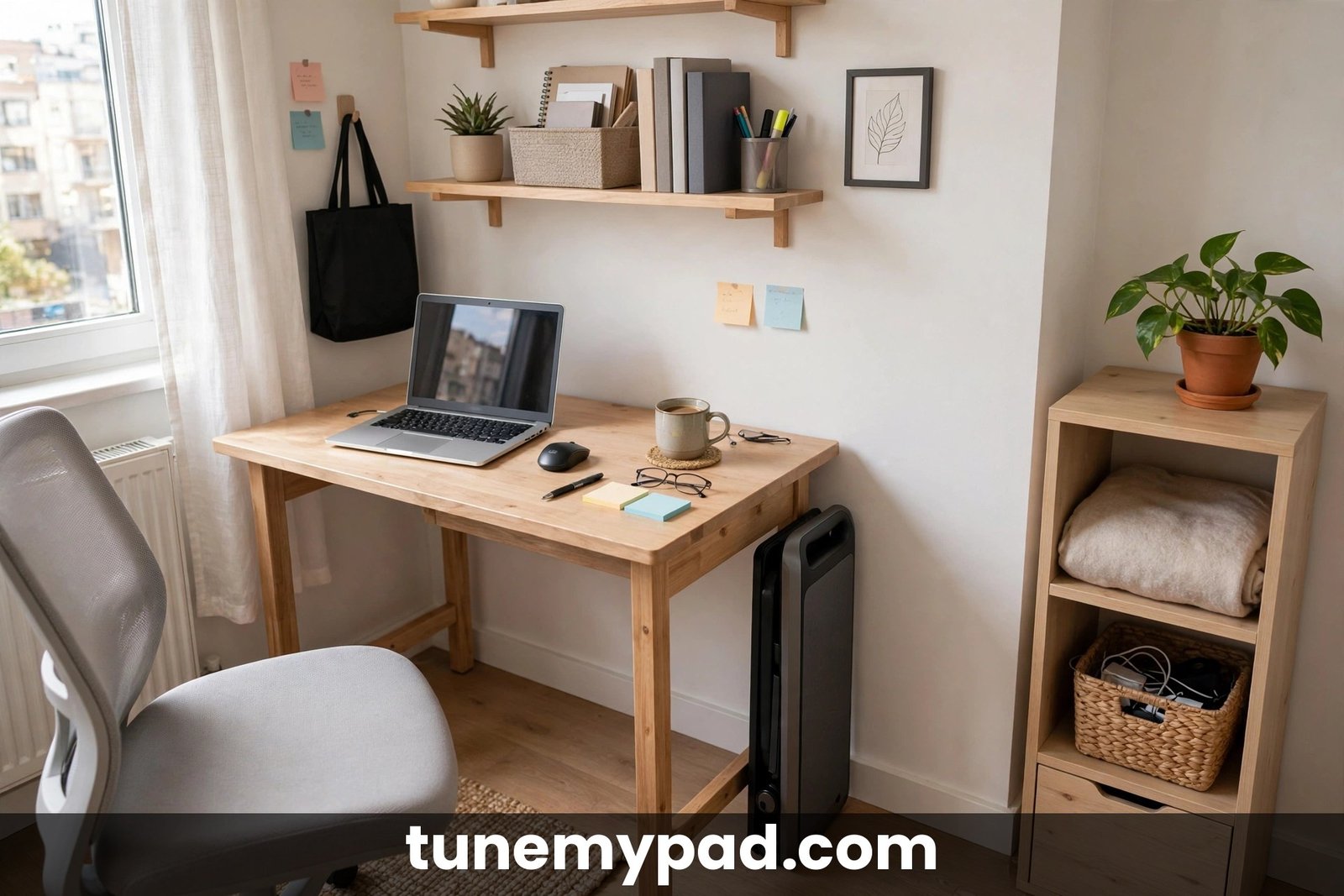
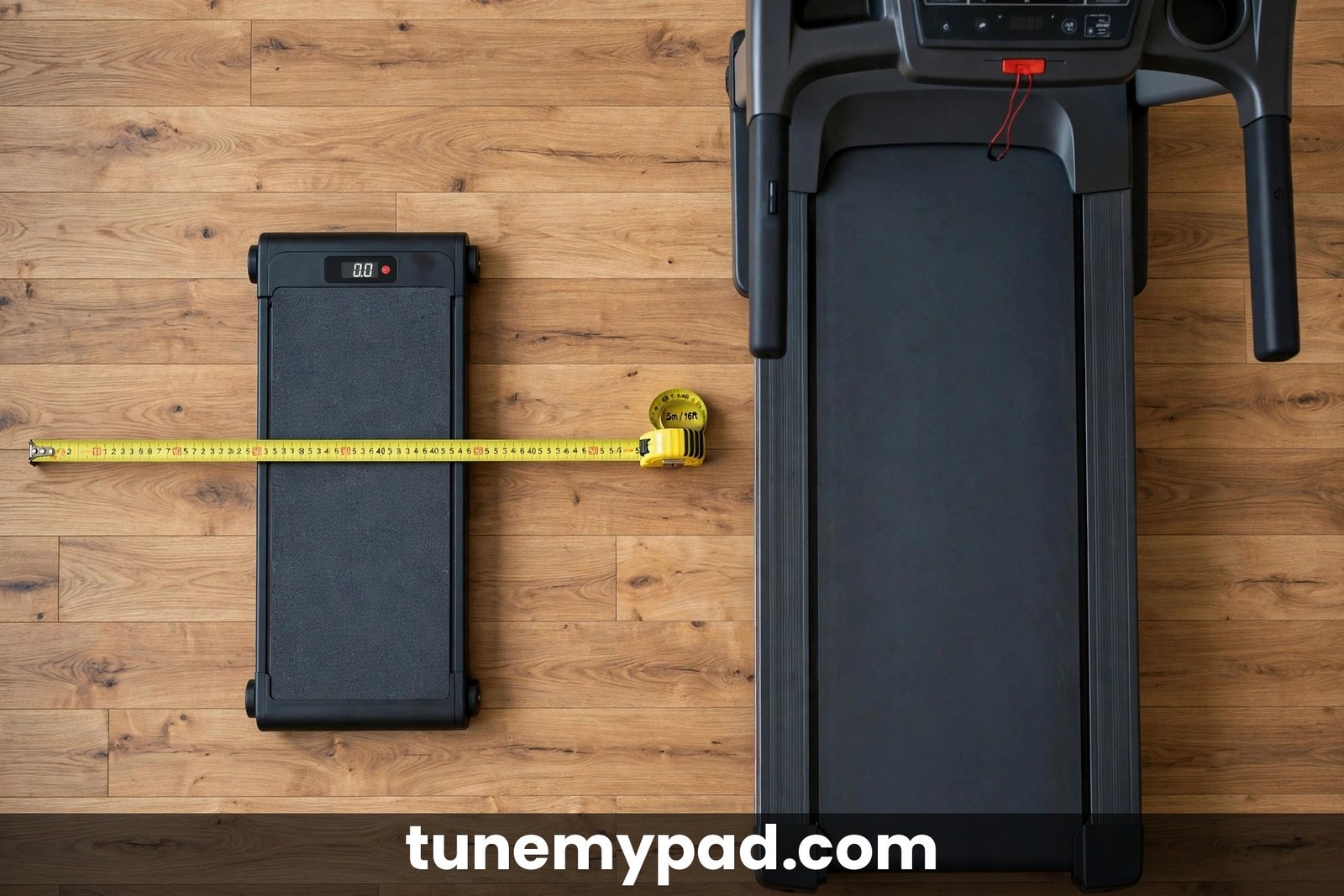
A walking pad is roughly 50 inches long and 20 inches wide, a few inches tall, and many models store upright in a closet or flat under a bed. A treadmill desk needs a permanent 5-by-3-foot zone plus clearance.
For apartments, bedrooms, and multipurpose rooms, this walking pad vs treadmill desk home office difference is decisive. Measure your space before buying anything: you need the unit’s footprint plus 2 feet of clearance behind it. If the room must serve other purposes, the pad’s ability to disappear wins outright.
Related: Walking Pad Studio Apartment Workout: Best Guide (2026)
Difference 3: Noise and Vibration
Smaller motors and lighter belts make walking pads the quieter choice in most walking pad vs treadmill desk home office comparisons: typically 45 to 55 decibels at walking speed, versus 50 to 65 for larger treadmill desks. Through floors and walls, that gap matters.
If you share walls, work early or late, or take calls all day, the pad’s noise advantage is real. Either way, put a dense equipment mat underneath, keep speeds moderate during calls, and remember that footfall technique (soft steps, good shoes) matters as much as the machine. In the walking pad vs treadmill desk home office noise contest, the pad wins, but setup matters more than the label.
Related: How to Make a Treadmill Desk Quieter: 8 Fixes That Actually Work
Difference 4: Working While Walking
Both setups handle typing, reading, and calls well at 1 to 2 mph, but the ergonomics differ. A walking pad under your own standing desk lets you keep a desk you already love, with your monitor arms, keyboard tray, and cable setup intact. An integrated treadmill desk gives you a purpose-built surface, usually with better cable management and a console at hand height.
The walking pad vs treadmill desk home office ergonomics verdict: if you already own a good standing desk, add a pad. If you are furnishing from scratch, a treadmill desk simplifies everything into one purchase. Either way, set monitor height to eye level and keep wrists neutral; walking magnifies every ergonomic flaw.
Difference 5: Stability, Rails, and Safety
Integrated treadmill desks usually include handrails and a more substantial frame, which inspires confidence, especially for older users or anyone with balance concerns. Most walking pads are railless by design, relying on your desk for emergency grabs.
In this walking pad vs treadmill desk home office safety comparison, the treadmill desk wins for wobblier users, while confident walkers do fine with a pad plus a sturdy desk edge. Whichever you choose, use the safety key, keep the area clear, and never step on or off a moving belt. Households with seniors should weight this difference heavily.
Related: Walking Pad for Seniors Over 60: 7 Safety Facts
Difference 6: Workout Quality and Speed Range
Walking pads typically top out at 3 to 4 mph (2-in-1 models reach 7.5 mph for running). Desk-specific treadmill bases cap around 4 mph by design: they are built for walking while working, not training.
For the walking pad vs treadmill desk home office fitness question, both deliver identical low-speed walking, which is where 95 percent of workday use happens. If you also want running workouts, a 2-in-1 walking pad with a raised handlebar beats a desk treadmill. If you want one machine that does everything including serious running, neither wins: buy a real treadmill separately.
Difference 7: Durability and All-Day Use
Motor duty cycle separates the two. A $350 walking pad is engineered for a few hours of daily walking; run it 8 hours straight and you will shorten its life. Premium treadmill desks use continuous-duty motors rated for all-day operation.
Be honest about your volume in this final walking pad vs treadmill desk home office consideration: under 3 hours daily, a quality pad lasts years. Over 4 to 5 hours daily, the treadmill desk’s stronger motor pays for itself in longevity. Check duty-cycle specs, not just horsepower marketing, and give any machine cool-down breaks.
| Use case | Winner | Why |
|---|---|---|
| Small apartment | Walking pad | Stores away, quieter |
| Tight budget | Walking pad | Half the price or less |
| Already own standing desk | Walking pad | Drop-in upgrade |
| 5+ hours daily walking | Treadmill desk | Stronger motor, rails |
| Balance concerns | Treadmill desk | Handrails, stability |
| Want to run too | 2-in-1 walking pad | Higher top speed |
| Furnishing from scratch | Treadmill desk | One integrated purchase |
FAQs
In a walking pad vs treadmill desk home office setup, which is better for beginners?
A walking pad. Lower cost means lower commitment risk, and the learning curve is identical. If you fall in love with walking while working, you can always upgrade later; most beginners never need to. The walking pad vs treadmill desk home office beginner question almost always resolves to “start with the pad.”
Can I use a walking pad with any standing desk in a walking pad vs treadmill desk home office?
Almost any. You need a desk that adjusts low enough for walking ergonomics (elbows at 90 degrees while standing on the pad, which adds 4 to 6 inches of height) and stays stable at that height. Check your desk’s minimum and maximum heights against your measurements before buying the pad.
Which is quieter for apartment use: walking pad vs treadmill desk home office?
The walking pad, generally by 5 to 10 decibels at walking speeds. Smaller motor, lighter belt, less vibration. For thin walls and downstairs neighbors, that margin is meaningful. Add a dense mat and keep brisk sessions to daytime hours regardless of which you choose.
Is a treadmill desk worth double the price in a walking pad vs treadmill desk home office comparison?
Only if you will use the advantages: 4+ daily hours, need for rails, or furnishing from scratch. For typical 1 to 3 hour daily use, a quality pad delivers the same health and productivity benefits for half the money. Match spending to hours, not hype.
Can a walking pad vs treadmill desk home office setup help me lose weight?
Both burn identical calories at identical speeds: roughly 150 to 250 calories per hour of slow walking. Weight loss comes from consistent daily volume plus nutrition, not from which machine you bought. Pick the setup you will actually use every day; that is the one that slims you down.
What about a 2-in-1 walking pad in the walking pad vs treadmill desk home office debate?
2-in-1 models (flat pad that converts with a raised handlebar for running) are the versatility pick: walk under your desk by day, run with rails by evening. They cost slightly more than flat pads and run louder, but for small spaces they replace two machines. If running matters to you, they beat both standard pads and desk treadmills.
How long do they last: walking pad vs treadmill desk home office longevity?
A quality walking pad used 1 to 3 hours daily typically lasts 3 to 5 years with basic maintenance (belt lubrication, cleaning). Premium treadmill desks often last 5 to 10 years under similar or heavier use. Maintenance matters more than category: lubricate, vacuum dust, and respect duty cycles. The CPSC’s treadmill safety resources cover safe operation for both types.
Which should I buy if I work from home full-time?
Full-time remote workers walking 3+ hours daily sit on the fence. If space and budget allow, a mid-range treadmill desk is the comfortable long-term pick. If you are unsure about the habit, start with a quality walking pad under your standing desk: the walking pad vs treadmill desk home office decision can be revisited in a year with real usage data.
The Bottom Line
The walking pad vs treadmill desk home office choice comes down to your space, budget, and daily hours. Small space or tight budget or an existing standing desk: walking pad, no contest. Heavy all-day use, balance concerns, or furnishing from zero: treadmill desk earns its premium. Either way, you are buying the same life-changing habit: thousands of daily steps without finding extra time. Measure your space, be honest about your hours, and let this walking pad vs treadmill desk home office guide make the decision easy.
Setup Checklist: Walking Pad vs Treadmill Desk Home Office
Whichever side of the walking pad vs treadmill desk home office debate you land on, run through this checklist before buying:
- [ ] Measure your space: unit footprint plus 2 feet behind and 1 foot on each side.
- [ ] Check desk height range (pad users): can it go low enough for walking ergonomics?
- [ ] Confirm floor type: hard floors need a mat; check weight limits for upstairs rooms.
- [ ] Verify the motor’s continuous-duty rating matches your planned daily hours.
- [ ] Confirm the safety key, emergency stop, and speed controls are easy to reach.
- [ ] Check noise specs if you share walls: under 55 dB at 2 mph is ideal.
- [ ] Read the return policy: you need at least 30 days to know if walking while working suits you.
Skipping these steps is how walking pad vs treadmill desk home office buyers end up with the wrong machine. Ten minutes with a tape measure saves a $500 mistake.
True Cost of Ownership Over 3 Years
Sticker price is not the whole walking pad vs treadmill desk home office story. Here is a realistic 3-year comparison:
| Cost | Walking pad ($400) | Treadmill desk ($1,500) |
|---|---|---|
| Purchase | $400 | $1,500 |
| Mat + accessories | $60 | $40 (often included) |
| Lubricant, cleaning | $45 | $60 |
| Electricity (2h/day) | ~$55 | ~$90 |
| Likely repairs | $0-100 | $0-150 |
| 3-year total | $560-660 | $1,690-1,840 |
The walking pad vs treadmill desk home office cost gap persists over time: roughly a 3x difference. That money could buy excellent shoes, a great chair for sitting breaks, and still leave hundreds spare. Only pay the premium if you will genuinely use the durability and features.
What Owners Say After One Year
Long-term owner reports add texture to the walking pad vs treadmill desk home office specs. Pad owners after a year most often say: “I wish I’d bought it sooner,” “the mat was essential,” and “I walk less than planned but still 5x more than before.” Their regrets cluster around underpowered motors and missing safety keys on ultra-cheap models.
Treadmill desk owners after a year most often say: “it’s built like a tank,” “I love the integrated desk,” and “it dominates the room.” Their regrets: the size commitment and wishing they’d tested walking-while-working on a cheaper pad first. The walking pad vs treadmill desk home office lesson from veterans: start smaller than your ambition, upgrade only when usage proves the need.
More FAQs
Does a walking pad vs treadmill desk home office choice affect posture differently?
Slightly. Treadmill desks with integrated surfaces are designed around walking posture from the start. Pad users must dial in their own standing desk height, and many set it too low at first, causing hunching. Either setup works well once adjusted; the walking pad vs treadmill desk home office posture difference disappears with proper setup.
Which holds its resale value better: walking pad vs treadmill desk home office?
Treadmill desks depreciate slower in absolute terms because fewer are sold used, but pads sell faster due to broader demand. Expect 40 to 60 percent of retail for either in good condition after a year. In the walking pad vs treadmill desk home office resale market, popular pad brands move quickest.
Can I try before I buy to settle the walking pad vs treadmill desk home office question?
Yes, and you should. Buy from retailers with 30-day returns, or test a friend’s setup. Some coworking spaces and gyms now have walking workstations. A week of real use answers the walking pad vs treadmill desk home office question better than any article, including this one.
Are refurbished units a smart play in the walking pad vs treadmill desk home office market?
Certified refurbished treadmill desks can be excellent value (often 30-40 percent off), since commercial-grade frames outlast their first owners. Refurbished pads are riskier: motors and belts wear, and savings are smaller. Check warranty length on any refurbished unit before deciding.
Related: Buying a Used Walking Pad? 9 Things to Check First
The Hybrid Approach: Pad Now, Desk Later
Still torn? There is a third path many buyers love: start with a quality walking pad under your existing standing desk today, and upgrade to an integrated treadmill desk in a year if your usage justifies it. This resolves the walking pad vs treadmill desk home office dilemma with real data instead of guesses.
The economics work: a $400 pad that teaches you that you walk 2 hours daily is the cheapest possible market research. If after a year you are walking 4+ hours daily and craving rails and a bigger motor, sell the pad (they resell fast) and buy the desk with confidence. If you walk 90 minutes daily and love the setup, you just saved $1,000. Either way, you win, because the decision was informed by your actual habit, not a showroom fantasy.
Final Decision Worksheet
Answer these five questions to settle your personal walking pad vs treadmill desk home office choice:
- How many hours will I realistically walk daily? (Under 3: pad. Over 4: desk.)
- Can the machine have a permanent spot? (No: pad. Yes: either.)
- Do I already own a good standing desk? (Yes: pad. No: consider the desk.)
- Do balance concerns or age make rails important? (Yes: desk. No: pad.)
- What is my budget comfort zone? (Under $700: pad. Over $1,000: either.)
If pads win 3 or more, buy the pad. This worksheet ends the walking pad vs treadmill desk home office debate for most buyers in under two minutes, and it is more reliable than any review because it is built on your life, not someone else’s.
Noise, Neighbors, and Shared Spaces
One factor buyers underestimate in the walking pad vs treadmill desk home office decision: other people. In apartments, the pad’s smaller motor and lighter footfalls transmit noticeably less vibration through floors. In shared home offices, its smaller footprint and lower profile feel less intrusive.
Mitigation works for both: a dense mat, daytime brisk sessions, soft-soled shoes, and considerate scheduling. But if your walls are thin or your office is a bedroom corner, the pad’s acoustic advantage alone can settle the walking pad vs treadmill desk home office question. Ask your downstairs neighbor after week one; their answer is the only review that matters.
Warranty and Support: Read Before You Buy
Final practical note for this comparison: check warranty terms. Quality pads typically offer 1-year parts warranties; premium treadmill desks often offer 2-5 years on frames and motors. Given the price gap, that difference is fair, but do register your product and keep the receipt.
Support responsiveness matters more than warranty length. Before buying either side of the walking pad vs treadmill desk home office divide, search recent buyer reviews for support experiences: slow or absent support turns a minor belt issue into a dead machine. Buy from brands with a real support presence, not just the lowest price.
One Last Sanity Check
Before you click buy, answer honestly: will I walk at least 4 days a week? If yes, either machine pays for itself in health within months. If you are unsure, start with the pad: it is the lowest-risk way to find out. The worst outcome is not choosing wrong; it is researching for another six months while walking zero steps. Decide this week, order, and start walking. Your move.
The Real Winner of Walking Pad vs Treadmill Desk Home Office
Here is the secret neither marketing team tells you: the real winner of the walking pad vs treadmill desk home office debate is simply the person who walks daily. Studies of treadmill-desk users consistently show that adherence, not equipment tier, predicts results. A $350 pad walked on for two hours daily beats a $2,000 desk used as a clothes rack every time. Choose the machine you will actually use, set it up well, and start walking today.