
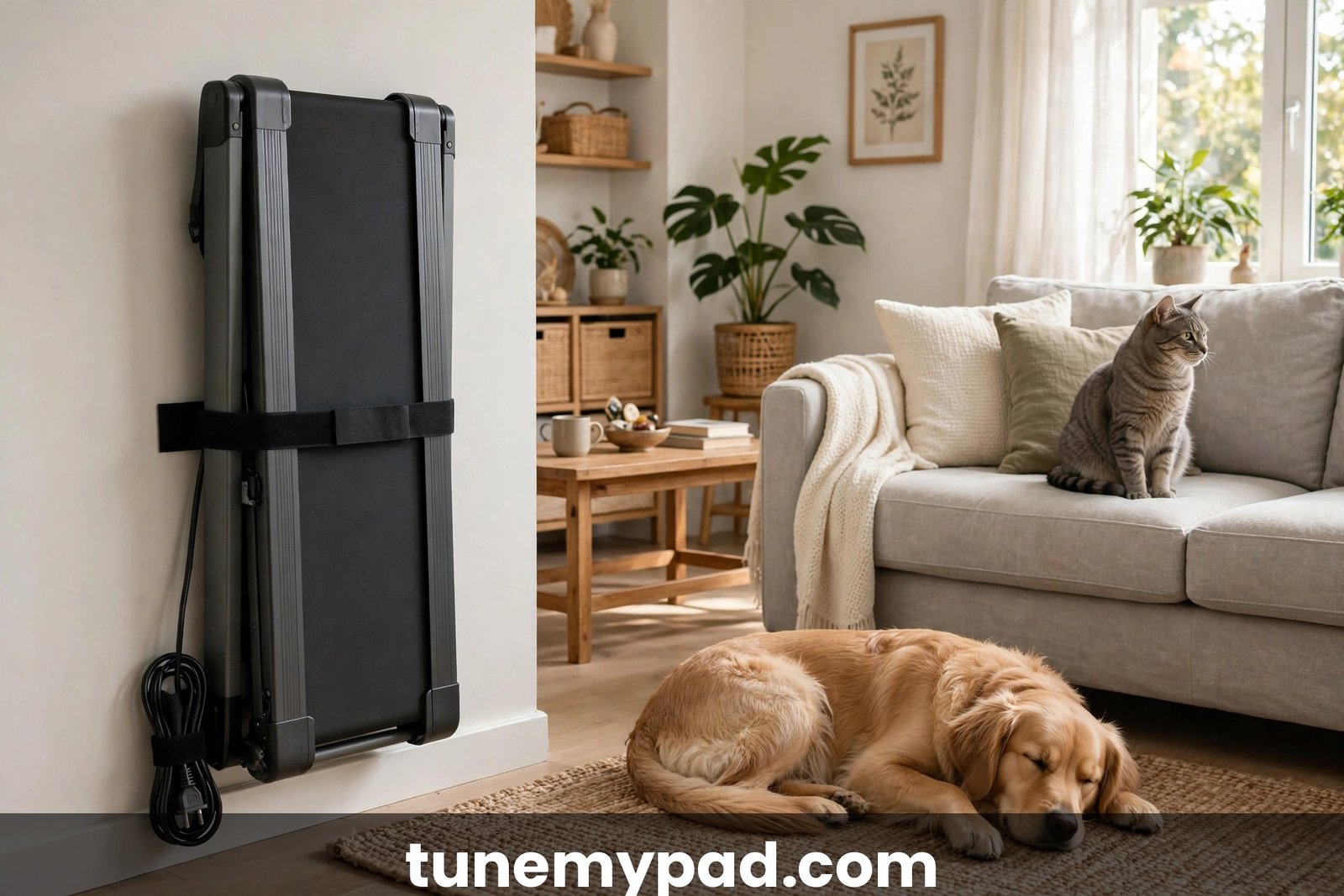
If you share your home with kids or pets, it’s smart to ask: are walking pads safe for children and pets? The honest answer: a walking pad is safe for you to use around children and pets — but it is not a toy, not a pet treadmill, and must never be left running (or plugged in) where little hands and paws can reach. Most accidents happen in the seconds an adult steps away.
This guide gives you the real risk picture, ten non-negotiable safety rules, and what to do if an accident happens — the precautions that actually prevent injuries.
Table of Contents
This guide covers the honest risk assessment, why walking pads are riskier than they look, ten essential safety rules, child vs. pet risk differences, age-by-age guidance, species-specific dangers for dogs and cats, a kid-and-pet-safe walking station setup, a 30-second shutdown ritual, rules for babysitters and guests, what to do if an accident happens, and answers to the most common questions.
Quick Answer: Are Walking Pads Safe for Children and Pets?
| Question | Answer |
|---|---|
| Are walking pads safe for children and pets? | For supervised adult use, yes. Unsupervised access is where injuries happen. |
| What’s the biggest risk? | Friction burns (hands/paws on a moving belt) and entrapment at the rear roller. |
| Can kids use a walking pad? | Only with direct adult supervision, at low speed, holding support — and ideally not at all for small children. |
| Can pets walk on it? | Not recommended. Pet-specific treadmills exist; walking pads aren’t designed for animals. |
| The single most important rule? | Unplug the pad and remove the safety key after every use. Every time. |
The Honest Risk Assessment
When asking “are walking pads safe for children and pets,” start with the injury data: U.S. emergency departments treat thousands of treadmill-related injuries yearly, with children overrepresented in friction-burn cases. Walking pads cause the same types of injuries as full-size treadmills — in a smaller, quieter package adults tend to leave lying around.
Friction burns are the signature injury. A moving belt acts like sandpaper: a child’s hand or a pet’s paw on the belt for even a second can produce a deep burn that scars — at low speed. It doesn’t take much.
Entrapment happens at the rear roller, where the belt disappears into the machine. Fingers, paws, tails, and drawstrings can be drawn into that gap — walking pads have smaller gaps than gym treadmills, but small fingers fit small gaps.
Falls and collisions affect toddlers most: a running belt at ankle height trips wandering children, and climbing onto a moving belt gets a child thrown. Startled pets can injure themselves bolting.
Electrical hazards round out the list. Chewed cords, knocked-over units pulling plugs halfway out, and objects poked into vents all create shock and fire risk. Unplugging after use — see whether a walking pad can catch fire — eliminates this entire category.
Why Walking Pads Are Riskier Than They Look
Full-size treadmills look dangerous, so people respect them. Walking pads look harmless, which is exactly the problem:
- They’re quiet. A child or pet can approach a running pad without the warning roar of a gym treadmill.
- They sit at floor level. The belt is exactly where crawling babies, toddlers, and pets live.
- They’re always “out.” Unlike a treadmill in a dedicated gym room, the walking pad lives in the living room or office — in shared space, all day.
- The remote is tempting. A small remote with big buttons is irresistible to toddlers and easy for a pet to step on.
- They start instantly. One button press and the belt moves. There’s no warm-up ritual that gives you time to notice a child approaching.
None of this means you can’t own one with kids and pets — it means the safety system must be deliberate, because the machine won’t warn anyone itself. In short, are walking pads safe for children and pets? Yes — with a deliberate safety system.
10 Essential Safety Rules for Kids and Pets
- Unplug after every use. Not switched off — unplugged. This single habit prevents unauthorized startups, the top cause of child and pet injuries.
- Remove the safety key and hide it. The safety key is the pad’s ignition. Pocket it — or stash it on a high shelf — so the pad can’t start without you.
- Lock away the remote. Remotes start the belt with one press. Store it out of children’s reach and off the floor — never on a low table where pets step.
- Never leave a running pad unattended. Not for “just a second” to answer the door — stop the belt first, every time. Most accidents happen in exactly that minute.
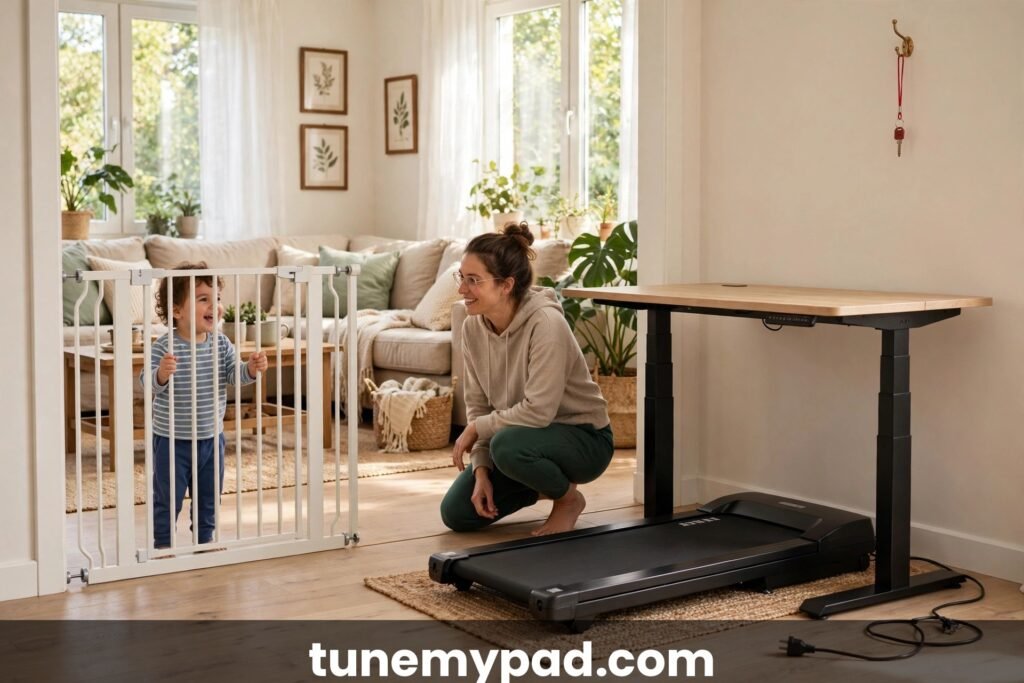
- Create a kid-and-pet-free zone while walking. Use a baby gate, a closed door, or a playpen barrier around your walking area. Out of sight plus out of reach beats vigilance alone.
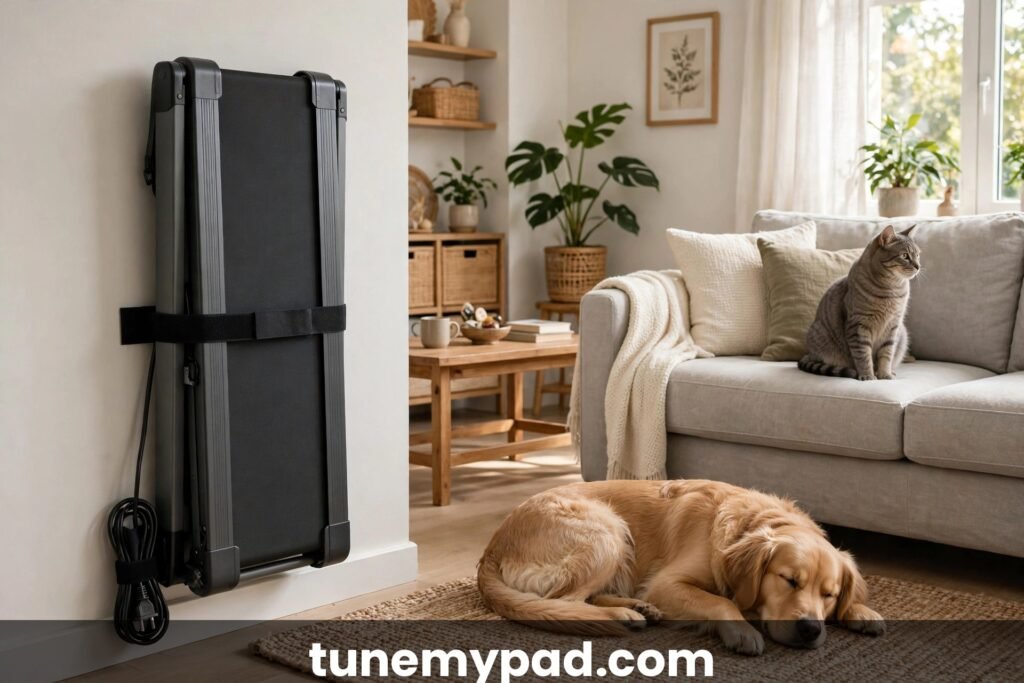
- Store it folded, upright, and secured. A folded pad is harder to climb on and can’t trap anyone underneath. Anchor or wedge it so a climbing toddler can’t pull it over.
- Keep cords out of reach and sight. Route the power cord where it can’t be chewed, tripped over, or yanked — and unplug after use.
- Teach older children the rules explicitly. “Never touch it, never turn it on, tell an adult if it’s running” — clear, repeated, and non-negotiable, like stove or pool rules.
- Never let pets “try” the walking pad. It’s not designed for animals: no side rails, and a panicking animal can injure itself badly. Pet treadmills with enclosures exist for a reason.
- Supervise every second of any child use. If an older child or teen uses the pad, stay in the room, keep speed low, and clip the safety key to them. No solo sessions for kids.
Supervision plus physical barriers (unplugged, key removed, gated area) is the layered approach safety experts recommend — no single measure is enough on its own. With all three layers in place, the answer to “are walking pads safe for children and pets” becomes a confident yes.
Child vs Pet Risks: What’s Different
| Risk | Children | Pets |
|---|---|---|
| Friction burns | Hands on moving belt — most common child injury | Paws/noses on belt; claws can catch and tear |
| Entrapment | Fingers, drawstrings, hair at rear roller | Paws, tails, collars, leashes at rear roller |
| Unauthorized startup | Toddlers press remote buttons | Pets step on floor-level remotes |
| Chewing | Toddlers mouth cords and small parts | Puppies/kittens chew cords — shock risk |
| Falls | Climbing on a moving belt; tripping into it | Startled bolting; slipping on the belt |
| Prevention edge | Can learn rules (older kids) | Cannot learn rules — barriers only |
The key difference: older children can be taught, but pets can only be managed with physical barriers — which is also the safest assumption for toddlers. This distinction shapes how you answer “are walking pads safe for children and pets” for a household with both.
Age-by-Age Guidance: Babies Through Teens
“Children” spans a huge range of risk. What’s appropriate for a teenager is reckless for a toddler — here’s how the guidance changes by age:
| Age group | Risk level | Guidance |
|---|---|---|
| Babies & crawlers (under 2) | Highest | No contact with the pad at all. Belt height matches a crawling baby’s head height; they cannot understand danger. Gate the room or gate the pad, every time. |
| Toddlers & preschoolers (2–5) | Very high | Should never operate or touch the pad. The remote is a magnet for this age group. Physical barriers only — rules don’t stick yet. |
| School-age (6–12) | Moderate | Teach the rules like stove safety: never touch a running pad, never press the remote, tell an adult if it’s on. Still no unsupervised access. |
| Teens (13+) | Lower but real | May use the pad with supervision at first, then independently once they consistently follow every rule — low speed, safety key clipped on, area clear, unplug after. |
The pattern: physical barriers for the youngest, taught rules for school-age kids, and graduated responsibility for teens. Follow it and “are walking pads safe for children and pets” gets a yes at every age; skip it and the answer changes. At no age should a child be left alone in a room with a plugged-in pad they could start — the “they know better” assumption is how most older-child injuries happen.
Dogs and Cats Face Different Dangers
Pets can’t be taught the rules, but knowing each species’ specific risks lets you aim your barriers correctly.
Dogs: chewers, steppers, and chasers
Dogs — especially puppies — explore the world with their mouths, and a power cord on the floor is an obvious target. A chewed cord is a shock and fire hazard; if it happens, unplug immediately and replace the cord before using the pad again (see our power cord replacement guide). Dogs also step on floor-level remotes, and a curious or anxious dog may lunge at a moving belt, risking paw burns or a panicked scramble across the room. Large dogs can knock an unfolded pad into walls or furniture. Management: gate the dog out of the room while you walk, keep the remote on a high shelf, and
never let a dog “try it out” — a startled 30-pound animal on a moving belt injures itself, the pad, and possibly you. Dog owners asking “are walking pads safe for children and pets” should know the answer hinges on separation during use, not training.
Cats: climbers, warm-seekers, and tail hazards
Cats are drawn to walking pads for the worst reasons: the warm motor housing is a perfect nap spot, the belt’s vibration is interesting, and a stored upright pad is a scratching post. A cat asleep on the deck when the belt starts will panic — claws out — and shredded belt plus shredded paw pads is a vet visit. Long tails near the rear roller during operation are an entrapment risk.
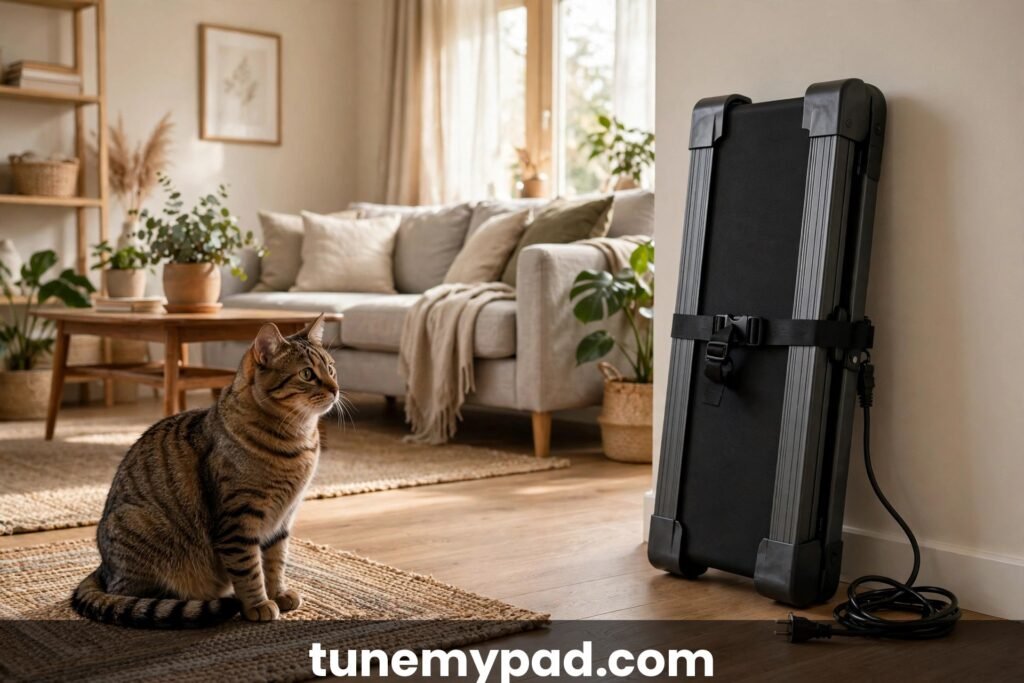
Management: unplug and remove the key after every walk (non-negotiable with cats), store the pad folded upright where it can’t be climbed, and consider a fitted cover over the stored unit so it stops looking like furniture. Cat owners wondering “are walking pads safe for children and pets” should treat the storage rules as equal to the in-use rules. Never leave the pad running unattended in a house with cats — the remote on a coffee table is one curious paw away from startup.
Setting Up a Kid-and-Pet-Safe Walking Station
A few setup choices make the rules above almost automatic:
Choose a closable room. A home office with a door beats a living-room corner — “door closed while walking” is the simplest, most reliable barrier.
Use a baby gate if there’s no door. A pressure-mounted gate across the office doorway or around the walking area keeps toddlers and most pets out while you walk. It’s a $30 solution to the biggest risk.
Designate a high shelf for key + remote. A small basket on a shelf, out of reach and out of sight, becomes the after-walk ritual: unplug, remove key, stash remote. Rituals beat memory.
Mind the storage spot. When folded, store the pad where it can’t be climbed or pulled over — a closet, behind furniture, or strapped upright. Not leaning loosely against a wall in a play area.
Keep the area clear. Toys, pet beds, and chew toys near the pad invite the exact proximity you’re trying to prevent. The walking zone should be boring to everyone but you.
A pad that shares a circuit with space heaters or trips breakers adds another hazard layer — see why a walking pad keeps tripping the circuit breaker if yours has electrical quirks.
The 30-Second Shutdown Ritual After Every Walk
The most dangerous walking pad is the one that’s “off but ready.” Make this shutdown sequence automatic and unauthorized startups become nearly impossible — which is what keeps “are walking pads safe for children and pets” a yes in your home:
- Stop the belt fully — wait until it comes to a complete stop, not just slows down.
- Pull the safety key and put it in your pocket or its high-shelf spot immediately.
- Pick up the remote — don’t leave it on the desk edge or floor “for next time.”
- Unplug from the wall — five seconds, removes the entire electrical and startup risk category.
- Fold and store if you won’t walk again today — upright, secured, away from play areas.
Do it in the same order every time and it becomes muscle memory within a week. If you’re walking in a shared or small space, our small-space treadmill desk setup has more ideas for making the shutdown routine compact and repeatable.
Babysitters, Guests, and Cleaners Need the Rules Too
Your safety system fails the moment someone who doesn’t know it walks into the room. Every person who spends time in your home unsupervised needs the two-minute version — because “are walking pads safe for children and pets” depends on every adult knowing the rules:
- Show, don’t just tell. Point at the pad, the unplugged cord, and the remote’s hiding spot. “This is unplugged and the key is up there — please don’t plug it in or let the kids touch it.”
- Make the rule binary. “Don’t let the kids near it, ever” works better than “it’s fine as long as they don’t press anything.” Nuance gets lost when someone’s attention is on a toddler.
- Write it down for regular sitters. A one-line note on the fridge — “Walking pad: stays unplugged, remote stays on the high shelf, kids stay away” — survives the handoff better than a verbal mention at the door.
- Don’t rely on “it’s folded away.” Curious kids unfold things. The unplugged cord and hidden key are the real protection; folding is the bonus layer.
- Cleaners and maintenance visitors should know not to plug it in “to test it” and not to move it somewhere accessible. A quick mention at the start of the visit covers it.
When the Pad Is Off but Still Risky: Storage Injuries
An unplugged pad isn’t automatically a safe pad. Storage-phase injuries are underappreciated:
- Tip-over. A folded pad leaning loosely against a wall is a climbing frame to a toddler and a rubbing post to a large dog. One good shove brings 50+ pounds down. Strap it upright, wedge it in a closet, or lay it flat under furniture.
- Pinch points. Folding mechanisms have hinges that pinch small fingers hard. Fold and unfold only when kids and pets are out of the room, and engage any transport lock the model has.
- Climbing and riding. An unfolded pad on the floor reads as a slide, a runway, or a bed to children and pets. Fold it after use — a folded pad is dramatically less inviting.
- Cord strangulation and tripping. Even unplugged, a cord trailing across a play area is a trip and tangle hazard. Coil it and tuck it behind the unit or in the storage spot.
What to Do If an Accident Happens
Stop the belt immediately. Hit stop, pull the safety key, unplug. Seconds matter with friction burns and entrapment.
Friction burns: Cool with lukewarm running water for 10+ minutes — not ice, which damages tissue. Cover loosely with a clean, non-stick dressing. Get medical care for blistered burns, burns larger than the child’s palm, burns on face/hands/joints, or any pet paw-pad burn (pets hide pain).
Entrapment: Stop the belt before pulling anything free — pulling against a moving belt worsens injury. Once stopped, gently free the trapped finger, paw, or tail and assess. Deep cuts, crushed fingertips, or a limping pet need professional care.
After any incident: figure out how access happened and close the gap — that’s the real fix. Check the pad for damage before using it again.
FAQs: Walking Pads, Children, and Pets
Are walking pads safe for children and pets to be around?
Yes — when the pad is unplugged, the safety key removed, and it’s stored securely. The danger is an accessible, powered pad, not its mere presence. Layered precautions (unplug + key + barrier) make coexistence safe. Safe is a system you build, not a feature you buy.
At what age can a child use a walking pad?
There’s no official age rating — walking pads are designed for adults. Older children or teens may use one only with direct adult supervision, at low speed, with the safety key attached. Young children should not use walking pads.
Can dogs walk on a walking pad?
Not recommended. Walking pads lack the side rails and enclosures of pet treadmills, and a startled dog can injure itself or damage the machine. For dog treadmill exercise, buy equipment designed for animals and introduce it with professional guidance.
How do I keep my cat off my walking pad?
Unplug and remove the key after every use, store it folded upright, and put the remote away. Cats love warm, vibrating surfaces — never leave the pad running unattended, and consider a cover for the stored unit.
What should I do if my pet chews the power cord?
Unplug immediately and don’t use the pad until the cord is replaced — chewed insulation is a shock and fire hazard, and damage often runs deeper than it looks. Route the replacement cord out of reach.
Is it safe to leave a walking pad plugged in overnight?
No — not with children or pets at home. An idle-but-plugged-in pad can start from a remote press or button bump. Unplugging takes five seconds and removes unauthorized-startup accidents entirely.
Can my toddler walk on the pad with me if I hold their hand?
Please don’t. Walking pads are designed and tested for a single adult user; carrying or guiding a toddler changes your balance and theirs, and a stumble puts the child directly onto a moving belt. There is no safe speed or hand-hold that makes a moving belt appropriate for a toddler. If you want active time together, walk outside or let them play nearby behind a barrier while you walk.
Is a walking pad safer than a full-size treadmill for a house with kids?
Somewhat — lower top speeds and lower belt height mean less severe falls, and there’s no elevated deck to fall from. But the injury types are identical: friction burns and rear-roller entrapment happen on both. Don’t let the friendlier form factor relax your safety system; a walking pad needs the same unplug-key-barrier discipline as a gym treadmill.
Should I put my dog in another room while I walk?
Yes — that’s the simplest version of the barrier rule. A closed door or baby gate between the dog and the walking area removes chewing, remote-stepping, and bolting risks in one move. Crating works too if the dog is crate-trained and comfortable. What doesn’t work is “he usually just lies there” — usually isn’t always, and you can’t stop a belt and grab a lunging dog at the same time.
What should I tell my babysitter about the walking pad?
Keep it to three sentences: the pad stays unplugged, the remote stays on the high shelf, and the kids don’t touch it, period. Show the sitter where the unplugged cord is so they can confirm at a glance. For regular sitters, leave it as a written note with the other house rules.
Conclusion
So, are walking pads safe for children and pets? They are — when the adults treat safety as a system, not a hope. Unplug after every use, pocket the safety key, lock away the remote, barrier the walking zone, and never leave a running belt unattended. Five habits, thirty seconds a day, virtually every injury prevented. With the system in place — unplug, key, barrier, supervision — yes, and comfortably so.
External References
- U.S. Consumer Product Safety Commission — Federal product safety guidance, recalls, and injury data for home exercise equipment.
- Safe Kids Worldwide — Child injury prevention resources, including home safety guidance for families.
- American Veterinary Medical Association — Pet health and household safety resources for pet owners.