
You step onto your brand-new walking pad, take three strides, and your foot lands half on the belt and half on the side rail. If that sounds familiar, you’re probably dealing with a Redliro walking pad too narrow for your stride — one of the most common complaints about this otherwise popular budget brand. Redliro’s compact models typically ship with belts around 15–16 inches wide, which feels fine in a product photo but can feel like a tightrope once you’re actually walking at 2.5 mph while answering emails.
Before you box it up for a return, read this: a Redliro walking pad too narrow for comfort is usually a solvable problem, not a defective product. Most narrow-belt discomfort comes from walking technique, placement, and setup choices that are easy to change — not from the belt itself. This guide explains why narrow belts feel the way they do, gives you 7 practical ways to walk comfortably on your Redliro anyway, and tells you honestly when the right answer really is a wider model.
Table of Contents
Quick Answer: Redliro Walking Pad Too Narrow
| Question | Answer |
|---|---|
| How wide is a Redliro walking pad belt? | Most Redliro under-desk models have belts roughly 15–16 inches (38–40 cm) wide — narrower than many competing walking pads and much narrower than full-size treadmill belts (20–22 inches). |
| Why does a Redliro walking pad feel too narrow? | A combination of belt width, walking speed, looking down at a screen, and drifting sideways during work tasks. Most users adapt within 1–2 weeks with the techniques below. |
| Can I fix it without returning the pad? | Usually yes: slower speed, centered stance, guide rails or floor markers, proper desk alignment, and good footwear solve it for most walkers. |
| When should I switch to a wider model? | If you’re over about 6’1″, have a naturally wide stance, or still clip the rails after two weeks of deliberate practice, a wider belt is the honest answer. |
| Does a narrow belt affect safety? | Only if you consistently drift off the edge. The techniques here keep you centered; the pad’s side rails and low deck height keep consequences minor. |
Why Narrow Belts Feel Narrower Than the Numbers Suggest
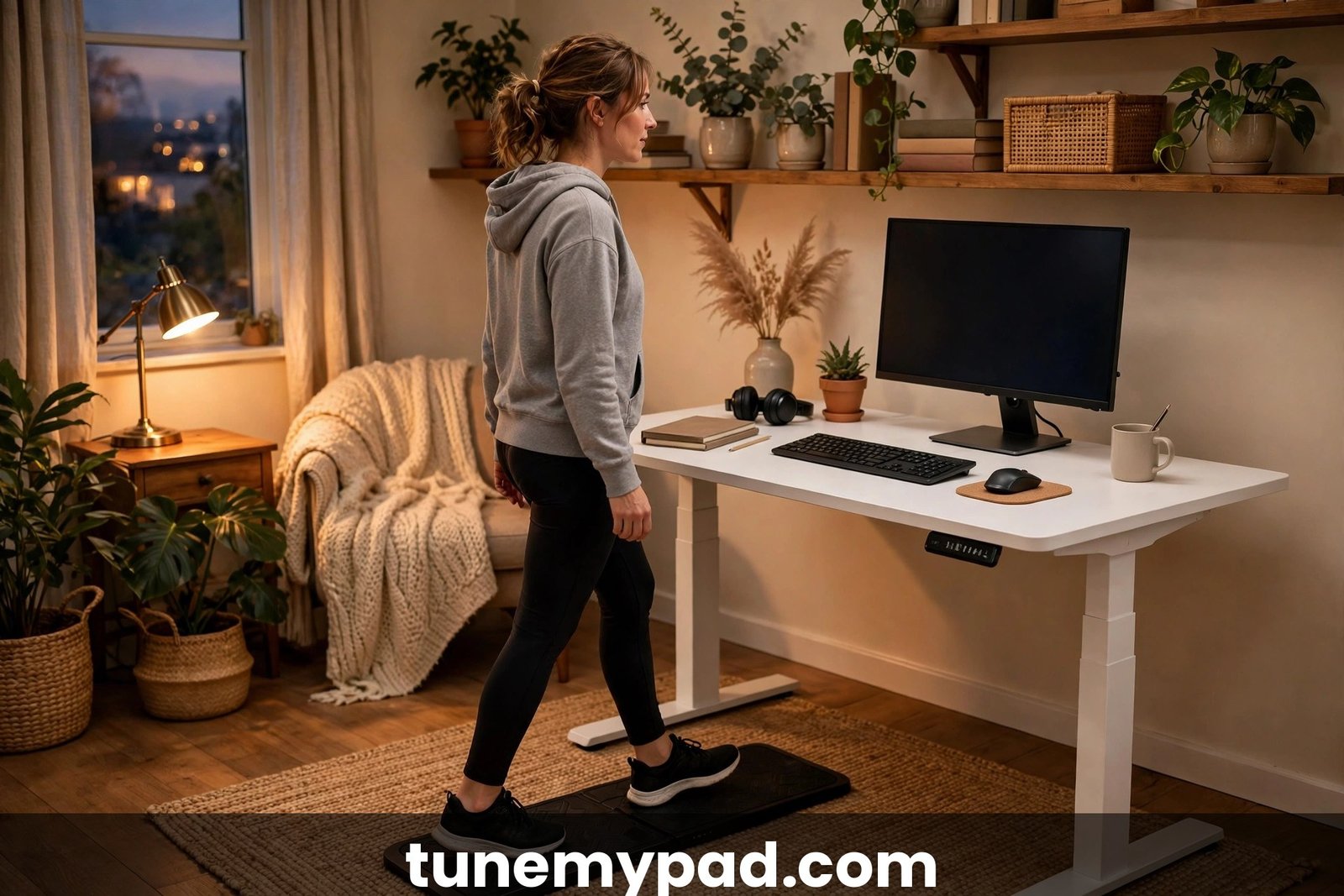
Two inches sounds trivial until you’re dealing with a Redliro walking pad too narrow for a relaxed stride. A 15-inch belt doesn’t sound dramatically smaller than a 17-inch belt — it’s only two inches. But on a walking pad, those two inches matter more than you’d expect, for several reasons.
Your stride is wider than you think
If you’re troubleshooting a Redliro walking pad too narrow for your natural stride, start by measuring it. When you walk naturally outdoors, your feet land roughly hip-width apart — typically 6–10 inches between foot centers for most adults. That fits comfortably on a 15-inch belt. But under a desk, three things widen your effective stance: you look down or at a monitor (which degrades balance), you reach for a mouse or keyboard (which shifts weight sideways), and you walk for hours instead of minutes (fatigue widens your base of support). The result: a belt that felt fine during a 5-minute test feels cramped during a 2-hour work block.
Treadmill walking is different from outdoor walking
The hard boundaries are what make a Redliro walking pad too narrow feel even narrower than the tape measure says. Outdoors, you can drift and correct freely. On a belt, the edges are hard boundaries — and your brain knows it. That awareness makes you walk tentatively, which paradoxically makes you drift more. New walking-pad users consistently report that the belt “shrinks” during their first week and “grows” during their second, as their motor control adapts. This adaptation is real and well-documented in treadmill familiarization research.
Redliro’s design trade-off
Redliro optimized for compactness and price: a narrower belt means a smaller overall footprint (easier to slide under a desk or store under a bed) and a smaller motor requirement (cheaper, quieter). For petite users and straight-ahead walkers, it’s a perfectly good trade. The problem cases are taller users, side-drifters, and anyone who expected a full-treadmill feel from a $300 pad. You can compare the current lineup on Redliro’s official site — and if you’re dealing with a Redliro walking pad too narrow for your stride, the width specs are the first thing to check.
Way 1: Slow Down — Speed Is the Biggest Factor
This is the single highest-leverage fix for a Redliro walking pad too narrow for your stride. Belt width problems scale with speed: at 1 mph, almost nobody drifts; at 3 mph, almost everybody does.
Find your no-drift speed
Finding your no-drift speed is the fastest win for a Redliro walking pad too narrow for your usual pace. Walk for 10 minutes at 2 mph. If you clip the rails, drop to 1.5 mph. The goal is the fastest speed at which you can walk for 20 minutes without touching the edges. For desk work, 1–2 mph is the productive range anyway — research on treadmill desks consistently uses these speeds because faster walking degrades typing and mouse accuracy. You’re not sacrificing productivity by slowing down; you’re entering the optimal zone.
Use speed as a diagnostic
If you can walk comfortably at 1.5 mph but not at 2.5, the belt isn’t truly too narrow — your speed is too high for your current skill level. Revisit faster speeds after a week of practice. If you clip the rails even at 1 mph while walking straight, that’s the signal that width (not speed) is the real issue. This diagnostic separates a Redliro walking pad too narrow for your skill level from one that’s genuinely undersized.
Way 2: Fix Your Stance and Foot Placement
Most stance fixes for a Redliro walking pad too narrow for comfort start with awareness. Most people walk on a treadmill the way they walk outdoors — and that’s the problem. A few deliberate adjustments buy you inches of effective belt width.
Walk narrower on purpose
This technique directly addresses a Redliro walking pad too narrow for your default gait. Consciously place each foot closer to the belt’s centerline, as if walking on a painted line. This feels odd for the first few sessions because your body wants its natural base of support. Practice it as a drill: 5 minutes of deliberate narrow walking at the start of each session. Within a week, the narrower placement becomes automatic.
Center yourself with a reference point
Put a small piece of colored tape on the floor in front of the pad, aligned with the belt’s center. Glance at it periodically to check your position. Better: align your desk chair’s center, your monitor, and the belt centerline — when your whole workstation is centered on the belt, drift drops dramatically. Misalignment between desk and pad is one of the sneakiest causes of a Redliro walking pad too narrow feeling, because you unconsciously walk toward your keyboard.
Shorten your stride slightly
Cadence tweaks are underrated for a Redliro walking pad too narrow for long strides. Long strides at higher speeds increase lateral sway. A slightly shorter, quicker cadence keeps your feet under your hips and reduces side-to-side movement. Think “shuffle, don’t stride.”

Way 3: Align Your Desk to the Belt (Not the Room)
Alignment issues amplify a Redliro walking pad too narrow for comfort. This one surprises people. Walk to your setup right now and check: is your monitor centered over the belt, or centered on the desk? If the desk is wider than the pad (it always is), and your monitor sits at the desk’s center, you may be walking off-center every single day without realizing it.
The alignment check
- Stand on the pad in your normal walking position.
- Have someone photograph you from directly behind, or prop your phone on a shelf and use the self-timer.
- Check whether your body centerline matches the belt centerline.
Every inch of offset makes a Redliro walking pad too narrow feel worse. If you’re offset by even two inches, you’ve effectively lost two inches of belt width on one side. Re-center the pad under your monitor — or shift your monitor over the pad. This single adjustment resolves a huge share of “too narrow” complaints.
Keyboard and mouse position
Reaching sideways on a Redliro walking pad too narrow for comfort is a drift trigger. Keep input devices close and centered. Reaching sideways for a mouse parked at the desk’s edge pulls your whole torso off-center with every click. A compact keyboard and a centered mouse (or a trackpad directly in front of you) keep your upper body over the belt.
Way 4: Add Physical Guides and Floor Markers
Landmarks give your feet what a Redliro walking pad too narrow for comfort takes away: reference points. Your feet can’t see the belt edges — especially when you’re looking at a screen. Give them landmarks.
Side guide rails
Physical guides are the most literal fix for a Redliro walking pad too narrow for your stride. Some users attach low-profile foam rails or pool noodles along the pad’s side rails. Your ankles brush them before your feet leave the belt, giving you a tactile warning to re-center. It’s inelegant, but it works — and it trains your proprioception so you need the guides less over time.
Floor tape markers
These markers help when a Redliro walking pad too narrow for comfort offers no visual edges. Place two strips of bright tape on the floor flanking the pad, aligned with the belt edges extended forward. In your peripheral vision, they create a “lane” that your brain tracks unconsciously. Runners use the same trick with lane lines; it works because your visual system is excellent at lane-keeping once it has references.
The mirror trick
Seeing your feet helps when a Redliro walking pad too narrow for comfort hides the edges. A small mirror propped at desk level, angled so you can see your feet in your peripheral vision, gives real-time feedback for the first week. Most people find they stop needing it after 5–7 days as their body learns the belt boundaries.
Way 5: Choose Footwear That Helps, Not Hurts
Shoe choice matters more when a Redliro walking pad too narrow for comfort leaves no margin. What you wear on a narrow belt matters more than on a wide one.
Best: thin, flat, grippy soles
A smaller contact patch helps on a Redliro walking pad too narrow for bulky trainers. Flat walking shoes or minimalist trainers with thin soles keep your foot’s contact patch small and your balance precise. Thick, cushioned running shoes with wide flared soles effectively make your feet wider — the opposite of what you want on a 15-inch belt.
Avoid: socks on a bare belt (at first)
Friction control is critical when a Redliro walking pad too narrow for comfort punishes every slip. Socks reduce friction, which increases micro-slips and corrective steps — exactly the lateral movements that eat belt width. Once you’re confident and centered, socks are fine. During the adaptation period, wear shoes.
Barefoot: a qualified maybe
Barefoot walking on a Redliro walking pad too narrow for comfort demands experience. Some experienced users prefer barefoot for maximum proprioception. But barefoot on a narrow belt while distracted by work is advanced mode. Earn it first with shoes, then experiment.
Way 6: Train Your Balance Off the Pad
Balance training pays off fastest on a Redliro walking pad too narrow for wobbly walkers. Ten minutes of balance work, three times a week, measurably reduces lateral sway on a treadmill. Your stabilizer muscles are the real width-limiting factor.
The single-leg stand progression
- Stand on one foot for 30 seconds, eyes open. When that’s easy, close your eyes.
- Add head turns while balancing — this trains your vestibular system the way screen-looking challenges it.
- Stand on a folded towel or balance pad for an unstable surface.
Core and hip work
Weak gluteus medius muscles (the outer-hip stabilizers) are the classic cause of side-to-side wobble. Clamshells, side-lying leg raises, and lateral band walks, done 2–3 times weekly, tighten up your gait noticeably within a month. This isn’t just about the pad — it’s the same musculature that keeps you stable on stairs and uneven ground.
Way 7: Know When to Upgrade (the Honest Checklist)
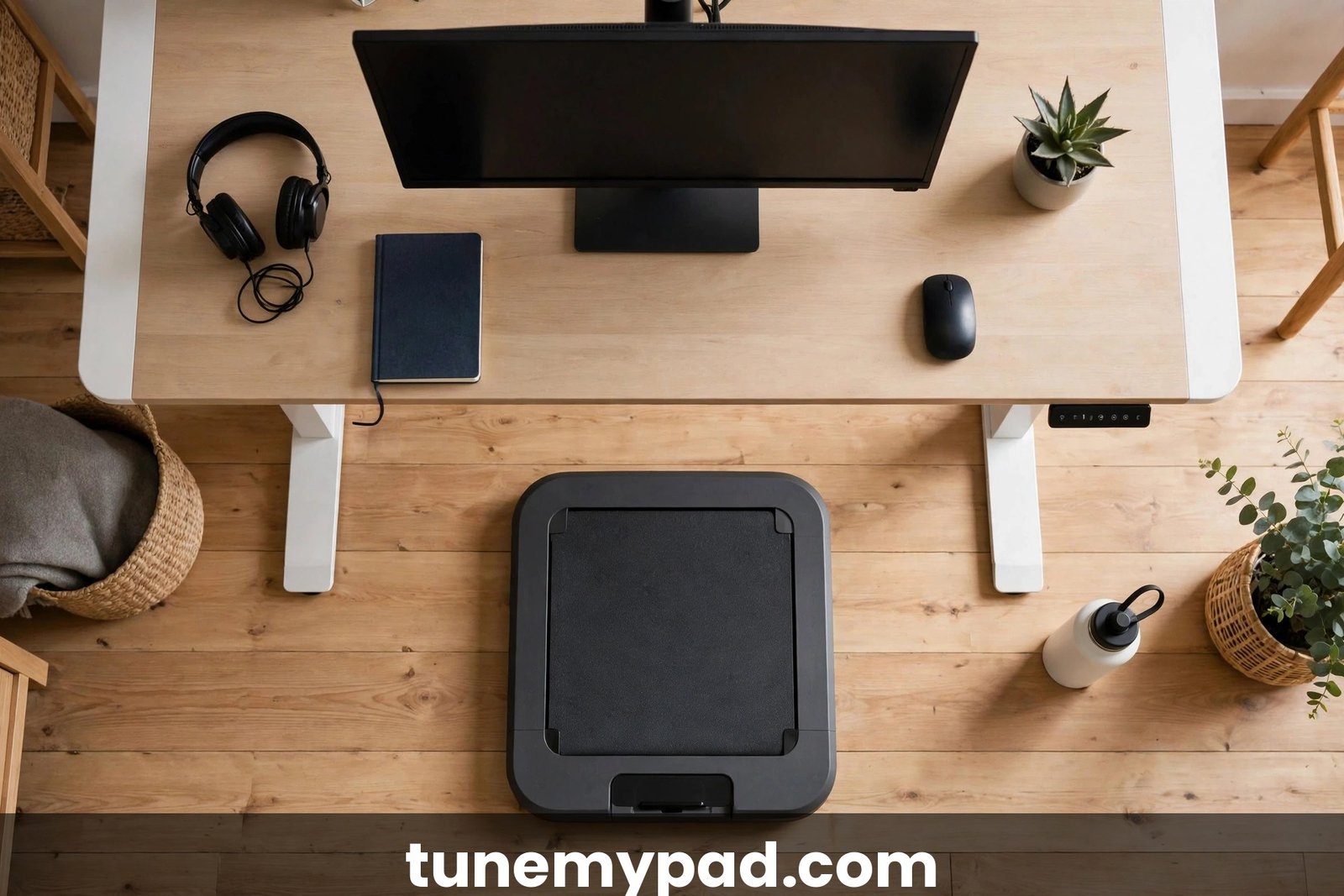
Sometimes a Redliro walking pad too narrow for you is simply a mismatch, and the right move is a wider belt. Here’s how to tell the difference between an adaptation problem and a sizing problem:
| Sign | Verdict |
|---|---|
| You clip the rails only above 2 mph | Adaptation/speed issue — slow down, practice |
| You clip the rails at 1 mph walking straight after 2 weeks of deliberate practice | Genuine width mismatch — consider upgrading |
| You’re over 6’1″ or have a naturally wide stance | Likely mismatch from day one |
| Your feet physically overhang the belt edges at rest | Definite mismatch |
| The problem is slowly improving week over week | Adaptation in progress — keep going |
| The problem is identical on day 14 as day 1 | Not adapting — upgrade |
What to look for in a wider replacement
If you decide to upgrade, look for belts at least 17–18 inches wide; 20 inches feels luxurious after a Redliro. Keep your Redliro as a travel or secondary unit — its compactness is genuinely useful — or sell it used; budget walking pads hold resale value well. Check our guide to buying a used walking pad if you’re going the secondhand route in either direction.
Before you return: the two-week rule
Don’t judge belt width in the first week. Treadmill familiarization research shows gait stabilizes over 5–10 sessions. Give the techniques above a genuine two-week trial — most users report the belt feeling “wider” by day 10 without any equipment change. If it still feels like a tightrope at day 14, return or upgrade with confidence that you gave it a fair test. This two-week test is the most reliable way to know if your Redliro walking pad too narrow for comfort is a temporary adaptation issue or a permanent mismatch.
Redliro Belt Width vs. Competitors: A Quick Comparison
Context helps. Here’s how Redliro’s typical belt width stacks up against other popular walking pad brands at similar price points:
| Brand / model type | Typical belt width | Overall machine width |
|---|---|---|
| Redliro compact under-desk | ~15–16 in (38–40 cm) | ~22–24 in |
| Typical budget walking pad | ~16–17 in (40–43 cm) | ~24–26 in |
| Mid-range 2-in-1 pad | ~17–18 in (43–46 cm) | ~27–29 in |
| Full-size home treadmill | ~20–22 in (51–56 cm) | ~34–36 in |
The pattern is clear: Redliro sits at the narrow end of the walking-pad range, but the gap to the average budget pad is only about an inch. That inch matters — as this whole guide shows — but it also means the techniques here transfer directly if you switch brands. A walker who learns centered, narrow, deliberate form on a Redliro will feel positively spacious on a 17-inch belt.
One more comparison worth making: belt length. Redliro belts are also on the shorter side (typically ~40–43 inches of walking surface). Shorter belts punish over-striding, which is another reason the “shorten your stride slightly” advice in Way 2 pulls double duty — it keeps you centered laterally and prevents your feet from landing too close to the front or rear edges.
Should belt width be your top buying criterion?
For most buyers, no — it’s one factor among several. Motor reliability, noise level, weight capacity, app quality, and warranty terms all matter more for long-term satisfaction than a single inch of belt width. But width becomes the top criterion in two cases: if you’re tall (over ~6’1″) or broad-shouldered, and if you plan to walk at higher speeds (2.5+ mph) for fitness rather than gentle 1–2 mph desk walking. Know which buyer you are before you prioritize. If you suspect a Redliro walking pad too narrow for your body type, make width your top criterion.
FAQ
Is the Redliro walking pad narrower than other walking pads?
Generally, yes — slightly. Many competing under-desk pads offer 16–18 inch belts, while Redliro’s popular compact models sit around 15–16 inches. The difference is small on paper but noticeable in use, especially for taller walkers. Always check the belt dimensions (not the overall machine dimensions) when comparing models. If you’re dealing with a Redliro walking pad too narrow for your stride, the techniques in this guide will help you adapt without replacing the machine.
Will walking on a narrow belt hurt my knees or hips?
Walking slightly narrower than your natural stance for a few weeks is unlikely to cause injury in healthy adults, but persistently forcing an unnaturally narrow gait isn’t ideal long-term. If you feel knee, hip, or ankle discomfort that you didn’t have before, treat it as a signal: either your technique needs work (see Way 2) or the belt is genuinely too narrow for your body (see Way 7). When in doubt, ask a physical therapist. If you have a Redliro walking pad too narrow for your natural gait, prioritize the stance fixes in Way 2 before assuming you need a new machine. For more on protecting your joints while walking, see Healthline’s guides to walking and joint health.
Can I widen the belt on my Redliro?
No — the belt width is fixed by the machine’s frame and roller length. A wider belt physically cannot fit. Your options are technique adaptation (this guide), or a different machine with a wider belt. A Redliro walking pad too narrow for your body isn’t a defect — it’s a sizing choice you can work around with the methods above.
Does walking speed really make that much difference?
More than any other single factor. Lateral sway increases disproportionately with speed, and at desk-walking speeds (1–2 mph) most width complaints disappear. If you bought the pad for fitness walking at 3+ mph, though, be honest with yourself: you may need a wider belt or a full-size treadmill for that use case. For anyone with a Redliro walking pad too narrow for comfort at higher speeds, dropping to 1–2 mph is the fastest fix.
Are there Redliro models with wider belts?
Redliro’s lineup changes frequently, and some larger 2-in-1 models offer wider belts than the compact under-desk units. Check the current model’s belt specifications on Redliro’s official site before buying — and measure your comfortable stance width at home (stand naturally, measure outside-edge to outside-edge of your feet) to know your minimum. If you’re shopping because your Redliro walking pad too narrow for comfort, prioritize belt width in the specs.
Conclusion
A Redliro walking pad too narrow for comfort is frustrating, but it’s one of the most fixable problems in the walking-pad world. Slow down to your no-drift speed, center your stance and align your desk to the belt, add tactile guides while you adapt, wear flat grippy shoes, and give your balance two honest weeks to catch up. Most walkers find the belt “grows” as their technique improves. And if the honest checklist says it’s a genuine mismatch, you’ll know it with confidence — and you’ll know exactly what width to shop for next.