
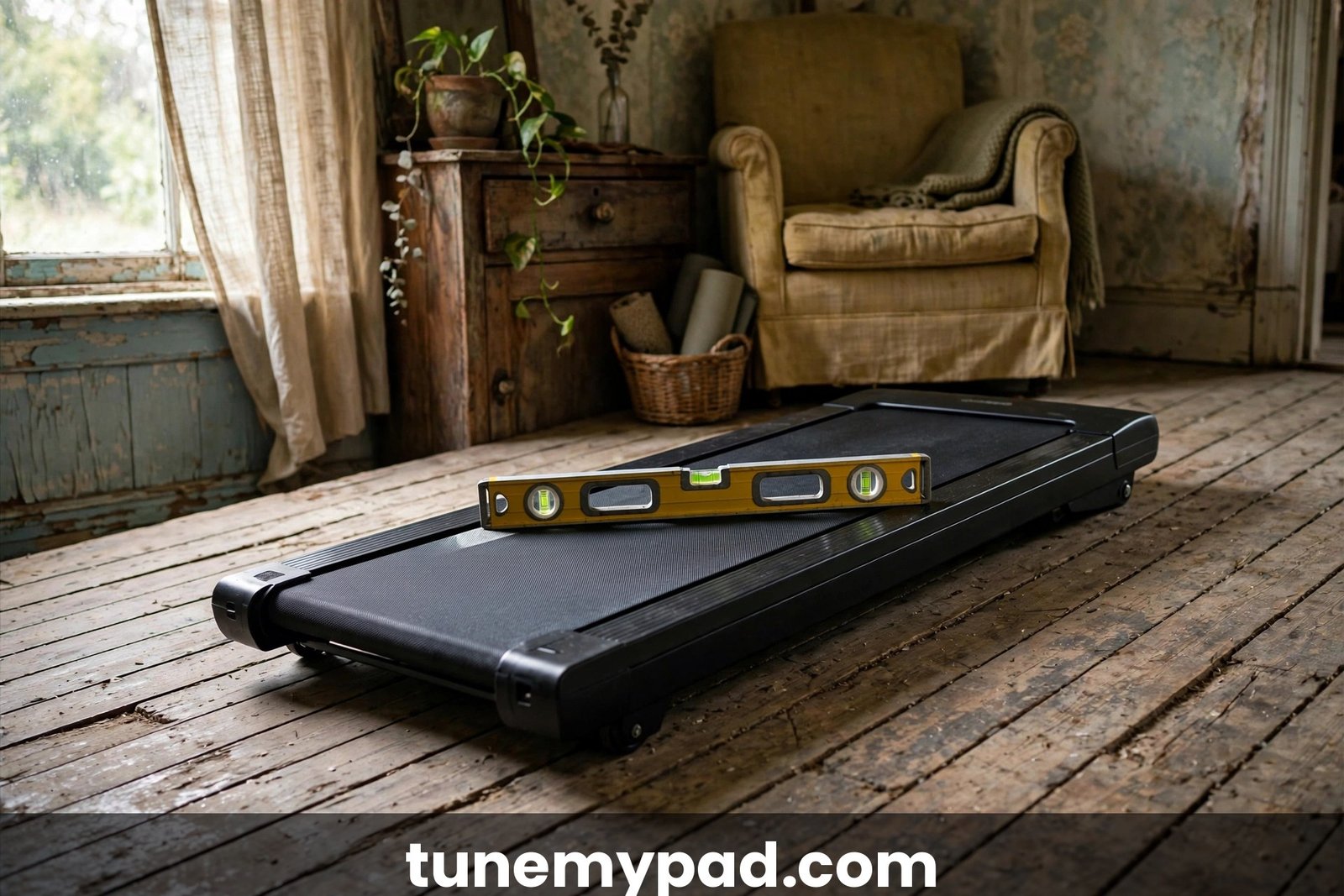
Your walking pad thumps with every step. The belt drifts to one side no matter how you adjust it. The whole frame rocks like a restaurant table with a short leg. If you’re using a walking pad on uneven floor, you’re not imagining it — an unlevel surface causes a cascade of problems that no amount of belt adjustment will fix, because the belt isn’t the problem. The floor is.
This guide shows you how to confirm the floor is the culprit, seven proven fixes ranked from free to serious, what long-term damage an uneven floor does to your pad, and how to set up a rock-solid walking station even in an old apartment with charmingly sloped floors.
Table of Contents
Quick Answer: Walking Pad on Uneven Floor
| Question | Answer |
|---|---|
| Can you use a walking pad on an uneven floor? | You can, but you shouldn’t long-term. Even a slight slope causes belt drift, extra noise, vibration, and accelerated wear on the belt and motor. |
| How level does the floor need to be? | Aim for the pad’s feet to sit solidly with zero rocking. A degree or two of slope is usually correctable with the pad’s adjustable feet and a mat. |
| What’s the fastest fix? | Move the pad to the flattest spot in the room (test with a marble or a level app), then fine-tune with the adjustable feet. |
| Will an uneven floor damage my walking pad? | Over time, yes — uneven loading wears the belt unevenly, strains the motor, and stresses the frame. It’s a slow killer, not an instant one. |
| Do I need a mat? | On any questionable floor, yes. A dense equipment mat compensates for minor unevenness and damps the vibration an uneven floor amplifies. |
Why an Uneven Floor Causes So Many Problems
A walking pad is a precision machine sitting on four (or six) small feet. When the floor under it isn’t flat, everything downstream suffers:
- Belt drift. Gravity pulls the belt toward the low side. You can center it with the adjustment bolts, but on a sloped floor it will always creep back — you’re fighting physics, not a misadjusted belt.
- Rocking and thumping. If one foot doesn’t touch the floor, every footstep rocks the frame and slams it back down. That thump travels straight through the floor to your downstairs neighbors.
- Amplified vibration and noise. An unlevel pad vibrates more, and vibration is noise. On a hard floor it rattles; on a suspended wood floor it booms.
- Uneven belt and deck wear. The belt loads harder on the low side, wearing one edge of the belt and deck faster. You’ll replace belts sooner.
- Motor and roller strain. The motor works harder to drive a belt that’s constantly climbing sideways, and the rollers bear uneven loads. Bearings wear unevenly and fail earlier.
- Inaccurate speed and distance. A belt fighting a slope doesn’t track speed the way the controller expects — your stats get noisier.
The maddening part: owners chase these symptoms with belt adjustments, lubrication, and new shoes, when the actual fix is under the pad’s feet. If you’ve been fighting a walking pad on uneven floor symptoms for weeks — drift you can’t tune out, thumps you can’t locate — always suspect the floor first, because the floor is the one component no adjustment bolt can compensate for.
How to Tell If Your Floor Is the Problem
Before buying anything, run these quick diagnostics:
- The wobble test. With the pad off, grab the frame and rock it diagonally. Any clunk or visible lift of a foot means the floor (or the feet) are uneven at that spot.
- The marble test. Place a marble or small ball on the bare floor where the pad sits. If it rolls, you’ve found your slope — and its direction.
- The phone level test. Lay your phone flat on the deck (pad off, belt still) and open a level app. Check both lengthwise and crosswise. More than about 1–2 degrees of slope is worth correcting.
- The move test. Slide the pad to a different spot — ideally a ground-floor concrete or tile area — and walk for five minutes. If the thumping, drift, or rocking disappears, the old spot’s floor was the problem. Diagnosis complete.
- The foot check. Flip the pad (unplugged, with help) and check that all adjustable feet are present, undamaged, and threaded properly. A missing or collapsed foot mimics an uneven floor perfectly.
If the pad rocks on every surface including a known-flat one, the frame itself may be twisted — that’s a warranty or support conversation, not a flooring project.
7 Proven Fixes for a Walking Pad on Uneven Floor
Fix 1: Move to the Flattest Spot in the Room
Free and often sufficient. Floors are rarely uniformly unlevel — the slope is usually worst near walls, doors, and transitions between flooring types, and flattest in the middle of the room or on concrete slabs. Use the marble test in three or four candidate spots and pick the winner. In apartments, also consider the downstairs-neighbor angle: the flattest spot that’s also over a load-bearing wall or away from bedrooms is ideal.
Fix 2: Level the Pad With Its Adjustable Feet
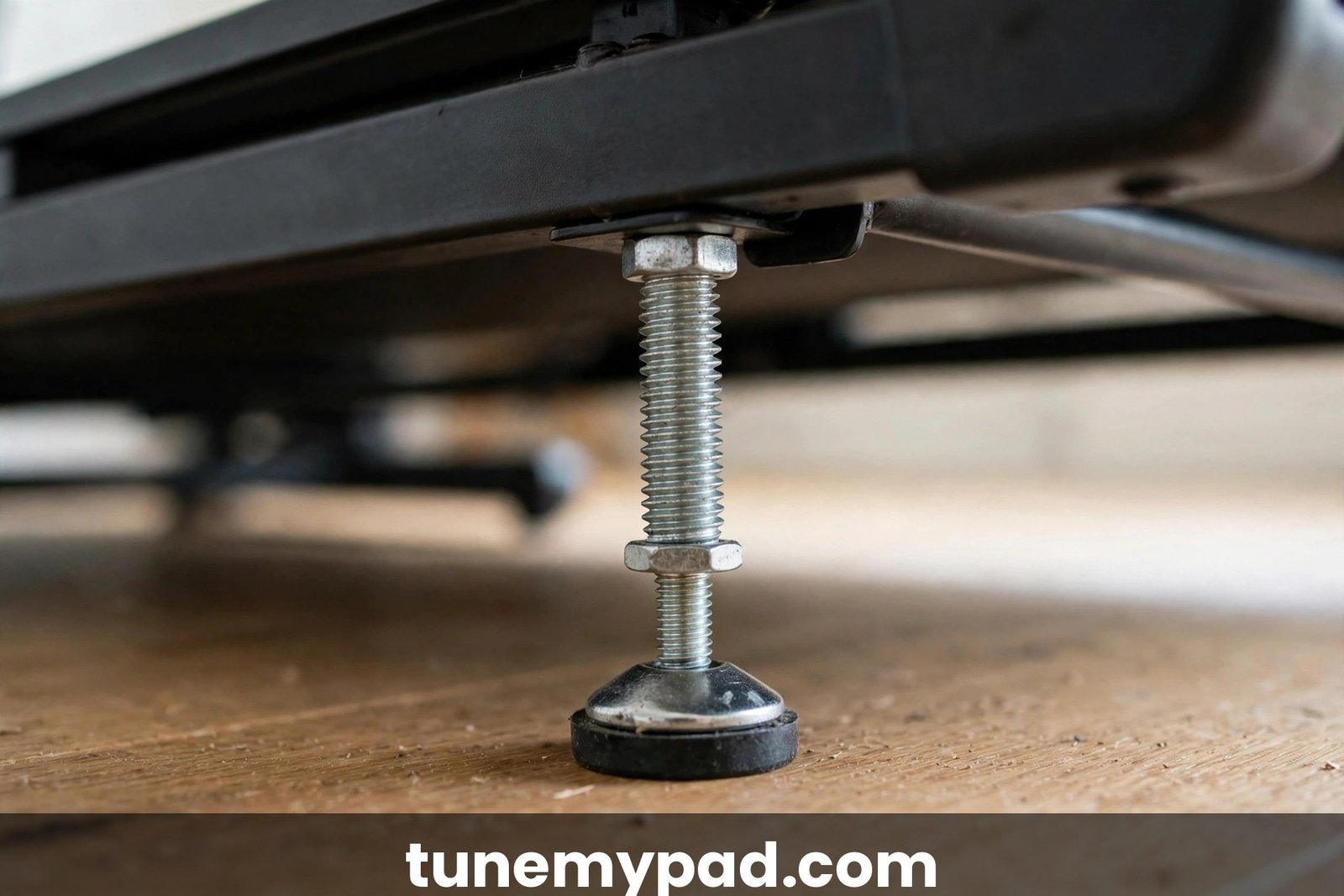
Most walking pads have threaded leveling feet — check your manual, because many owners never realize they exist. With the pad in position, screw the feet in or out until all feet bear weight evenly and the wobble test passes. Adjust in small increments and re-test; the goal is zero rocking, not a bubble-perfect level. Tighten any lock nuts on the feet afterward so vibration doesn’t walk them out of adjustment over weeks.
Fix 3: Put a Dense Equipment Mat Underneath
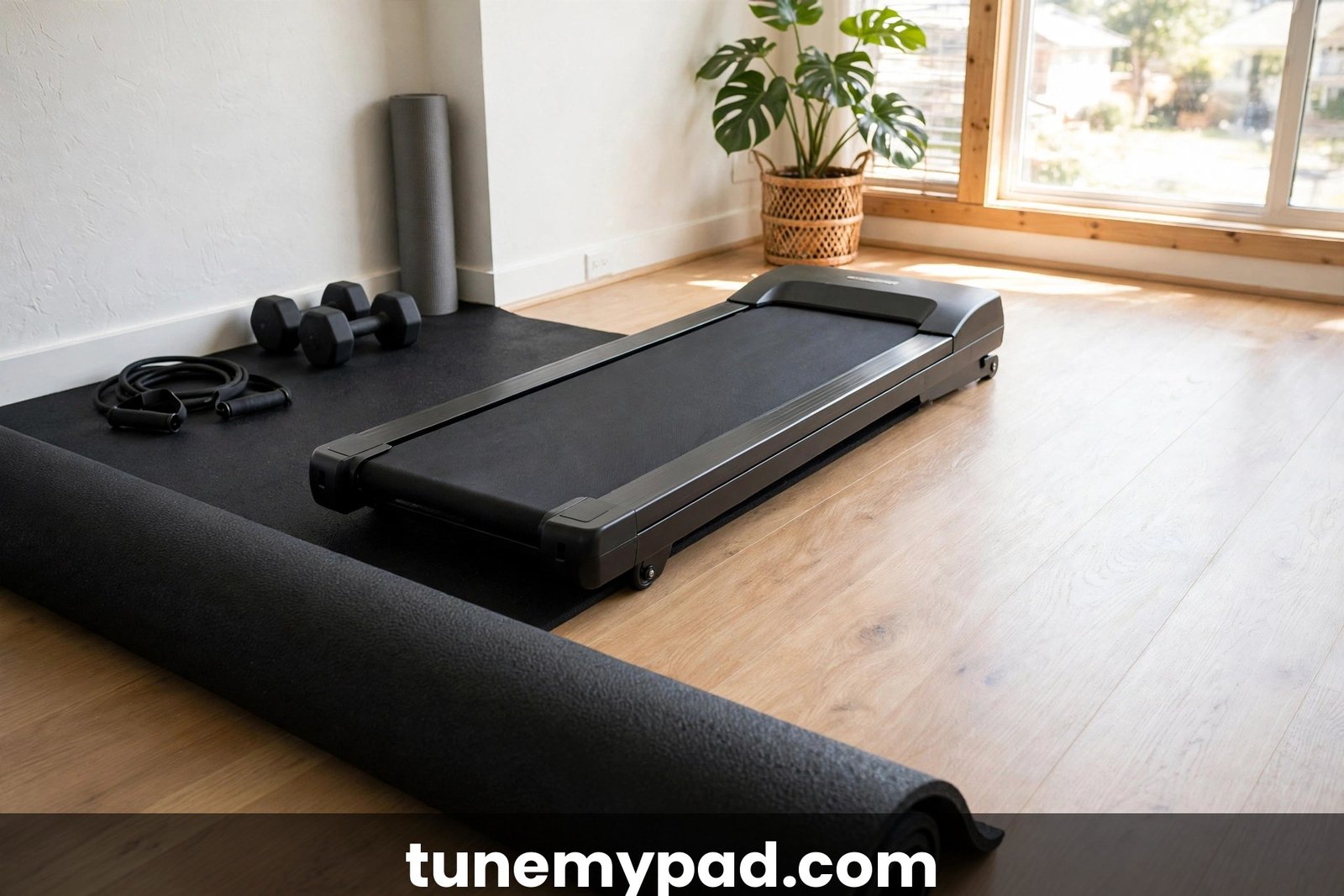
A 1/4- to 1/2-inch dense rubber mat does three jobs at once: it bridges minor dips and bumps in the floor, damps the vibration that an uneven floor amplifies, and protects the flooring itself. This is the single best purchase for a questionable floor. Avoid soft foam puzzle mats — they compress unevenly under load and can make rocking worse. You want dense, heavy rubber that stays put. (Our carpet guide covers mat selection for carpeted floors specifically.)
Fix 4: Shim With Purpose-Made Levelers
For a persistent low corner that the adjustable feet can’t fully correct, use hard rubber or composite shims — the wedge-shaped kind sold for furniture and appliances. Place the shim under the mat (not directly under the foot, where it can slip), and check stability afterward. What not to use: folded cardboard (compresses and molds), loose coins (migrate), or stacks of paper (a fire-adjacent bad idea near electronics — the Electrical Safety Foundation has good general guidance on keeping home workout areas electrically safe). Shims are a legitimate permanent fix when they’re the right material and they don’t move.
Fix 5: Tighten and True the Frame
Sometimes the “uneven floor” is actually a loosened frame. Vibration slowly backs out frame bolts, and a slightly racked frame rocks exactly like it would on a bad floor. Unplug the pad, then check every visible frame and foot bolt with the appropriate tool — snug, not gorilla-tight. If the frame was racked, loosening all frame bolts a half turn, setting the pad on a flat surface, gently squaring it by hand, and re-tightening in a cross pattern can true it up. Add bolt checks to your maintenance schedule.
Fix 6: Address the Room, Not Just the Pad
If the whole room slopes — common in old houses and converted attics — consider the bigger fix: an interlocking rubber tile platform. A 6×4-foot area of 3/4-inch rubber tiles creates a reliably flat, decoupled surface anywhere, and it also solves noise transmission in one move. It’s the “home gym floor” solution, and for a dedicated walking workstation it’s worth it. Rugs and carpet pads are not substitutes; they add softness, not flatness.
Fix 7: Build a Plywood Platform (The Nuclear Option)
For floors that defeat everything else — badly sloped garage slabs, heaved basement concrete — a 3/4-inch plywood sheet (cut slightly larger than the pad) on top of a rubber mat gives you a manufactured-flat surface. Shim the plywood itself level, then place the mat and pad on top. It’s ugly, it’s effective, and it lives happily in garages and basements where aesthetics don’t matter. Make sure the platform can’t slide: rubber mat underneath, and ideally the platform braced against a wall.
Symptom Decoder: What the Uneven Floor Is Doing to Your Pad
| Symptom | Floor-related cause | Fix to try first |
|---|---|---|
| Belt constantly drifts to one side | Gravity pulling the belt toward the low side | Fix 1 (move) + Fix 2 (level feet) |
| Rhythmic thump with every step | One foot lifting and slamming | Fix 2, then Fix 3 (mat) |
| Whole pad “walks” across the floor | Vibration on a hard, slick, sloped surface | Fix 3 (rubber mat anchors it) |
| Rattling or buzzing | Frame vibration amplified by hard uneven flooring | Fix 3 + Fix 5 (tighten frame) |
| Squeaking that comes and goes | Frame flexing as it rocks | Fix 2 + Fix 5 |
| One side of the belt wearing faster | Uneven loading from the slope | Level properly, then monitor; rotate/replace belt per belt guide |
What an Uneven Floor Does to Your Pad Long-Term
None of this kills a pad in a week. But months of walking on a slope quietly tax everything:
- Belt life shortens. Uneven edge loading wears one side of the belt and deck faster — expect earlier replacement.
- Motor runs hotter. Constant sideways belt drag is extra load the motor wasn’t sized for. Heat is the enemy of motor lifespan.
- Bearings wear unevenly. Rollers loaded on one side develop play sooner, which then causes its own noise and drift — a vicious cycle.
- Frame fatigue. Thousands of rocking cycles flex the frame at the hinge and joints. Metal fatigue is cumulative and invisible until something cracks.
- Electronics suffer. Vibration is the enemy of solder joints and connectors; an unlevel pad vibrates more, full stop.
This is why “it works fine, it’s just a bit wobbly” is a trap. The pad compensates until it can’t, and the repair bill arrives all at once. Leveling is preventive maintenance with a real return.
Apartment Special: Uneven Floors and Downstairs Neighbors
Old apartment buildings combine the two worst traits: sloped wood floors and neighbors below who hear everything. If that’s your situation, prioritize in this order:
- Flattest spot first — often the middle of the room, away from the walls where old floors sag most.
- Dense mat, non-negotiable — it’s doing double duty as leveler and soundproofer.
- Walking shoes with soft soles for pad sessions, or clean socks — hard soles on a rocking frame are the worst noise combination.
- Reasonable hours — no fix fully silences a pad on a bad floor at midnight. See our full guide on not bothering downstairs neighbors.
If your building’s floors are dramatically sloped (marble rolls fast), talk to your landlord — severe slope can indicate structural settling worth documenting anyway.
The 15-Minute Level Setup Routine (Do This Once)
Here’s the whole process as a single routine. Do it once when you first place the pad, and repeat briefly every few months:
- Pick the spot (3 min). Marble-test three candidate locations; choose the flattest. Keep clearance in mind — you need open space behind the pad for safe dismounts.
- Lay the mat (2 min). Dense rubber, larger than the pad’s footprint, on clean dry flooring.
- Place and wobble-test (2 min). Set the pad down, grab the frame diagonally, and rock. Note which foot lifts.
- Adjust the feet (5 min). Thread the low-side feet out (or high-side feet in) in small increments, re-testing after each adjustment, until zero rocking in both diagonal directions.
- Lock and verify (2 min). Tighten foot lock nuts, then walk for two minutes at your normal speed. Listen for thumps, watch for drift.
- Phone-level check (1 min). Confirm under ~2 degrees both directions for your records — if drift appears months later, re-check against this baseline to see what moved.
Write the date on a sticky note under the desk. When the pad starts drifting in six months, you’ll know whether the floor settled, the feet walked loose, or the belt itself is wearing — because you have a baseline.
Frequently Asked Questions
How do I level a walking pad on uneven floor if it has no adjustable feet?
Use the mat + shim approach: a dense rubber mat with composite shims under the low side, placed under the mat so nothing slips. Check stability carefully — without threaded feet you have less fine control, so verify zero rocking before every few sessions until you’re confident it’s settled.
Will the belt keep drifting even after I level the pad?
Once the pad is truly level, re-center the belt per your manual and it should stay put. If drift returns within days on a level pad, the belt itself may be worn unevenly from its time on the slope — inspect for one-sided wear and consider replacement.
Can I use a walking pad on a sloped driveway or patio?
Occasional use on a mild slope is fine if the pad doesn’t rock, but don’t make it permanent: weather, moisture, and temperature swings damage pads stored outside, and most manuals specify indoor use. A slight slope for one session won’t hurt; a season of it will.
Is a wobbling walking pad dangerous?
A mild rock is mostly an annoyance and a wear issue. A severe wobble — feet visibly leaving the floor — is a fall risk, especially at higher speeds or when distracted by work. The U.S. Consumer Product Safety Commission (cpsc.gov) records thousands of treadmill injuries every year, many involving falls — a stable, level setup is basic prevention. Fix the wobble before it throws you off balance mid-stride.
Do I need a professional to level my floor?
For the pad, no — the fixes above handle anything a walking pad cares about. If your floor’s slope is severe enough to bother furniture and doors too, that’s a house problem worth a contractor’s opinion, but the pad just needs its own flat island.
My pad is level but still noisy. What else could it be?
Belt tension and lubrication are the next suspects — a dry or over-tight belt is loud on any surface. Check your maintenance schedule before concluding the floor is still at fault.
Conclusion
A walking pad on uneven floor is one of those problems that disguises itself as five other problems — belt drift, thumping, noise, vibration, premature wear — until you look down at what’s under the feet. And because the symptoms mimic belt and motor issues so convincingly, owners waste money on the wrong fixes for months before discovering the floor was guilty all along. The diagnostic is free (marble, phone level, wobble test), the most common fixes are free (move it, adjust the feet), and the best purchased fix (a dense rubber mat) pays for itself in belt life alone.
Level the pad, mat it, tighten the frame, and re-check every few months — floors settle, feet walk loose, and mats compress. Ten minutes of attention per season keeps the pad quiet, the belt centered, the neighbors happy, and the machine running years longer than a wobbly setup ever would. Your future self will thank you every silent step of the way.