
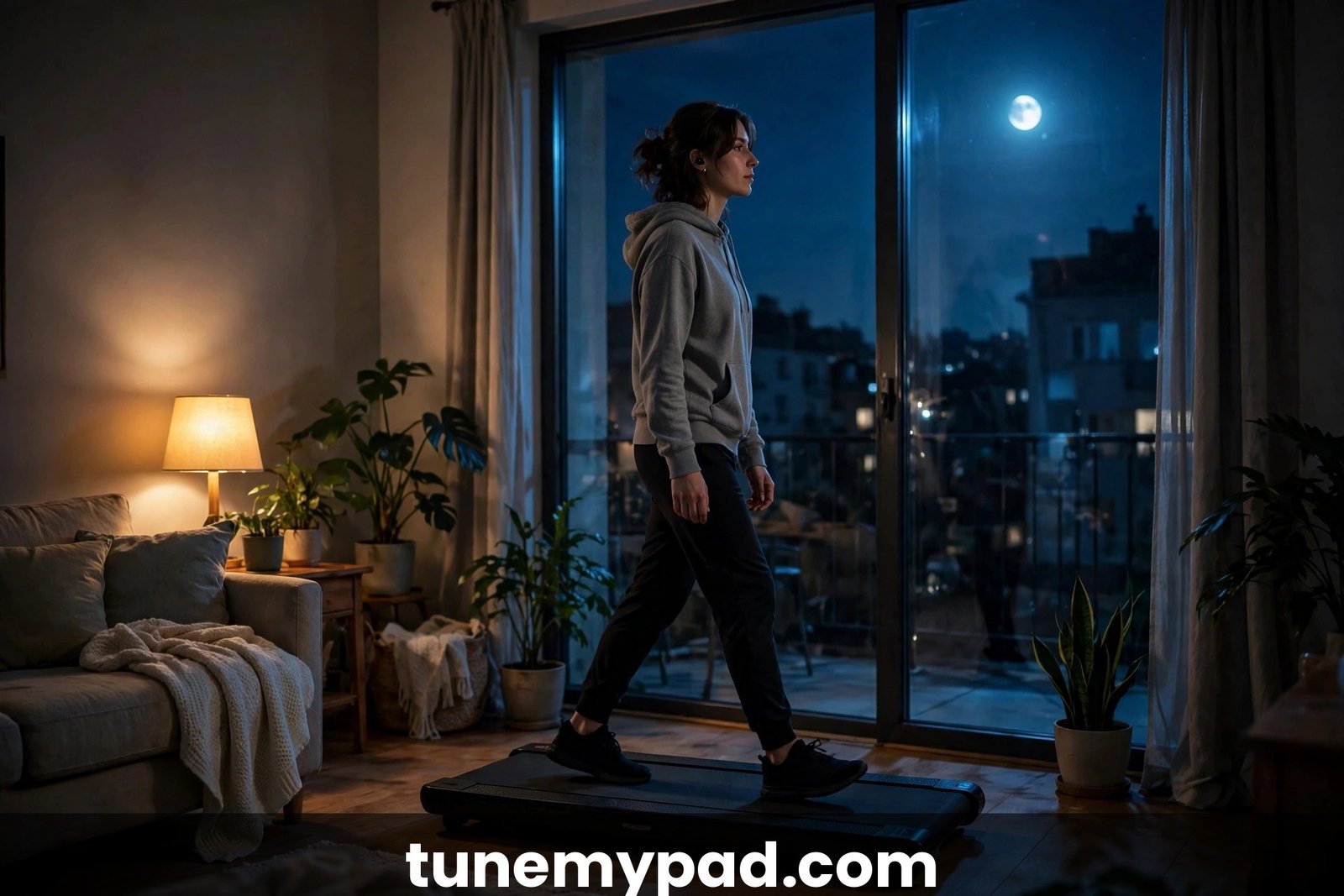
The “walking pad late at night apartment” question comes up constantly — is it really OK to work out at 11 pm while your neighbors sleep? It feels like the perfect life hack: the day’s finally yours, the apartment is quiet, and you can bank steps while everyone sleeps. But it’s also the highest-risk time to use one: ambient noise drops to near zero after 10 pm, so every thump carries further, and your downstairs neighbor is lying directly under your workout trying to sleep.
The good news? A walking pad late at night apartment routine is absolutely doable — it just needs a different playbook than daytime training. This guide covers the quiet setup, the ideal low-noise routine, what to avoid after dark, and how late-night exercise affects your sleep.
Table of Contents
Quick Answer: Walking Pad Late at Night Apartment
| Question | Answer |
|---|---|
| Is it OK to walk at 11 pm in an apartment? | Yes — at 2 mph or under, on a mat, in socks, with all beeps muted. |
| What’s the quietest setup? | Foam tiles + treadmill mat + socks + 1.5–2 mph + a freshly lubricated belt. |
| Will it ruin my sleep? | Gentle walking is sleep-neutral or sleep-positive; vigorous late exercise isn’t. |
| How late is too late? | Finish by 10–11 pm; keep post-midnight sessions to 15 gentle minutes. |
| Should I warn my neighbor? | Yes — one friendly heads-up prevents most conflicts. |
Walking Pad Late at Night Apartment: Why Night Is Different
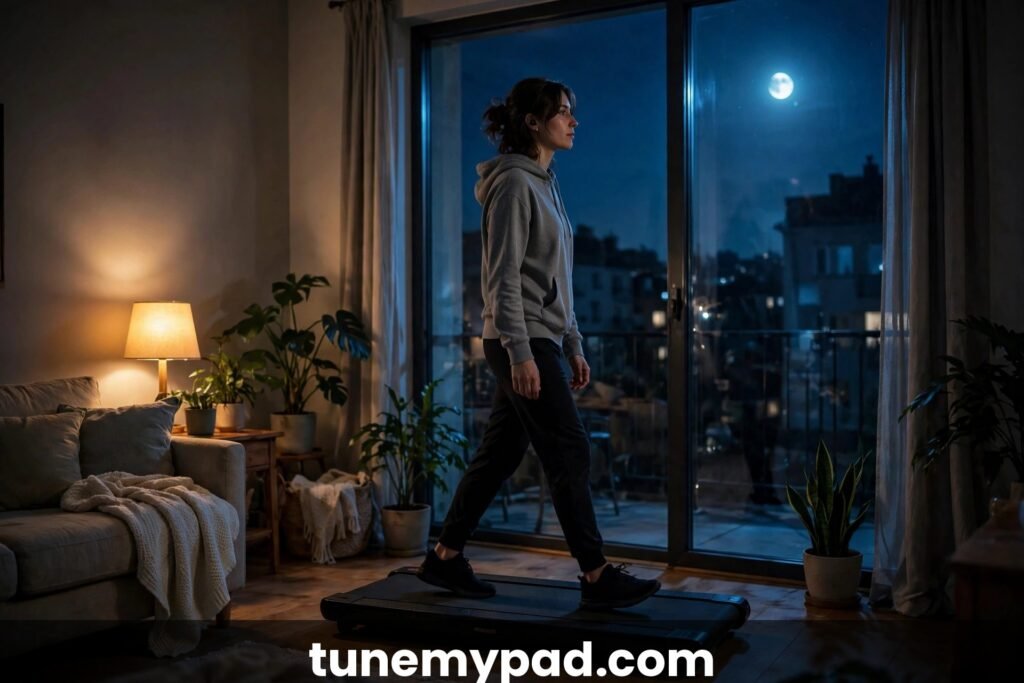
By day, your pad competes with traffic, TVs, and building hum — background noise around 40–50 dB. At night that drops toward 30 dB: the pad didn’t get louder, the apartment got quieter. The same 2.5 mph walk that’s inaudible at 2 pm can read as a distinct thump at 11:30 pm.
Impact sound is the specific problem. Research on apartment noise annoyance shows that impulsive sounds — short, repeating thuds like footsteps — are perceived as far more annoying than steady sounds at the same volume, and they travel through floor structures with ease. That’s why the walking pad late at night apartment playbook starts with isolation, not speed. At night, when your neighbor’s brain is listening for exactly that kind of intrusion, even a well-set-up pad needs extra care.
None of this rules out a walking pad late at night apartment workout. It means the late-night rules are stricter: slower speeds, better isolation, shorter sessions, and zero surprises.
Walking Pad Late at Night Apartment: The Quiet Setup Checklist
Do this once, and every walking pad late at night apartment session stays peaceful:
- Double up floor isolation. The night stack: EVA foam tiles on the floor, dense treadmill mat on top, pad on top. Foam decouples vibration; the mat absorbs impact. On concrete you can often skip the foam; on wood framing, don’t.
- Mute everything. Remote beeps, app chimes, the pad’s startup jingle — silence them all before your first night session. Fumbling with settings at midnight while the pad beeps is exactly the scenario that wakes people.
- Prep your entertainment silently. Headphones in, show queued, phone on silent. No speaker audio, ever, after quiet hours start.
- Wear socks or the softest shoes you own. Hard soles slapping the belt is the single most avoidable late-night noise. Socks win.
- Position away from bedrooms — theirs and yours. Avoid walking directly over your downstairs neighbor’s bedroom, and use the living area if your bedroom shares a neighbor’s wall.
- Lubricate and de-squeak proactively. A belt that’s silent at noon can develop a faint squeak by evening as it warms and cools. Keep it lubricated and fix any squeak the moment it appears — at night, minor noises become major ones.
Night-Noise Measures, Ranked by Impact
| Measure | Noise reduction | Cost / effort |
|---|---|---|
| Foam tiles + treadmill mat stack | High — decouples vibration and absorbs impact | ~$40–60, one-time setup |
| Drop speed to 1.5–2 mph | High — impact energy falls steeply with pace | Free |
| Socks instead of hard shoes | Medium — removes sole slap from every step | Free |
| Mute all beeps and chimes | Medium — eliminates startling night sounds | Free, 2 minutes |
| Fresh belt lubrication | Low–medium — kills squeaks before they start | ~$10, quarterly |
The Ideal Walking Pad Late at Night Apartment Routine
Forget intervals and intensity after dark. A walking pad late at night apartment session has one job: gentle movement that burns off the day without spiking your heart rate, your noise, or your alertness before bed.
The 30-Minute Night Wind-Down Walk:
- Minutes 0–5: 1.2 mph — barely moving. Let your body shift gears from the day. This is also your noise check: if you can hear thump through the floor at this pace, something in your setup needs fixing before you go faster.
- Minutes 5–20: 1.8–2.2 mph — easy conversational pace. Walk while watching a show, reading, or listening to a podcast. Your heart rate stays low, your footsteps stay soft, and the belt hum stays in the background.
- Minutes 20–25: 1.5 mph — begin easing down. Start your mental shutdown: dim the lights if you can, switch to calmer content.
- Minutes 25–30: 1.0–1.2 mph — cool-down stroll. Step off, stretch calves and hip flexors for two minutes (they tighten with desk work), and you’re done.
Total: about 1.2–1.5 miles, 2,500–3,500 steps, near-silent. Done by 11 pm, in bed by 11:30, with none of the tossing and turning that follows intense late exercise. This is the routine that makes a walking pad late at night apartment setup genuinely sustainable.
The even-quieter 15-minute version: if it’s past midnight or you’re unsure about noise, do minutes 0–5 and 20–30 of the above back to back — 5 minutes at 1.2 mph, 10 minutes at 1.8 mph, done. Fifteen gentle minutes still beats zero, and at these speeds the pad is barely louder than walking to the kitchen.
What to Avoid After Dark
- Intervals and speed work. The jump from 2 to 4 mph roughly quadruples the impact energy your floor feels. Save the hard sessions for daytime — your neighbors and your sleep will thank you.
- Jogging or running. Even on a hybrid pad, running at night in an apartment is a neighbor complaint with extra steps. Walk only after quiet hours.
- New routines or max tests. Night is for the familiar and easy. Testing your top speed at 11 pm is how you discover both your limits and your neighbor’s patience simultaneously.
- Long sessions. Keep night walks to 15–30 minutes. Longer sessions mean more cumulative noise exposure for anyone below you, and diminishing returns for your sleep.
- Bright screens and intense content. A true-crime documentary at full brightness keeps your brain wired. Save stimulating content for daytime walks.
Late-Night Exercise and Sleep: What the Science Says
The old “never exercise before bed” advice has softened: research consistently finds light-to-moderate evening exercise doesn’t harm sleep quality for most people. The catch is intensity and timing:
- Gentle walking (like the routine above) is sleep-neutral or sleep-positive, even within an hour of bed. It lowers stress and body tension without spiking core temperature or adrenaline.
- Vigorous exercise within 1–2 hours of bedtime can delay sleep onset in some people, partly through elevated core body temperature and alertness. That’s another reason night sessions stay easy.
- Keep the lights low. Bright overhead light during a night walk suppresses melatonin more than the walking itself helps. Use a lamp, not the ceiling lights.
- Finish with a real wind-down. Step off the pad at least 20–30 minutes before you intend to sleep. Stretch, dim everything, and let your heart rate settle — don’t walk straight into bed.
If you consistently sleep worse on nights you walk, try moving the session earlier — a walking pad evening routine after dinner is ideal — or shortening it. Individual responses vary, and your sleep data, however you track it, outranks any general guideline.
If Late Night Is Your Only Window
Some people genuinely can’t train during the day — night shifts, kids, long commutes. If late night is your only window, your walking pad late at night apartment plan needs to be sustainable, not just quiet:
- Invest in the isolation stack once (foam + mat) rather than fighting noise nightly.
- Have the neighbor conversation proactively. “I work late and walk gently on a pad around 10:30 — please tell me if you ever hear it” prevents 90% of conflicts. People forgive noise they were warned about far more readily than noise that surprises them.
- Keep a consistent schedule. A predictable 30 minutes at 10:30 pm is far less annoying than random sessions at odd hours — routine noise becomes background.
- Consider your building honestly. In a concrete high-rise, you’re fine; in a creaky wood-frame walk-up with a light sleeper below, even a perfect setup has limits — early morning may be kinder. See our downstairs-neighbor guide.
Walking Pad Late at Night Apartment: FAQs
Is it OK to use a walking pad at 11 pm in an apartment?
Yes, if you keep it gentle: 2 mph or under, on a mat (ideally foam + mat on wood floors), in socks, with everything muted. Most buildings’ quiet hours restrict loud noise, not all activity — a quiet walk is comparable to normal apartment living sounds. When in doubt, ask your downstairs neighbor once. A walking pad late at night apartment session is fine when the setup respects quiet hours.
How can I make my walking pad quieter at night?
The night stack in order of impact: (1) foam tiles under your treadmill mat, (2) drop to 1.5–2 mph, (3) socks instead of shoes, (4) mute all beeps and chimes, (5) make sure the belt is freshly lubricated. Each step is small; together they’re transformative.
Will walking before bed keep me awake?
For anyone on a walking pad late at night apartment schedule, the answer is reassuring: gentle walking usually doesn’t keep you awake — and often helps you unwind. The risk comes from vigorous exercise close to bedtime, bright lights, and stimulating content, not from easy movement itself. Keep the session light, the lights low, and finish 20–30 minutes before sleep.
What’s the latest I should use a walking pad in an apartment?
For any walking pad late at night apartment routine, finish by the time your building gets truly quiet (often 10–11 pm), and keep post-midnight sessions to 15 gentle minutes max. Consistency at a reasonable hour beats heroic late sessions.
Should I tell my neighbor I walk late at night?
If you follow a walking pad late at night apartment schedule, one brief, friendly heads-up is the highest-value move. It frames you as considerate, gives them permission to raise issues early, and defuses the surprise factor that turns minor noise into major grievances. Most neighbors will simply say “I never hear it.”
Is walking or standing better for late-night desk work?
Walking at 1–1.5 mph beats standing still for late sessions: it keeps blood flowing and alertness up without the leg fatigue and fidgeting that standing produces. Just keep the pace genuinely slow — this is about staying awake and moving, not training.
Walking Pad Late at Night Apartment: The Decibel Reality Check
“Quiet” is meaningless without numbers. Here’s what a walking pad late at night apartment session actually measures, and what your neighbor hears through the floor:
| Sound source | Typical level | What it compares to |
|---|---|---|
| Quiet apartment at night (ambient) | ~30 dB | Whisper-quiet room |
| Walking pad motor at 2 mph | ~40–45 dB | Quiet library |
| Footsteps on belt, socks, on mat | ~45–50 dB at the pad | Moderate rainfall |
| Footsteps transmitted downstairs (wood frame) | ~35–45 dB in their room | Noticeable in a 30 dB room |
| Footsteps transmitted downstairs (concrete) | ~30–35 dB in their room | Nearly masked by ambient |
| Hard shoes, no mat, 3+ mph | 55–65 dB transmitted | Normal conversation — complaint territory |
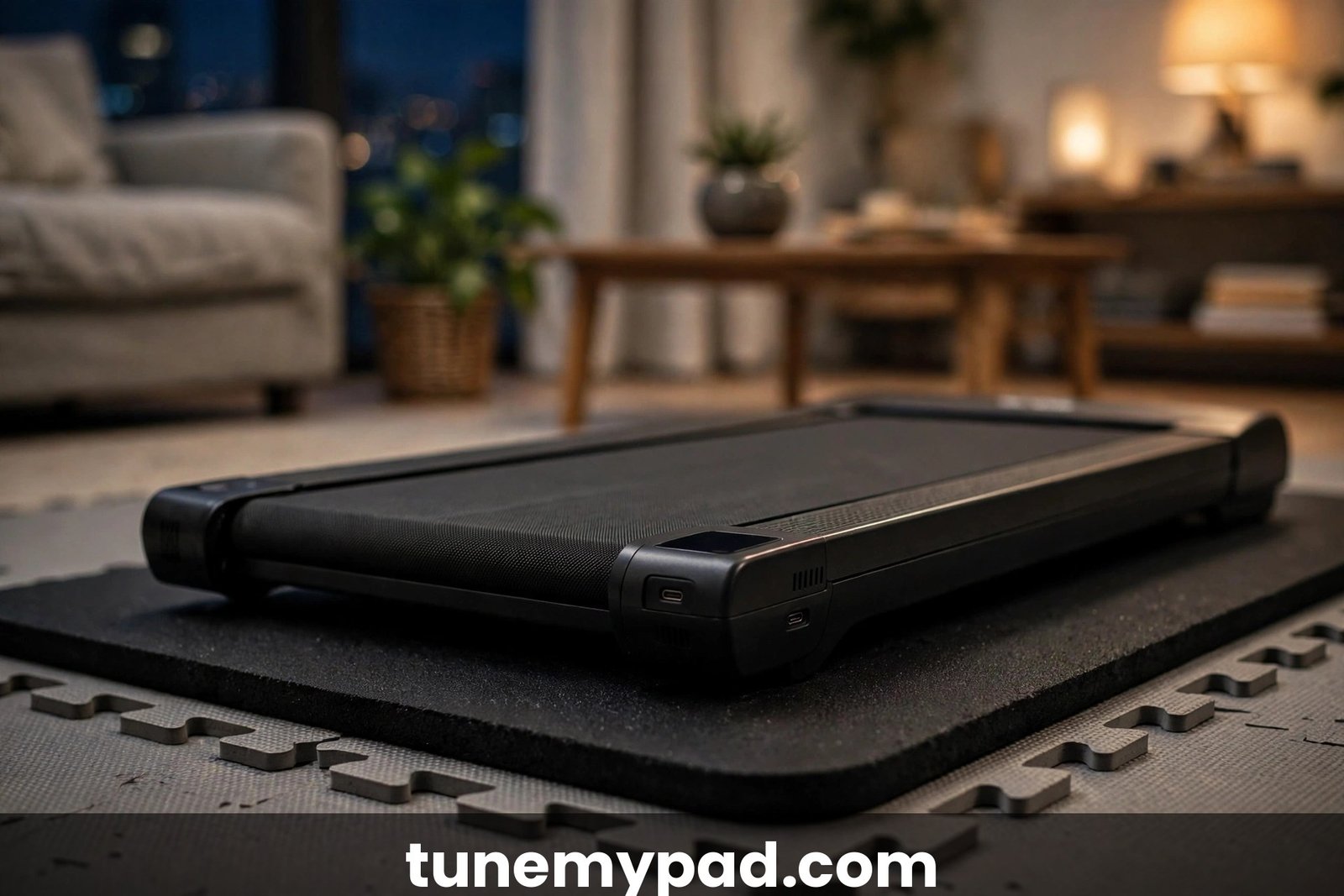
The key insight: your building’s construction matters more than your pad’s spec sheet. On concrete, almost any walking pad late at night apartment setup is fine; on wood framing, the transmitted thump is the whole game, and the foam-plus-mat stack plus socks plus 2 mph is what keeps you in the 35–40 dB zone where most sleepers never notice.
Want real numbers for your setup? Free phone decibel apps are accurate within a few dB — enough for this purpose. Measure at the pad, then have a friend measure in the room below (or yours, with the pad running upstairs if you’re testing). If the downstairs reading stays within ~10 dB of ambient, your walking pad late at night apartment routine is genuinely neighbor-safe.
Walking Pad Late at Night Apartment: 4-Week Quiet-Hours Plan
Don’t start with 30-minute sessions on night one. This ramp lets you verify noise, build the habit, and protect your sleep:
| Week | Session | Goal |
|---|---|---|
| Week 1 | 10 min at 1.5 mph, 3 nights | Noise audit — confirm the setup is silent enough before committing |
| Week 2 | 15 min at 1.8 mph, 4 nights | Neighbor check-in: ask downstairs if they’ve heard anything |
| Week 3 | 20 min at 2.0 mph, 5 nights | Build the wind-down ritual — same time, same show, same stretch after |
| Week 4 | 25–30 min at 2.0 mph, nightly | Full routine; by now it’s just what your evenings look like |
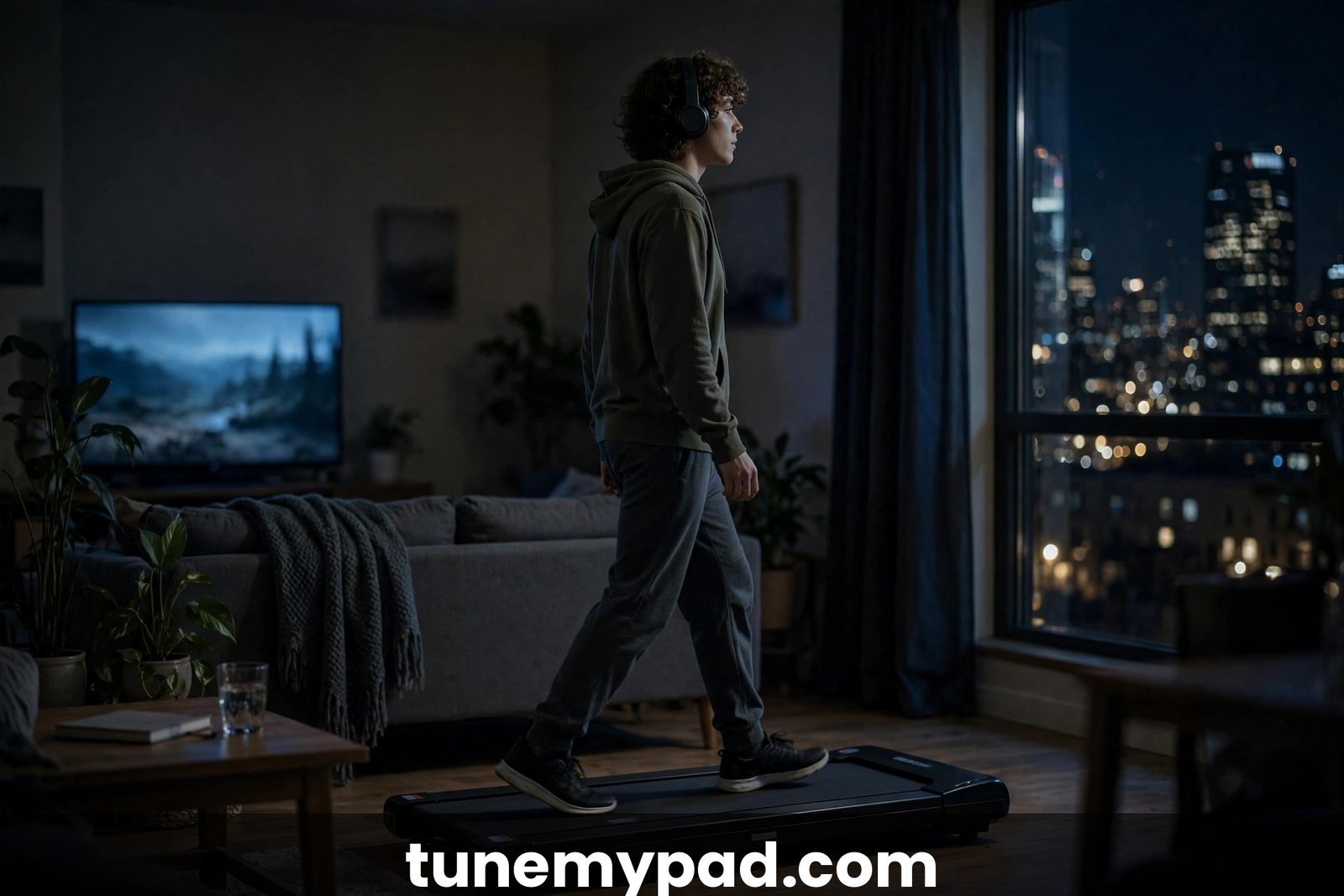
The week-2 neighbor check is the highest-value step in the whole plan. Knock, smile, and ask: “I walk gently on a treadmill pad some evenings around 10:30 — have you heard anything?” If they say no, you have a green light and goodwill banked. If they say yes, you learn exactly what to fix while it’s still a small issue. Either way, a walking pad late at night apartment habit built on that conversation survives; one built on hope doesn’t.
Finally, keep a simple log for the first month: date, minutes, speed, and a 1–5 sleep-quality score the next morning. If sleep scores hold steady or improve, your walking pad late at night apartment routine is working exactly as intended — and you have data to prove it the next time anyone questions the habit.
Can my downstairs neighbor hear my walking pad through concrete floors?
Almost certainly not at walking speeds with a mat. Concrete slabs transmit very little impact sound — a walking pad late at night apartment session on concrete typically reads near ambient levels downstairs. Wood-frame buildings are the opposite: they transmit thumps efficiently, which is why the foam-tile-plus-mat stack matters so much there. Know your building type before worrying.
Is it better to walk late at night or early in the morning?
For neighbors, early morning (after 7–8 am) is slightly kinder — ambient noise is higher and everyone’s awake. For your body, it barely matters; gentle walking is fine at either end of the day. Choose based on your schedule and sleep: if a walking pad late at night apartment session leaves you alert at midnight, shift it to the morning. Consistency at the hour you’ll actually keep beats theoretical optimization.
Do I need a special mat for nighttime walking pad use?
Not a special one — just a good one, ideally doubled up. The proven walking pad late at night apartment stack is interlocking EVA foam tiles on the floor with a dense treadmill mat on top, pad on top of that. The foam decouples vibration from the floor structure; the mat absorbs the footfall impact. Together they cost $40–60 once and solve the problem permanently.
Conclusion
A walking pad late at night apartment routine is one of the best uses for the machine — if you respect the night rules. Slow down to 2 mph or less, double up your floor isolation, mute everything, wear socks, keep sessions to 15–30 gentle minutes, and give your neighbor one friendly heads-up. Do that, and the night walk becomes the most peaceful part of your day: steps banked, stress burned off, nobody woken, sleep intact. Save the intervals for daylight — and let your walking pad late at night apartment routine become the habit you look forward to most.
External References
- NPR’s NEAT explainer — why easy walking through the day compounds.
- ASA impact-sound research summary — why nighttime thumps carry and annoy.
- Tom’s Guide’s WalkingPad Z1 review — independent real-world noise measurements.