
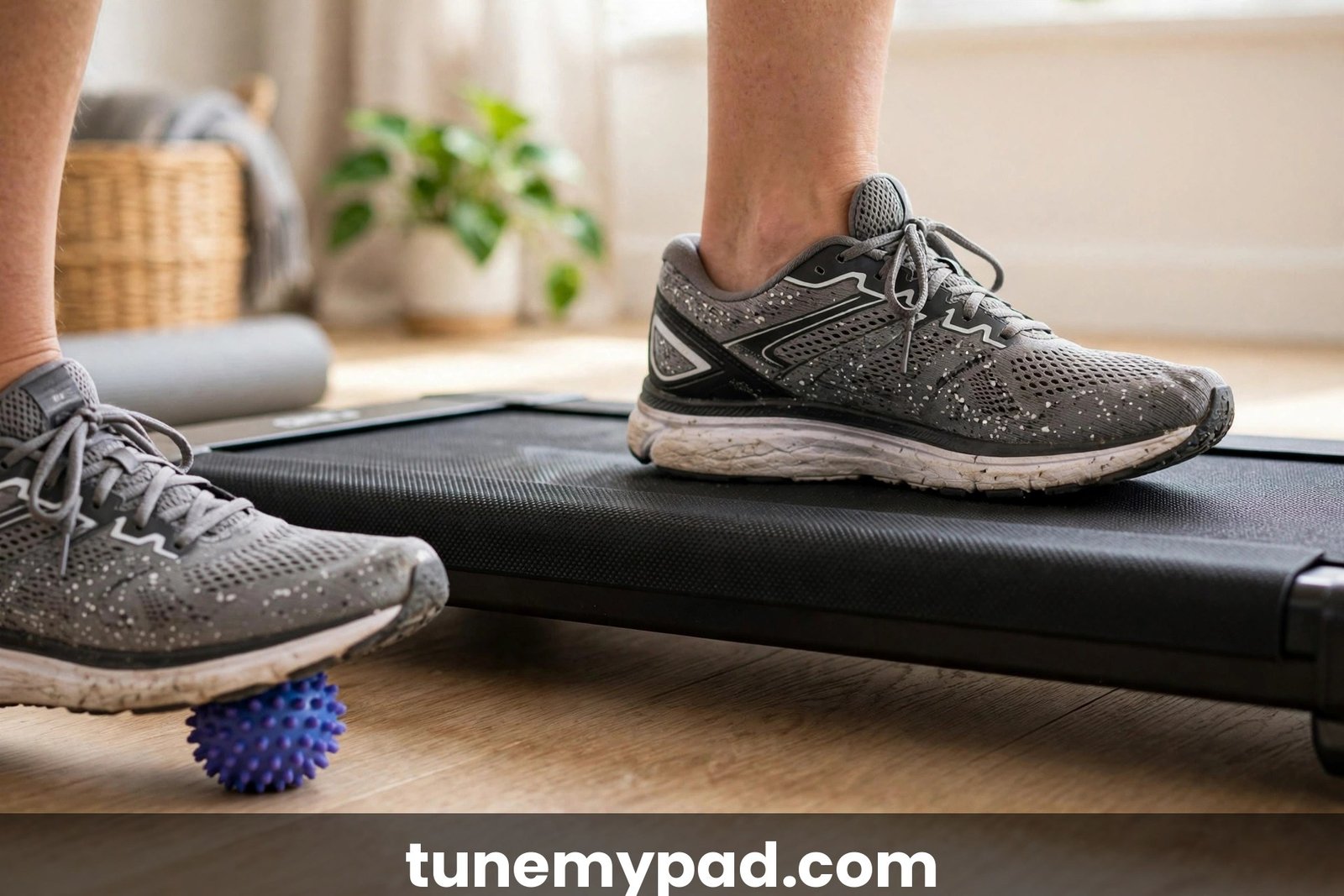
If your heel stabs with each morning’s first steps and you are wondering whether a walking pad for plantar fasciitis is a smart move or a fast track to more pain, you are asking the right question. The honest answer: gentle walking on a pad is often helpful — but only at the right dose, with the right shoes. Too fast, too long, or barefoot, and the same pad that could aid recovery will set you back weeks.
This complete walking pad for plantar fasciitis guide explains what plantar fasciitis actually is, when a walking pad is appropriate, the speed and duration limits that keep you safe, why footwear matters more than the machine, a complete warm-up and stretch program, a week-by-week recovery protocol, the best inserts and support options compared, taping and night-splint strategies, and the red flags that mean stop and see a podiatrist.
Important: This article is for general information only and is not medical advice. Foot pain has many causes, and only a doctor or podiatrist can diagnose yours. If your heel pain is severe, worsening, or has not improved after a couple of weeks of sensible care, get it evaluated in person before continuing to walk on it.
Table of Contents
Quick Answer: Walking Pad for Plantar Fasciitis
| Question | Answer |
|---|---|
| Short answer | Yes, usually — a walking pad for plantar fasciitis is commonly fine and may even aid recovery, with the right shoes and limits. |
| Safe speed | 1.5–2.0 mph — slow and comfortable, never brisk or power-walking. |
| Session length | 10–20 minutes to start; stop if heel pain rises above mild. |
| Frequency | Every other day at first; daily only once pain stays stable. |
| Golden rule | Supportive shoes with inserts on the pad — never barefoot or in flat socks. |
| When to skip | Sharp or worsening pain, acute flare-ups, swelling, or pain that increases during the walk. |
What Is Plantar Fasciitis, Exactly?
The plantar fascia is a thick band of tissue along the bottom of your foot, from heel to toes, supporting your arch and absorbing impact with every step. Plantar fasciitis means that tissue has become irritated — typically from micro-tears caused by overload, not from a single injury.
The hallmark symptom is unmistakable: a stabbing heel pain, worst with the first steps after getting out of bed or after sitting a long time. It often eases as the foot “warms up,” then returns after long standing or walking. Common contributors include tight calves, flat feet or high arches, sudden increases in walking time, unsupportive footwear, and extra body weight. If you are researching a walking pad for plantar fasciitis, knowing your foot type helps you choose the right inserts from the comparison table below.
Here is the part that matters for this guide: plantar fasciitis is an overload problem. The question is never really “is walking allowed?” — it is “how much walking, at what intensity, with what support, does this foot tolerate today?” That framing is exactly why a walking pad for plantar fasciitis can work so well: the dose is fully under your control.
Can You Walk on a Walking Pad With Plantar Fasciitis?
For mild to moderate cases, most clinicians consider gentle walking acceptable — and walking pad for plantar fasciitis use has genuine advantages for an irritated foot:
- A flat, predictable surface. No curbs, slopes, gravel, or surprise potholes forcing your foot into awkward angles.
- Exact speed control. You can lock in a slow 1.8 mph and hold it, instead of drifting faster the way people do outdoors.
- Instant bail-out. The moment pain rises, you stop. There is no “but I still have to walk home” problem.
- A slightly forgiving belt. Most walking pad belts have a little more give than concrete or asphalt.
The risks are real but manageable: walking too fast or too long, walking daily before the tissue is ready, or — the classic mistake — walking barefoot or in flat socks because “it’s just the pad at home.” The machine is not the enemy. The dose and the footwear are.
The Surprising Part: Why Gentle Walking Often Helps Recovery
Counterintuitively, complete rest is not always the fastest route out of plantar fasciitis. Many podiatrists favor relative rest — avoiding aggravating loads while keeping the foot moving — because gentle movement brings blood flow to tissue with limited circulation, keeps the fascia supple instead of letting it decondition, and works the calves through their range. There is also a behavioral spiral to avoid: foot pain leads to less movement, which leads to weight gain and weaker feet, which loads the fascia more.
The operative word is always gentle. This is progressive loading, not pushing through pain. If a walk leaves your heel worse the next morning, the dose was too high — scale back, don’t grit your teeth. Used this way, a walking pad for plantar fasciitis becomes a rehab tool: measurable, repeatable, and adjustable to the milligram of effort.
The Rules: Speed, Duration and Surface Limits
Follow these limits and a walking pad for plantar fasciitis stays firmly in the helpful zone:
| Parameter | Guideline |
|---|---|
| Walking speed | 1.5–2.0 mph — slow and conversational; verify the display with our speed calibration guide |
| Session length | 10–20 minutes, especially in the first weeks |
| Frequency | Every other day at first; daily only if pain is stable or improving |
| Pain rule | Mild discomfort during the walk is acceptable (about 3/10 or less); pain that rises during the walk means stop |
| Morning-after check | Heel pain the next morning should be no worse than baseline; if it is, halve the next session |
| Belt condition | Keep the belt clean and lubricated — a dry, jerky belt jars the foot; follow our maintenance schedule |
The morning-after check is the single most useful metric: fascia pain often lags a day behind the activity that caused it, so judge a session by the next morning’s first steps, not by how it felt at the time.
A 4-Phase Recovery Protocol for Walking Pad Users
Here is how to structure a walking pad for plantar fasciitis routine across the typical recovery arc. Move to the next phase only when the current one produces no morning-after worsening for a full week.
| Phase | Timeline | Pad sessions | What success looks like |
|---|---|---|---|
| 1 — Calm it down | Weeks 1–2 | 10 min at 1.5 mph, every other day, shoes + inserts | Morning first-step pain stops getting worse |
| 2 — Rebuild tolerance | Weeks 3–4 | 15 min at 1.5–1.8 mph, every other day; daily stretching | First-step pain eases within minutes, not hours |
| 3 — Extend | Weeks 5–8 | 20 min at 1.8–2.0 mph, 4–5 days/week | Some mornings nearly pain-free |
| 4 — Maintain | Week 9+ | 20–30 min at 2.0 mph most days; keep the stretch habit | Walking feels normal; occasional mild ache only |
If a phase stalls for more than two weeks — no improvement despite faithful stretching, good shoes, and sensible dosing — that is your signal to book the podiatrist rather than grinding through another month. Remember: a walking pad for plantar fasciitis works best as a patient, long-game tool, not a quick fix. And remember the caveat from the top: this protocol is general information, not a personal treatment plan.
Supportive Shoes and Inserts Matter More Than the Pad
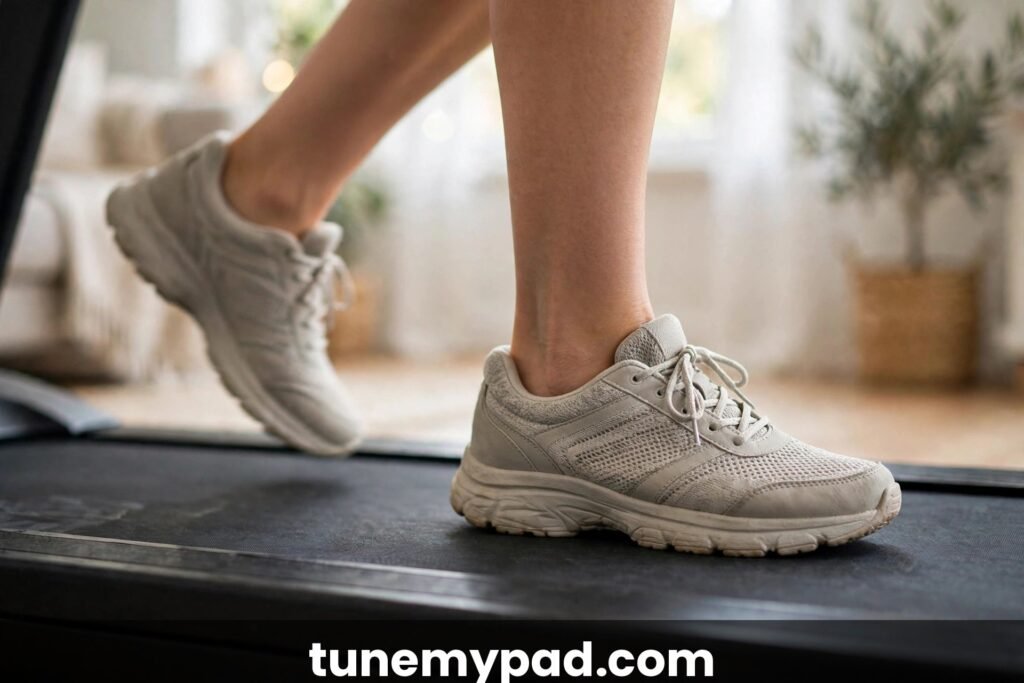
When you use a walking pad for plantar fasciitis, the shoes matter more than the machine. A walking pad does not cushion your foot — the shoe does. Walking barefoot or in flat socks with plantar fasciitis is the fastest way to turn a mild case into a stubborn one.
- Wear real walking shoes on the pad. Lace-up athletic shoes with arch support and a cushioned heel.
- Add inserts or heel cups. Over-the-counter orthotic inserts or silicone heel cups reduce peak load on the fascia with every step — often the single most effective intervention.
- Replace worn shoes. Compressed heel cushioning or uneven tread wear changes how force travels through the foot.
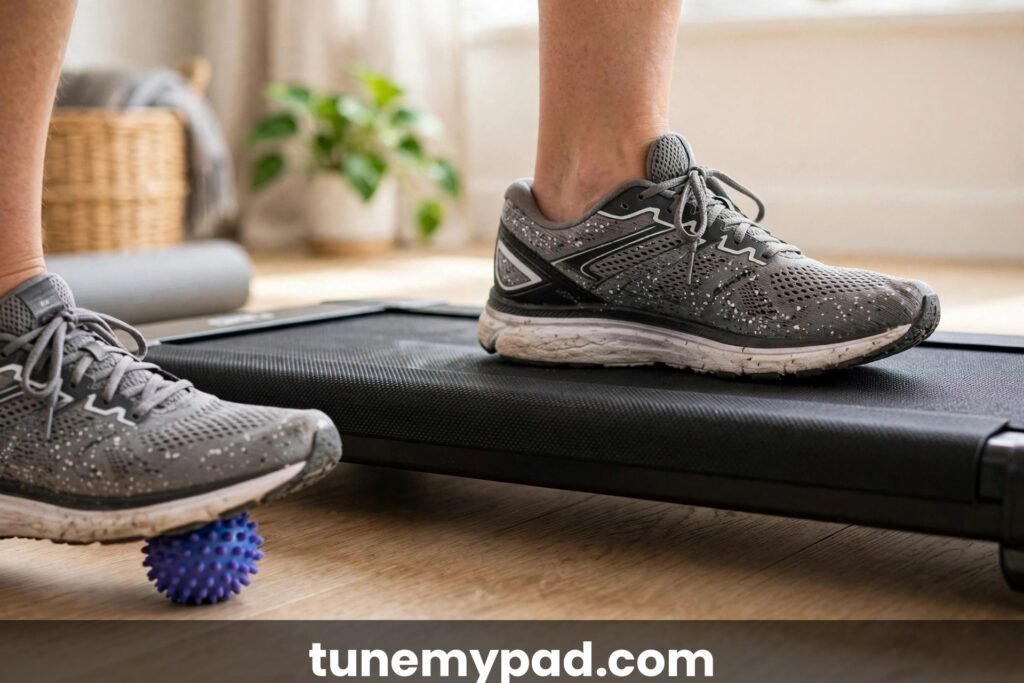
- Ice after sessions. A frozen water bottle rolled under the arch for 10–15 minutes after walking is the classic stretch-plus-cold combo.
Choosing Inserts and Heel Cups: A Comparison
Not all support is equal. Here is how the common options stack up for walking pad for plantar fasciitis use:
| Option | What it does | Best for | Notes |
|---|---|---|---|
| Silicone heel cups | Cushion the heel strike, absorb shock | Heel-centered pain | Cheap, fits any shoe; minimal arch support |
| Over-the-counter orthotic inserts | Support the arch, distribute pressure | Most mild–moderate cases | Best value; replace every 6–12 months |
| Custom orthotics | Molded to your exact foot shape | Stubborn cases, unusual foot shapes | Prescribed by a podiatrist; pricier but precise |
| Arch-support sleeves | Compression + light arch lift | All-day wear between sessions | Won’t replace a real insert during walks |
Start with over-the-counter inserts plus heel cups — that combination resolves a large share of mild cases. If you are still struggling after 6–8 weeks of consistent use, custom orthotics from a podiatrist are the logical next step, not a fancier shoe.
Warm-Up Stretches Before You Step On
Never step onto a walking pad for plantar fasciitis with a cold foot. Five minutes of stretching first changes everything:
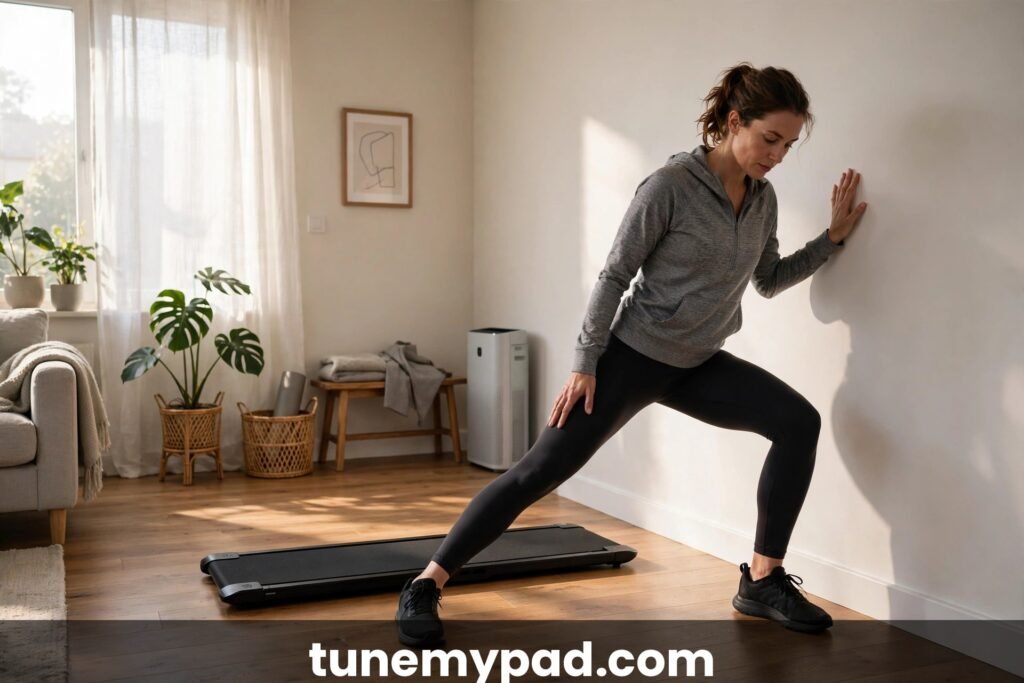
Calf wall stretch
Face a wall, one foot back, heel pressed into the floor, knee straight. Lean in until you feel the calf stretch. Hold 30 seconds per leg, twice. Tight calves are the number-one accomplice of plantar fasciitis — this stretch is non-negotiable.
Towel stretch
Sit with your leg extended, loop a towel around the ball of your foot, and gently pull your toes toward you. Hold 30 seconds, repeat three times per foot. This directly stretches the fascia — the classic morning routine.
Frozen bottle roll
Roll your arch over a frozen water bottle for 3–5 minutes. It stretches, massages, and ices in one move — ideal both before and after a pad session.
Ankle circles and toe curls
Ten slow circles each direction per ankle, then scrunch a towel with your toes. It wakes up the small stabilizing muscles of the foot.
The full pre-walk sequence
Do them in this order for a complete 5-minute warm-up: frozen bottle roll (2 min) → calf wall stretch (2 min) → towel stretch (1 min). Then step onto the pad at 1.5 mph for the first two minutes before settling into your session pace. This ritual alone prevents a surprising number of flare-ups for walking pad for plantar fasciitis users.
Taping, Night Splints and Massage Tools
Beyond shoes and stretching, three adjuncts can support a walking pad for plantar fasciitis routine:
Low-Dye taping
Athletic tape applied in a basket-weave under the arch (the “low-Dye” technique) unloads the fascia during activity. Many people tape before pad sessions in the early phases and drop it as pain stabilizes. A physiotherapist can teach the pattern in one visit, or video tutorials from reputable clinics walk through it step by step.
Night splints
A night splint holds the foot at a gentle stretch while you sleep, preventing the fascia from tightening overnight — which is exactly what causes that brutal first-step morning pain. They are not comfortable at first; start with an hour before bed and build up. Many users report the morning pain easing within two weeks of consistent use.
Massage balls and rollers
A lacrosse ball under the arch (seated, gentle pressure, 2–3 minutes) breaks up adhesions better than passive stretching alone. Keep the pressure moderate — aggressive mashing of an irritated fascia backfires. Use it after walks, not before.
Cross-Training While the Fascia Heals
On non-walking days — or when your walking pad for plantar fasciitis routine needs a pause — keep moving without loading the foot:
- Cycling or stationary bike. Zero foot impact, solid cardio. Keep the resistance moderate.
- Swimming or water walking. The gold standard for irritated feet — buoyancy unloads the fascia almost entirely.
- Upper-body and core strength. A foot injury is a fine time to build the rest of the body.
- Seated calf raises. Light, pain-free calf work maintains the muscle without the impact of walking.
The goal is maintaining fitness and mood while the fascia calms down — not total inactivity, which weakens the foot further.
Daily Habits That Speed (or Slow) Your Recovery
Your walking pad for plantar fasciitis sessions are only part of the picture. What you do in the other 23 hours either supports the healing or quietly undermines it:
- Wear supportive shoes all day, not just on the pad. The recovery you earn in a careful 15-minute walking pad for plantar fasciitis session can be undone by an afternoon in flat flip-flops on hard floors. Keep the inserts in your daily shoes too.
- Do the morning towel stretch before your feet hit the floor. Keep a towel by the bed. Thirty seconds of gentle pulling before those first steps reduces the daily micro-trauma that keeps the fascia irritated.
- Manage body weight gradually. Every extra pound increases the load on the fascia with each step — which is one more reason a sensible walking pad for plantar fasciitis routine pairs so well with steady, sustainable weight management.
- Don’t stand still for long periods. Prolonged static standing loads the fascia continuously without the pumping benefit of movement. If your job involves standing, shift weight regularly and keep supportive footwear on.
- Sleep in a way that helps. Sleeping with the sheets tucked tightly over your toes points the foot downward all night, shortening the calf and fascia. Loosen the bedding at the foot of the bed — a small change that makes mornings noticeably easier for walking pad for plantar fasciitis users.
Red Flags: When to Stop and See a Podiatrist
Stop your walking pad for plantar fasciitis sessions and get professional evaluation if:
- Pain is sharp or stabbing rather than a dull ache, especially mid-walk
- Heel pain is steadily worsening over weeks despite sensible care
- There is visible swelling, bruising, or warmth in the heel
- You feel numbness or tingling in the foot
- Pain does not ease after the foot “warms up,” or you cannot bear weight on the heel comfortably
- Pain persists beyond a few weeks of proper care — stubborn cases sometimes need physical therapy, custom orthotics, or other treatment only a clinician can provide
Foot pain that does not follow the classic plantar fasciitis pattern may be something else entirely — a stress fracture or nerve issue — which is exactly why the clinician caveat at the top exists.
FAQs
Is a walking pad for plantar fasciitis better than walking outside?
Usually, yes. The flat, predictable belt with exact speed control and an instant stop is gentler on an irritated foot than uneven outdoor surfaces and hills. Keep sessions short and the shoes supportive.
Can walking on a pad make plantar fasciitis worse?
It can — if you walk too fast, too long, too often, or in bad shoes. The aggravating factors are dose and footwear, not the walking pad for plantar fasciitis setup itself. Pain that rises during the walk or is worse the next morning means you overdid it.
Should I walk barefoot on a walking pad with plantar fasciitis?
No. Barefoot or flat-sock walking concentrates load on the irritated fascia. Always wear supportive, laced walking shoes with inserts or heel cups on the pad.
How long does it take for walking to help plantar fasciitis?
Most mild cases improve over several weeks to a few months with consistent sensible care — stretching, supportive shoes, sensible activity levels. Judge progress week to week, not day to day.
When should I see a podiatrist instead of managing it myself?
If pain is severe, worsening after a couple of weeks of sensible care, involves swelling or numbness, or simply is not improving after 6–8 weeks, book an appointment. Persistent cases benefit from professional treatment plans.
What speed should I use on a walking pad for plantar fasciitis?
Stay at 1.5–2.0 mph. This range keeps impact forces low while still giving you the blood-flow benefits of movement. If 2.0 mph produces next-morning soreness, drop to 1.5 and rebuild — the exact number matters less than the morning-after result.
Can I use incline on a walking pad for plantar fasciitis?
Skip the incline until you are pain-free. Uphill walking increases calf and Achilles loading, which pulls harder on the fascia’s heel attachment — exactly what you don’t want during recovery. Flat belt only in phases 1–3.
Can I run on a walking pad for plantar fasciitis?
No — running multiplies impact forces several times over compared to walking, which is exactly what an irritated fascia cannot handle. Stick to walking until you have been pain-free for several weeks, then discuss any return to running with your clinician first.
Do I need to stop using my walking pad for plantar fasciitis entirely during a flare-up?
During an acute flare-up (sharp pain, swelling), take 3–5 days off the pad and focus on ice, gentle stretching, and cross-training. Then restart at phase 1 of the protocol above. Brief strategic rest beats months of limping through sessions.
Conclusion
A walking pad for plantar fasciitis is not a contradiction — for most mild to moderate cases, gentle, well-dosed pad walking aids recovery and beats outdoor walking thanks to the flat surface, exact speed control, and instant bail-out. Keep it slow (1.5–2.0 mph), short (10–20 minutes), and shod (supportive shoes plus inserts, never barefoot). Follow the 4-phase protocol, warm up with calf and fascia stretches, judge every session by the morning-after test, and back off the moment pain rises.
And the clinician caveat bears repeating: this walking pad for plantar fasciitis guide is general information, not a diagnosis or treatment plan. If heel pain is severe, changing, or stubborn, see a doctor or podiatrist — feet are worth the appointment.
External references: Mayo Clinic on plantar fasciitis (symptoms, causes, and when to see a doctor), Cleveland Clinic’s plantar fasciitis guide (treatment options including stretching and orthotics), and the American Academy of Orthopaedic Surgeons on plantar fasciitis (detailed home-care and exercise guidance).