
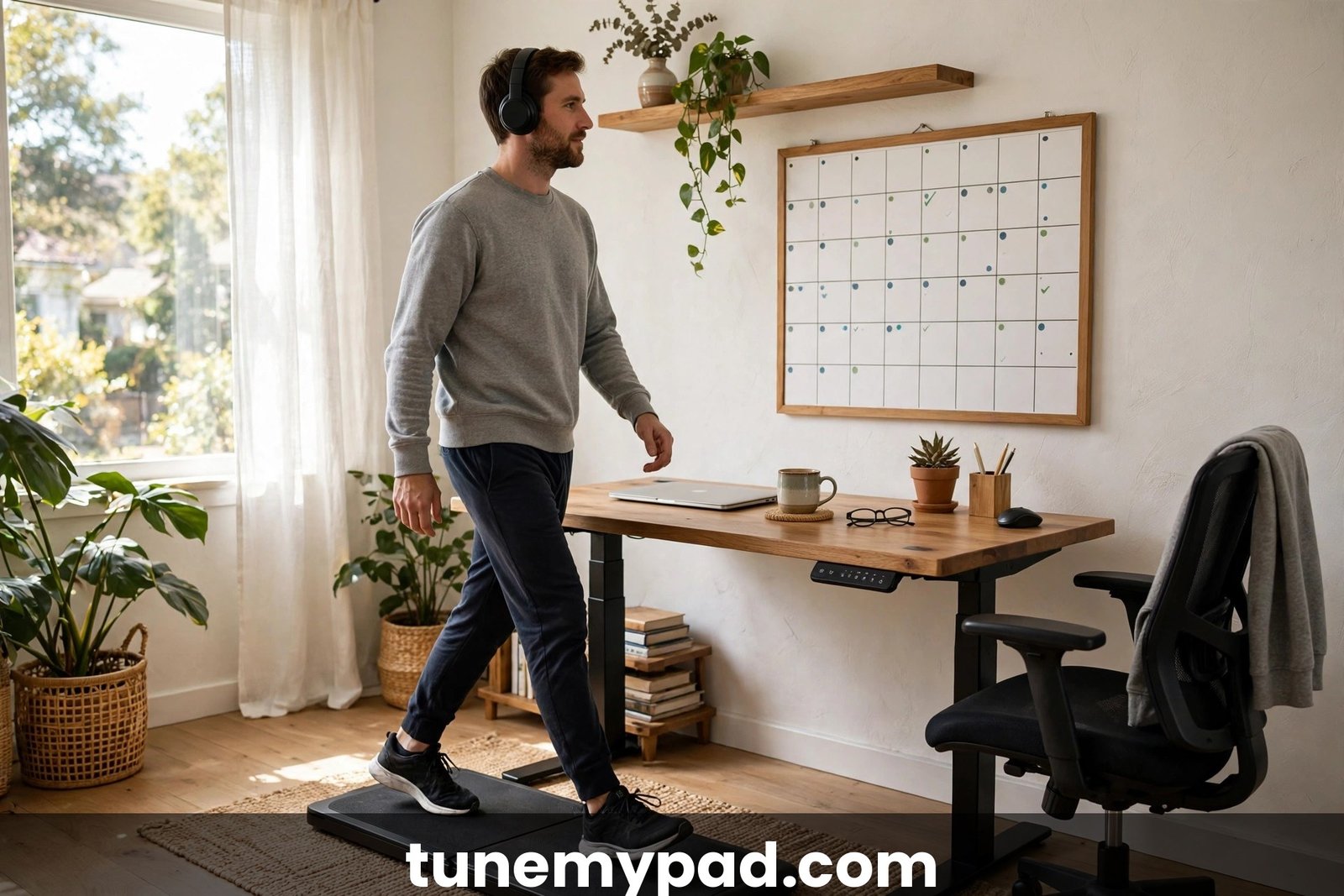
Can you use a walking pad every day? For most healthy adults, the answer is a confident yes — daily walking is the gentlest, most sustainable cardio habit you can build, and a walking pad removes weather, darkness, and scheduling from the equation entirely. But “every day” is not the same as “all-out every day.” If you are wondering can you use a walking pad every day without burning out, the answer lies in dosing: a daily walking pad routine thrives on sensible volume, real walking shoes, and respect for recovery — and it breaks down fast when it turns into a punishing hour-long grind with no easy days. This guide gives you the complete playbook: the short answer with its caveats, what daily walking actually does to your body, realistic daily amounts, an 8-week build-up plan, recovery logic, overuse warning signs, shoe and setup essentials for daily use, rest-day strategy, long-term joint care, tracking tips, and an honest pad-versus-outdoors comparison.
Table of Contents
Quick Answer: Can You Use a Walking Pad Every Day
| Question | Answer |
|---|---|
| Short answer | Yes — can you use a walking pad every day? For most healthy adults, absolutely; daily walking is one of the safest exercise habits you can build. |
| Sensible daily amount | 30–60 minutes for most people; beginners start at 15–20. |
| Maximum worth doing daily | Around 90 minutes; beyond that, split sessions or add rest days. |
| Overuse warning signs | Achy shins, sore arches/heels, cranky knees, or hip tightness lingering into the next day. |
| Rest-day rule | At least 1–2 easy or rest days per week, especially in the first 2–3 months. |
| Long-term joint outlook | Walking is joint-friendly; problems come from bad shoes, worn surfaces, or too much too soon — not the daily habit itself. |
The Short Answer: Yes, With a Few Caveats
Human bodies are built for daily walking — it is the movement pattern we evolved around. Unlike running, which hammers joints with 2–3 times your body weight per stride, walking keeps one foot on the ground and generates far lower impact. That is why doctors routinely tell sedentary patients to “just walk every day” as a starting point.
So can you use a walking pad every day? Physiologically, yes — but your feet, shins, and tendons adapt slower than your cardio fitness does, volume matters (30 minutes daily is gentle; two hours from a standing start is a load spike), and a daily habit multiplies every equipment flaw — dead shoes, a dry belt, poor posture — by 365. In short: can you use a walking pad every day? Physiologically yes — but suddenly daily long walking is where people get hurt.
What Happens to Your Body When You Walk Every Day
Understanding the physiology makes the “every day” question almost answer itself. Here is what a daily walking pad habit does across your systems over weeks and months.
Cardiovascular system
Brisk daily walking strengthens the heart muscle, improves circulation, and lowers resting blood pressure over time. Your heart becomes more efficient — it pumps more blood per beat, so your resting heart rate drifts down. This steady cardiac adaptation is one of the strongest reasons the answer to “can you use a walking pad every day” is yes for most healthy adults. The 150 minutes per week of moderate activity recommended by health authorities is easily covered by 30 minutes of daily pad walking, and regular walkers show measurably better cholesterol profiles than sedentary peers.
Metabolism and blood sugar
Walking after meals is one of the most underrated metabolic tools available. Even a slow 15-minute walk blunts the post-meal blood sugar spike, which matters for energy stability and long-term metabolic health. For people asking can you use a walking pad every day for better health, the metabolic payoff is real: daily walkers also tend to maintain healthier body weight — not because walking burns enormous calories (it doesn’t), but because the habit displaces sitting, curbs mindless snacking, and keeps daily energy expenditure consistently elevated.
Muscles, bones, and joints
Walking loads the skeleton in exactly the way bones need to stay dense — weight-bearing, rhythmic, low-trauma. The calves, glutes, and core all get steady low-grade work. Cartilage, which has no blood supply, depends on joint movement to circulate nutrients; daily walking literally feeds your joints. This is why the “walking wears out your knees” fear is backwards for healthy joints.
Brain and mood
Daily walkers consistently report better sleep quality, lower stress, and steadier mood. Rhythmic walking seems to help the brain process the day’s cognitive load — many people find their best thinking happens mid-walk. For desk workers wondering can you use a walking pad every day without losing focus, the news is good: a walking pad session doubles as a screen break that reduces eye strain and mental fatigue without costing work time.
The Sweet Spot: How Much Walking Per Day Is Realistic
There is no single magic number, but if you are asking can you use a walking pad every day and how much is sensible, these ranges cover nearly everyone:
| Level | Daily target | Pace | Notes |
|---|---|---|---|
| Sedentary beginner | 15–20 min | 1.5–2.0 mph | Split into two 10-min sessions if needed |
| Building the habit | 30 min | 2.0–2.5 mph | The classic “doctor’s orders” dose |
| Fit and consistent | 45–60 min | 2.5–3.0 mph | Solid daily cardio; watch feet and shins |
| Experienced walker | 60–90 min | 2.5–3.5 mph | Fine once adapted; split sessions help |
A few reality checks: the famous 10,000 steps is a marketing number, not a medical one — meaningful benefits kick in around 7,000–8,000 steps for most adults. And intensity counts: a brisk 30 minutes beats a dawdling 60 for cardiovascular benefit — which is why “can you use a walking pad every day” matters less than how you walk each day.
The 10%-per-week rule is your friend: increase total weekly walking time by no more than 10% week over week. Going from 20 minutes daily to 30 is a 50% jump — too much.
An 8-Week Build-Up Plan for Daily Walking
If you are asking can you use a walking pad every day as a beginner, this progression takes you from zero to a solid daily habit without the classic too-much-too-soon injuries. Each week adds a little time; speed stays comfortable throughout.
| Week | Daily target | Rest days | Focus |
|---|---|---|---|
| 1 | 15 min at 1.5–2.0 mph | 2–3 | Just show up; learn the machine |
| 2 | 20 min at 1.5–2.0 mph | 2 | Build the routine around work blocks |
| 3 | 25 min at 2.0 mph | 2 | Check shoes; note any hot spots |
| 4 | 30 min at 2.0–2.5 mph | 1–2 | First “real” daily dose |
| 5 | 35 min at 2.0–2.5 mph | 1–2 | Add one slightly brisker session |
| 6 | 40 min at 2.0–2.5 mph | 1 | Try splitting into two sessions one day |
| 7 | 45 min at 2.5 mph | 1 | Comfortable daily habit forming |
| 8 | 45–60 min at 2.5 mph | 1 easy day | Maintain; adjust to your schedule |
If any week produces lingering soreness, repeat that week instead of progressing. The plan is a template, not a deadline — your tendons set the schedule. Follow it, and the question of can you use a walking pad every day answers itself: yes, comfortably.
Recovery Logic: Why Walking Needs Less Recovery Than Running
Walking sits in a sweet spot: aerobic enough to improve fitness, low-impact enough that most people do not need full rest days the way runners do. The cardio system recovers from a walk within hours, and muscles used at walking intensity clear fatigue overnight.
But “low impact” is not “no impact.” The structures that need recovery time are the passive ones — tendons, fascia, joint cartilage, and the small stabilizing muscles of the feet and shins. These adapt more slowly than muscle does, and they are the source of the classic daily-walker complaints: shin splints, plantar fascia irritation, Achilles grumbles, IT-band tightness.
Practical recovery when you ask can you use a walking pad every day: use easy days (a slow 15-minute stroll) instead of full rest days, never increase time and speed in the same week, and give yourself 1–2 true rest days per week for the first two or three months.
Warning Signs of Overuse: Shins, Feet and Knees
| Signal | What it usually means | What to do |
|---|---|---|
| Achy shins during walks | Shin splints brewing — classic too-much-too-soon | Halve time and speed; walk every other day until settled |
| Sore arches or morning heel pain | Plantar fascia overload | Shorter sessions, supportive shoes + inserts; see our plantar fasciitis guide |
| Dull ache around the knee | Irritated joint or tracking issue | Reduce speed, check shoes, add rest days |
| Tight hips or lower back | Posture fatigue or weak glutes | Shorten sessions; add hip stretches and glute work |
| Pain lingering into the next day | Recovery capacity exceeded | Take a full rest day; resume at lower volume |
The golden rule: soreness that fades within the walk or by morning is adaptation; pain that greets you the next morning is overload. Respect the difference. None of these change the answer to can you use a walking pad every day — they mean the current dose is wrong.
Shoes, Surface and Setup: The Daily Walker’s Trinity
Anyone asking can you use a walking pad every day should know this: small equipment flaws compound into real problems under daily use. Three things deserve your attention before you worry about anything else.
Shoes: rotate and replace on schedule
Walking shoes lose cushioning long before they look worn. A daily walker should replace shoes every 300–500 miles — roughly every 4–6 months of heavy daily use. Serious daily walkers often rotate two pairs, which lets the foam fully rebound between sessions and extends each pair’s life. The shoes should be actual walking or running shoes with arch support, not flat casual sneakers — and never barefoot on the pad for daily volume, since the belt offers no cushioning of its own.
The belt: maintain it like you mean it
Can you use a walking pad every day on a neglected machine? Technically yes, but you shouldn’t: a daily-use pad needs lubrication on schedule (typically every 3 months or ~40 hours of use), regular belt-centering checks, and a quick wipe-down after sweaty sessions. A dry, jerky belt doesn’t just feel bad — it changes your gait slightly with every step, and over thousands of daily steps that adds up to real joint stress. Follow our maintenance schedule and your machine will stay joint-friendly for years.
Posture: the silent multiplier
Daily walking with a forward head lean or a death-grip on the desk edge will create neck and lower-back complaints that people blame on “too much walking.” Stand tall, keep the desk at elbow height, let your arms swing naturally, and land midfoot rather than overstriding. If your shoulders ache after sessions, the desk height — not the walking — is usually the culprit.

Rest Days and Easy Days: Building Them Into the Week
So can you use a walking pad every day without any rest at all? You could, but smart programming still includes lighter days. A rest day means no pad at all; an easy day means a short, slow stroll that promotes blood flow without adding load. Here is what a sensible week looks like at different stages:
| Day | Beginner (weeks 1–8) | Established walker |
|---|---|---|
| Monday | 20 min easy | 45 min moderate |
| Tuesday | Rest | 30 min easy |
| Wednesday | 20 min easy | 60 min moderate |
| Thursday | Rest | 30 min easy |
| Friday | 25 min moderate | 45 min moderate |
| Saturday | 30 min moderate | 60–75 min long walk |
| Sunday | Rest or 15 min easy | 30 min easy or rest |
Notice the beginner column has three rest days — that is deliberate, not lazy. Connective tissue needs those gaps while it adapts. Cross-training helps too: a day of bodyweight strength or cycling instead of walking gives walking-specific tissues a break while keeping the daily-movement habit alive.
Long-Term Joint Considerations
The fear that daily walking “wears out” joints is mostly a myth — cartilage needs regular loading to stay healthy, since it has no blood supply and relies on joint movement to circulate nutrients. Regular, sensible walking does not increase arthritis risk in healthy joints; inactivity is the greater threat.
What actually damages joints over years is not walking itself but the conditions around it:
- Dead shoes. Cushioning compresses; a daily walker should replace shoes every 300–500 miles (roughly every 4–6 months of heavy daily use).
- Bad surfaces. A well-maintained pad belt with a little give is kinder than concrete. Daily use means maintenance matters more, not less — follow our maintenance schedule.
- Extra body weight. Every pound multiplies through the knees with each step; walking helps manage weight, protecting joints in a virtuous cycle.
- Ignoring pain. The difference between a minor irritation and a chronic joint problem is often just a few weeks of “walking through it.” Never do that.
If you have existing arthritis or joint damage, the question of can you use a walking pad every day gets more individual — check with your doctor or physiotherapist about volume and surface.
Daily Walking Pad vs. Daily Outdoor Walking
| Factor | Walking pad daily | Outdoor walking daily |
|---|---|---|
| Consistency | Wins — weather and darkness never cancel a session | Loses — rain, heat, ice, and bad air kill streaks |
| Surface | Flat, predictable, slightly forgiving belt | Varied — curbs, slopes, and uneven ground work stabilizing muscles |
| Mental health | Fine with a show or podcast; can feel monotonous | Wins — daylight, greenery, and vitamin D lift mood |
| Safety | Controlled; stop instantly; safety key on the belt | Traffic and path conditions vary by area |
| Multitasking | Wins — calls, reading, and shows pair naturally with slow walking | Limited — hard to type or read while navigating |
| Cost per step | Pad + electricity + maintenance | Free (good shoes still required) |
The honest best answer for most people asking can you use a walking pad every day versus heading outdoors: use the pad for consistency on workdays and lousy weather, and get outside when conditions are pleasant. They complement each other — the pad builds the daily habit, the outdoors feeds the soul.
Tracking Progress: Steps, Streaks and Plateaus
Daily walking rewards tracking because the numbers accumulate so satisfyingly. A simple approach beats a complicated one:
- Track weekly minutes, not just daily steps. Steps vary with stride; minutes of walking are the honest metric. Aim for that 150-minute weekly floor, then build toward 200–300.
- Use streaks carefully. A “can you use a walking pad every day” streak is motivating until it pressures you to walk through pain. Build in planned easy days so the streak survives your recovery needs.
- Expect the month-2 plateau. Around weeks 6–8, the rapid early fitness gains level off and the novelty fades. This is normal — not a sign to quit. Vary speed with intervals, change your entertainment rotation, or add an outdoor walk to refresh the habit.
- Re-test quarterly. Every three months, note your comfortable cruising speed and how you feel after 45 minutes. Once the answer to “can you use a walking pad every day” is an unthinking yes, the habit has stuck — gradual improvement over quarters is the real story.
Can You Use a Walking Pad Every Day? Answers for Common Situations
Older adults. Can you use a walking pad every day after 60? Generally yes — walking is the recommended entry exercise for older adults, and the pad’s handrail-free flat belt with instant stop is safer than icy sidewalks. Keep speeds modest, use the safety key, and clear the surrounding floor.
Weight-loss focused. Can you use a walking pad every day to lose weight? Daily walking helps, but treat it as one pillar alongside nutrition and sleep. Longer, easy sessions (45–60 minutes) suit fat-loss goals better than short intense ones, because they’re sustainable day after day.
With a standing desk. Can you use a walking pad every day while working full-time? This is the classic use case — 2–4 hours of slow walking spread across the workday. Keep work-walking at 1.0–2.0 mph so typing stays accurate, and alternate walking and sitting blocks.
While injured or returning from injury. Can you use a walking pad every day during rehab? Only with professional guidance. The pad’s controlled speed is genuinely useful for graded return-to-activity, but daily loading of healing tissue needs a physiotherapist’s plan, not a blog’s permission.

FAQs
Can you use a walking pad every day as a beginner?
Yes, but start with 15–20 minutes and include 2–3 rest days per week for the first couple of months. Your cardio fitness adapts faster than your feet, shins, and tendons — the rest days protect the slow adapters.
Do I need rest days if I only walk slowly?
Slow walking still loads tendons and fascia, so yes — especially early on. “Rest” for a walker can be a 15-minute easy stroll rather than full inactivity; the point is varying the load.
Is it better to walk every day or do longer walks fewer times per week?
For general health and habit-building, shorter daily walks usually win — consistency beats heroics. Total weekly volume matters more than how you slice it.
How do I keep a daily walking habit from getting boring?
Rotate entertainment (shows, podcasts, audiobooks), vary speed with interval sessions, and alternate pad days with outdoor walks. Boredom kills more walking habits than sore feet do.
Can you use a walking pad every day for weight loss?
Daily walking supports weight loss as part of an overall calorie picture, but walking alone rarely drives major loss — a 45-minute walk burns roughly 150–250 calories depending on body weight and speed. Where daily pad walking really shines for weight management is consistency: it is the easiest exercise habit to sustain for years, and sustained habits beat intense-but-abandoned programs every time.
Will walking every day tone my legs?
It builds endurance in the calves and improves muscle tone modestly, but walking is not a muscle-building stimulus. If toning is the goal, add two days of bodyweight strength work (squats, lunges, calf raises) alongside your daily walks.
Can you use a walking pad every day if you have flat feet or high arches?
Often yes, with proper footwear. Flat feet and high arches change how force travels through the foot, so supportive shoes (and possibly over-the-counter inserts) matter even more for daily volume. Start at the beginner amounts above, watch for arch or heel soreness the next morning, and see a podiatrist if pain persists — foot shape doesn’t veto the habit, but it raises the stakes on shoes.
Is it okay to walk on the pad twice a day?
Yes — splitting your walking into two shorter sessions (say, 25 minutes morning and evening) is joint-friendly and often easier to fit around work. This split approach is one of the most practical answers to can you use a walking pad every day on a packed schedule: two short walks beat one skipped long one. Just keep total daily volume within your adapted range and the 10%-per-week progression rule.
Conclusion
So, can you use a walking pad every day? Yes — daily walking is one of the healthiest, most sustainable habits a person can build, and a walking pad removes nearly every excuse that kills outdoor streaks. The practical formula behind can you use a walking pad every day: start at 15–30 minutes, progress about 10% per week, keep 1–2 easy or rest days in the rotation, wear real shoes (replaced on schedule), maintain the machine, and track weekly minutes rather than obsessing over daily perfection. Watch for overuse signals — shins, arches, knees — and treat them as dosing feedback, not a verdict on the habit. The evidence is clear: can you use a walking pad every day? For most healthy adults, absolutely — dose it wisely and it pays dividends for decades. Do that, and a daily walking pad routine can carry you for decades.
External references: The CDC on why physical activity matters (150 minutes of moderate activity per week and its benefits), Mayo Clinic’s walking guide (technique, shoes, and staying motivated), and the NHS walking for health guide (getting started and building up safely).