
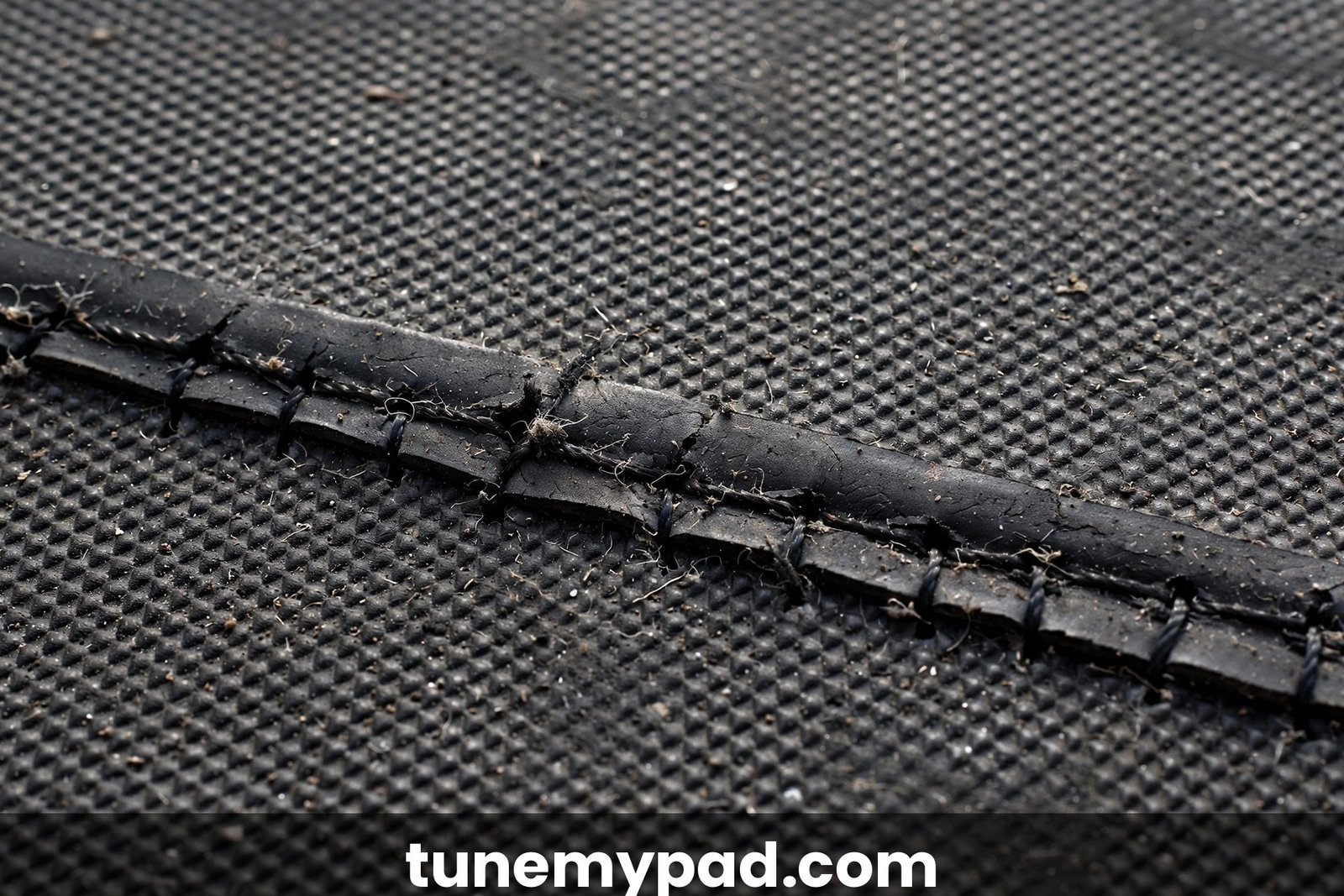
Every so often you feel it: a subtle thump-thump-thump under your feet, perfectly rhythmic, once per belt revolution. Or you spot a slightly raised line across the belt and wonder if it’s damaged. What you’re feeling is the belt seam — the splice where the two ends of the belt loop were joined at the factory. Every walking belt has one, and a slight bump from it is one of the most normal things about these machines. But “slight” is doing important work in that sentence — here’s how to tell the difference between a normal seam and a failing one.
Quick Answer: Walking Pad Belt Seam Bump
| Question | Answer |
|---|---|
| Do all walking belts have a seam? | Yes — every belt loop is spliced somewhere; a visible or slightly raised line across the belt is normal. |
| Is a bump once per revolution normal? | A slight, consistent bump is normal, especially on new belts. It often settles with break-in. |
| When is it NOT normal? | If the seam is lifting, separating, fraying, or causing thumping, slipping, or clicking. |
| How do I check the seam? | Loosen the belt slightly and inspect from underneath — the seam should look even from one side to the other. |
| Can a bad seam be repaired? | No — a separating seam means the belt needs replacing. Glues and patches don’t hold under belt tension and heat. |
What the Belt Seam Is (and Why You Can Feel It)
A walking belt starts life as a flat strip of rubberized material. To become a loop, the two ends are overlapped and bonded — usually with heat-activated adhesive, sometimes with a diagonal (“angle”) splice that spreads the joint over a longer section. That overlap is fractionally thicker than the rest of the belt, so each time it passes under your foot or rounds a roller, you may feel or hear a faint bump.
On quality belts the splice is nearly undetectable. On budget walking pads, the seam can be more pronounced — a visible ridge or a slightly different texture in a band across the belt. Both are manufacturing reality, not defects, as long as the joint is solid and even.
New belts are the most noticeable: the seam hasn’t yet been pressed and polished by hundreds of revolutions. Many owners report the bump fading significantly over the first few weeks of use as the splice beds in.
Normal Seam Bump vs. Failing Seam
| Sign | Normal | Replace the belt |
|---|---|---|
| Feel | Faint bump, once per revolution, easy to ignore | Pronounced thump that disturbs your stride |
| Look (top) | Slightly raised or textured line across the belt | Edges lifting, curling, or peeling up |
| Look (underside) | Seam even from one side to the other | Uneven width, visible gaps, or separation |
| Sound | Silent or a very soft tick | Loud thump or clicking each revolution |
| Belt behavior | Runs smoothly, tracks straight | Slipping, hesitating, or catching at the seam |
| Over time | Stays the same or fades with break-in | Getting worse week by week |
The trend matters as much as the snapshot: a seam bump that’s stable for months is character; one that’s growing is failure in progress.
How to Inspect Your Belt Seam (5 Minutes)
TreadmillDoctor’s long-standing guidance for belt issues applies directly here: loosen the walking belt and check the seam from underneath — even on an angle splice, the seam should be even from one side to the other.
- Unplug the pad.
- Find the seam. Run your hand slowly along the belt surface (or rotate the belt by hand) until you feel the slightly raised band. Mark it with tape on the belt edge.
- Inspect the top. Look at the seam in good light. A flat, bonded line is fine. Lifting edges, fraying, cracking along the joint, or a flap you can catch with a fingernail are not.
- Check from underneath. Lift the belt edge at the seam and look at the underside. Measure or eyeball the seam width at several points across the belt — it should be consistent. Obvious separations or a seam that’s visibly wider on one side mean the splice is failing.
- Feel for catching. Rotate the belt by hand past the front and rear rollers. The seam should pass smoothly; a snag or grab at the rollers confirms it’s more than cosmetic.
Do this check the moment a seam bump changes character — gets louder, starts catching, or the belt begins slipping at the seam point. Catching a failing seam early is the difference between an orderly belt replacement and a belt that lets go mid-stride.
What Causes a Seam to Go Bad
- Age and mileage. Adhesive bonds fatigue over years of flexing around rollers. A seam that was fine for two years and now lifts is simply worn out.
- Over-tensioning. Cranking the belt too tight stresses the splice more than any other part of the belt — TreadmillDoctor specifically warns that overtightened belts contribute to seam separation. Keep to the 2–3 inch center-lift spec.
- Heat. A chronically dry, under-lubricated belt runs hot, and heat softens adhesives. Another reason lubrication protects more than just the deck.
- Chemical damage. Petroleum solvents (never WD-40) and harsh cleaners can attack the splice adhesive.
- Manufacturing defect. A seam that lifts or separates in the first weeks on a new pad is a warranty claim, not wear. Document it with photos and contact the seller immediately.
Can You Fix a Bad Seam?
Short answer: no, not reliably. The splice lives under constant tension, flexing, and heat — exactly the conditions that defeat glues, tapes, and patches. Some owners report temporary success re-gluing a cleanly separated seam with flexible adhesive, but it’s a stopgap: the joint is structurally compromised, and a re-glued seam that lets go at speed can jam or throw the belt.
The correct fix for a separating seam is a replacement belt. On most walking pads this is a manageable DIY job (remove end caps, loosen rear roller, slide the old belt off and the new one on, re-center and tension). Before ordering, check your warranty — premature seam failure is frequently covered — and confirm the exact belt size for your model.
Reducing a Normal Seam Bump
If your seam is healthy but the bump annoys you:
- Give it break-in time. A few weeks of regular use often settles a new seam noticeably.
- Keep the belt lubricated. A slick deck lets the seam glide over the rollers instead of grabbing — 5–10 ml of silicone oil every 3 months.
- Check belt tension. A slightly loose belt slaps more at the seam; a slightly tight one presses the seam harder into the deck. Aim for the 2–3 inch lift spec — but never overtighten to chase a bump away.
- A treadmill mat helps. It damps the vibration that makes a faint bump feel bigger than it is.
Safety Stop-Points
- A seam that’s visibly separating: stop using the pad. A splice that lets go under load can jam the belt suddenly or throw you off balance.
- Thumping plus belt slipping or hesitation: the seam is likely catching on a roller — step off and inspect before the next session.
- Burning smell near a failing seam: excessive friction at the joint — unplug and inspect; don’t run it “until the new belt arrives.”
Walking Pad Belt Seam Bump FAQs
Is it normal to feel a bump on a walking pad belt?
Yes, if it’s slight and rhythmic — once per belt revolution. That’s the factory splice seam, which is fractionally thicker than the rest of the belt. It usually fades somewhat as the belt breaks in. A bump that’s loud, growing, or disturbing your stride is not normal.
Why does my walking pad thump once every few seconds?
Count the rhythm: if the thump lines up with one belt revolution, it’s the seam (or debris stuck to the belt — check for that first, it’s free to fix). Faster or irregular thumping points to rollers or the drive belt instead — see our clicking noise guide.
Can I sand down a raised belt seam?
Don’t. Sanding thins the belt at its structurally weakest point and can destroy the splice adhesive through heat and abrasion. If the seam is genuinely raised enough to bother you and the pad is new, that’s a warranty conversation.
How long do walking pad belts last?
Typically 2–5 years depending on use, maintenance, and belt quality. Regular lubrication, proper tension, and keeping the pad clean all extend belt life. Seam separation before the one-year mark usually indicates a defect — keep your receipt.
Will a seam bump damage the rollers or motor?
A normal, slight seam bump: no. A badly raised or catching seam: yes, over time — it hammers the rollers with each pass and makes the motor work harder at the catch point. Another reason to replace a failing belt rather than tolerating it.
My new walking pad has a very noticeable seam — is it defective?
Not necessarily — budget pads often have more pronounced splices, and new seams are at their most noticeable. Give it 2–3 weeks of regular use. If it’s still severe, or if the seam edges are lifting rather than just raised, contact the seller with photos.
Conclusion
A slight once-per-revolution bump is just your belt’s factory seam — normal, common, and usually fading with break-in. The line is drawn at lifting, separating, or catching: check the seam from underneath for evenness, keep the belt lubricated and correctly tensioned, and replace the belt if the splice is failing rather than trying to glue it. For related belt issues, see belt slipping fixes, belt drifting to one side, and our lubrication guide. External references: TreadmillDoctor’s belt-slipping diagnostics (checking seam evenness from underneath, overtightening causing seam separation), and TreadmillDoctor’s guide to belts moving to one side (tension and seam wear).