
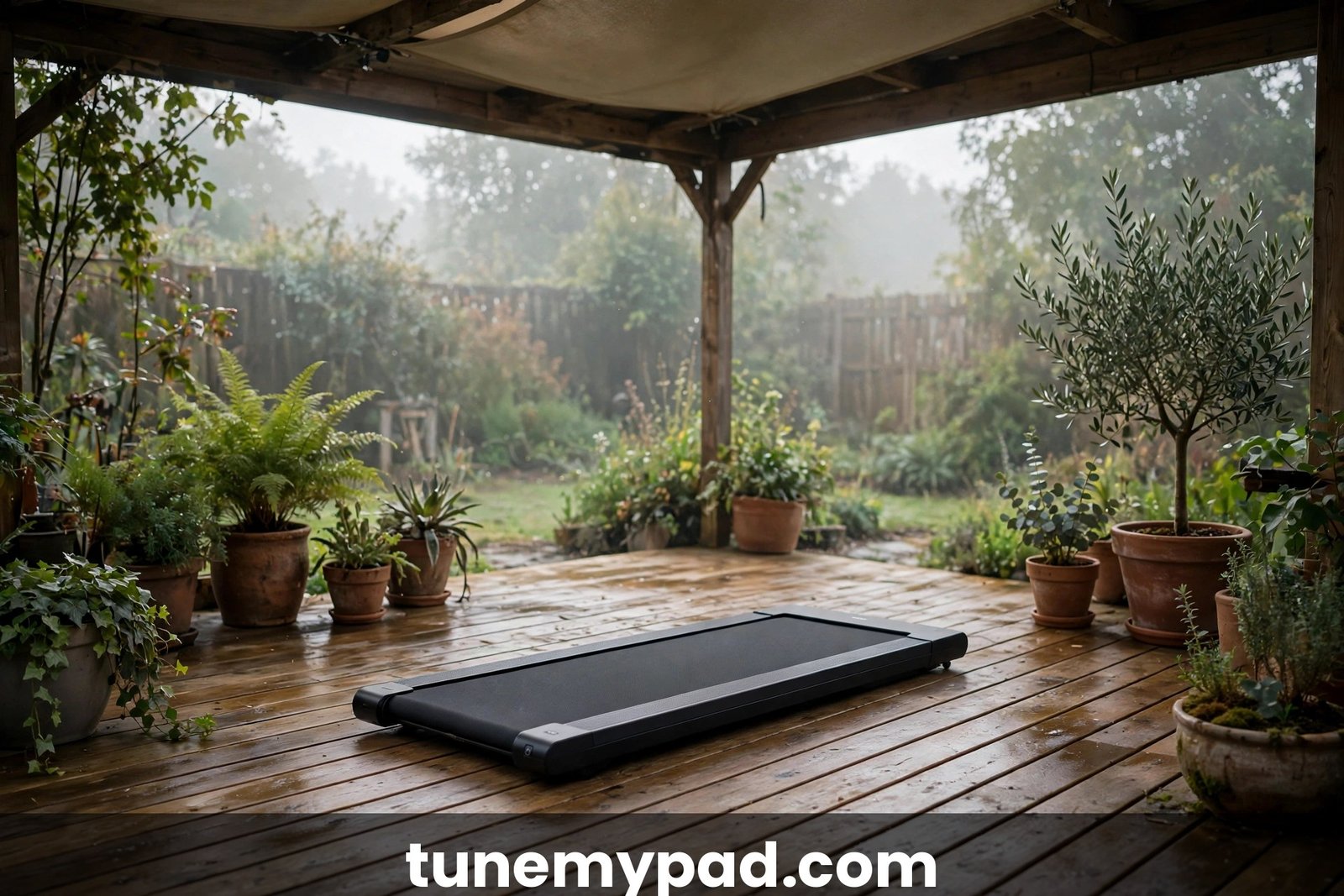
It’s a tempting thought: roll the walking pad onto the patio, get fresh air with your steps, skip the stuffy home office. So can you use a walking pad outdoors? Physically, yes — it will turn on and the belt will move. But “it powers on” and “it’s a good idea” are very different things, and the gap between them is full of voided warranties, fried motors, and rust.
Here’s the honest breakdown: what happens to a walking pad outside, when it’s relatively safe, when it’s genuinely risky, and what to use instead.
Table of Contents
Quick Answer: Can You Use a Walking Pad Outdoors?
| Question | Answer |
|---|---|
| Can you use a walking pad outdoors? | It will work, but it’s not designed for it. Outdoor use voids virtually every manufacturer’s warranty. |
| What’s the biggest risk? | Moisture — humidity, dew, and rain kill motors and electronics. Dust and grit are the second-biggest killer. |
| Is a covered patio okay? | Safer than open sky, but still risky: humidity, temperature swings, and dust reach covered patios too. Occasional use is low-risk; daily use is not. |
| Will it void my warranty? | Almost certainly yes. Every major walking pad manual specifies indoor use only. |
| What’s the safe alternative? | Walk outside without the pad, or put the pad near an open window/balcony door for airflow while it stays indoors. |
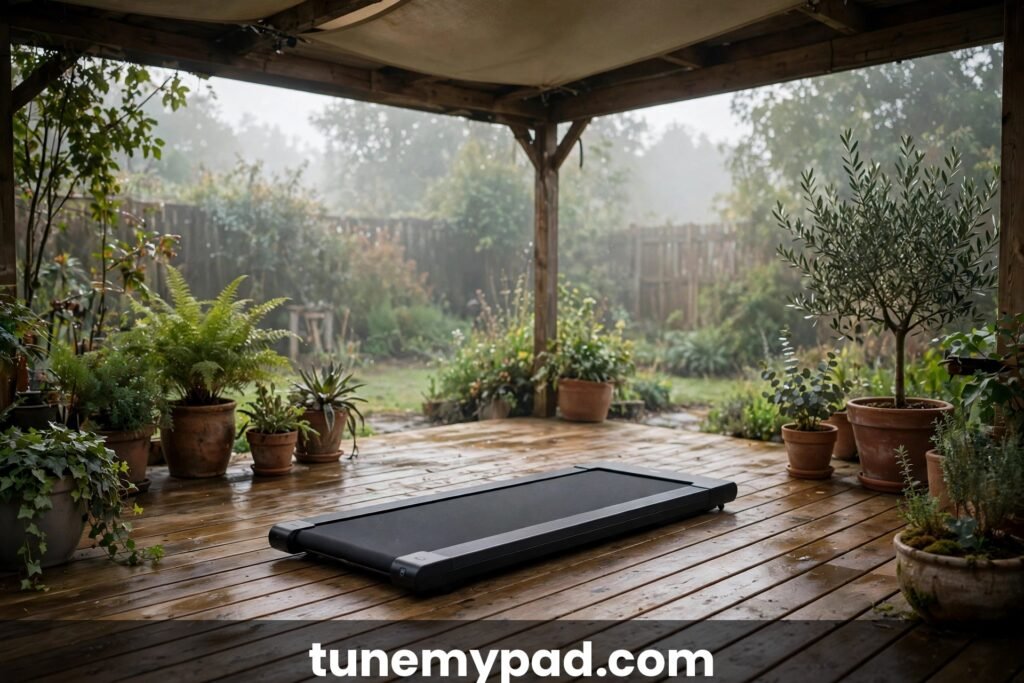
What Walking Pads Are Built For (Hint: Not Outside)
A walking pad is an indoor appliance wearing exercise equipment’s clothes. Its motor, controller board, and display are designed for a climate-controlled room: roughly 50–80°F (10–27°C), low humidity, no direct sun, no dust beyond normal household levels. The manual’s “indoor use only” line isn’t lawyers being cautious — it’s engineers describing the environment the components were tested in.
Outdoors, every protective assumption fails at once:
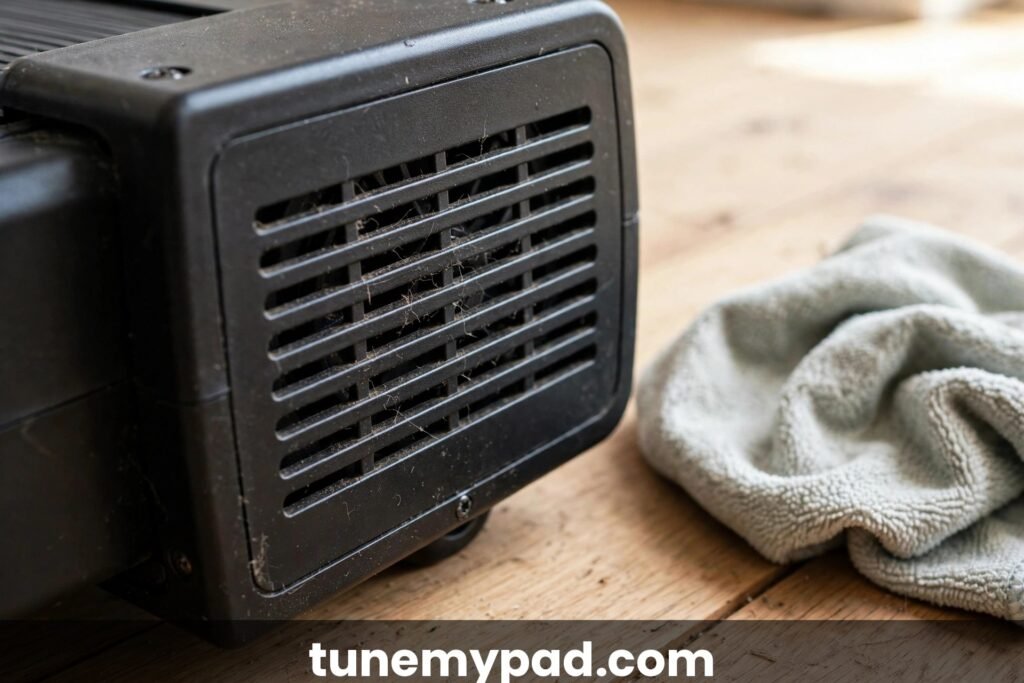
- No weather sealing. The motor housing has ventilation slots (motors need airflow). Those slots admit humidity, dust, pollen, and — in a surprise shower — water. There’s no IP waterproof rating on a walking pad, because it’s not supposed to need one.
- Electronics hate moisture. The controller board that drives the motor corrodes in persistent humidity. Corrosion is slow, invisible, and cumulative — the pad works fine for weeks, then dies one morning for “no reason.”
- The belt and deck absorb moisture. Belt materials and deck coatings take on water, which changes friction characteristics, accelerates wear, and can cause the belt to slip or grab.
- Temperature swings stress components. Electronics expand and contract; lubricants thin in heat and thicken in cold. A pad stored in an unheated garage through winter often needs re-lubrication and belt re-tensioning in spring — if it survived at all.
None of this means the pad explodes the moment it sees daylight. It means outdoor use converts a 3–7-year indoor lifespan into an unpredictable gamble.
The Moisture Problem, Specifically
If you take one thing from this article: water is the enemy, and “no rain” doesn’t mean “no moisture.”
Morning dew settles on everything left outside overnight — including a pad you “only” left on the patio after yesterday’s session. Humidity above ~70% for extended periods corrodes exposed contacts and seeps into the motor windings. A single rain shower can do in minutes what months of humidity do slowly: water in the motor housing can short the controller board outright, and that failure is both dangerous and warranty-voiding.
The insidious version: you use the pad on a dry patio all summer, everything works, and you conclude it’s fine. Meanwhile humidity has been quietly oxidizing connections. The failure arrives in month four, looking sudden, and the manufacturer — who can tell from corrosion patterns that it lived outdoors — denies the claim. This is the most common outdoor-use story, and it ends the same way every time.
Electrical safety note: a walking pad is a mains-powered device with no outdoor rating. Using it on wet ground, in rain, or with a wet power cord is a genuine shock hazard. Never run the pad on damp surfaces, never handle the plug with wet hands, and never use a damaged cord outdoors. If the pad has ever been rained on, let it dry completely indoors for 24–48 hours before plugging it in — and even then, have it checked if you have any doubt. Our guide on walking pad electrical safety covers the fire and shock risks in detail.
Dust, Sun, and Temperature: The Other Killers
Dust and grit. Outdoor air carries fine dust, pollen, and sand that indoor air doesn’t. This grit works its way under the belt and into the deck, acting as sandpaper on every revolution. Belt and deck wear accelerates dramatically — you’ll be lubricating constantly and replacing parts far sooner. If you must use a pad outside occasionally, a thorough wipe-down and belt-area cleaning afterward is mandatory, not optional. Follow the walking pad maintenance schedule and double the cleaning frequency for any outdoor sessions.
Direct sunlight. UV degrades the belt material and any plastic housings over time, making them brittle. Worse, a dark belt in direct sun gets hot — hot enough to soften belt coatings and make the walking surface uncomfortably warm. Electronics also hate heat: controller boards in direct sun can overheat and shut down or fail.
Cold. Below about 50°F (10°C), belt lubricant thickens, the belt gets stiff, and the motor works harder — drawing more current, running hotter, wearing faster. In freezing temperatures, moisture can condense inside the housing when the pad warms up during use, which is the worst of both worlds.
Wind. Less destructive, but gusty wind plus a lightweight pad (40–60 lbs) is a tip-over risk, and wind-blown debris goes straight into the motor vents.
What About Garages, Sheds, and Screened Porches?
The gray zone between “indoors” and “outdoors” deserves its own answer, because can you use a walking pad outdoors often really means “can I use it in my garage.” Attached garages are the best of the gray zone — roofed, walled, and sharing the house’s temperature moderation — but they still bring dust, humidity swings, and winter cold. Occasional garage sessions with the pad stored indoors are low-risk; permanent garage residence is slow-motion outdoor use. Anyone asking can you use a walking pad outdoors usually pictures the patio — but the garage is where most gray-zone damage actually happens.
Detached sheds are worse: uninsulated, prone to condensation, and often hitting temperature extremes the pad was never designed for. Screened porches sit in between — they block direct rain and debris but admit humidity freely, which is the silent killer. The rule of thumb: if the space isn’t somewhere you’d comfortably store a laptop long-term, it’s not somewhere a walking pad should live either. Apply that laptop test honestly and the can you use a walking pad outdoors question answers itself for storage too.
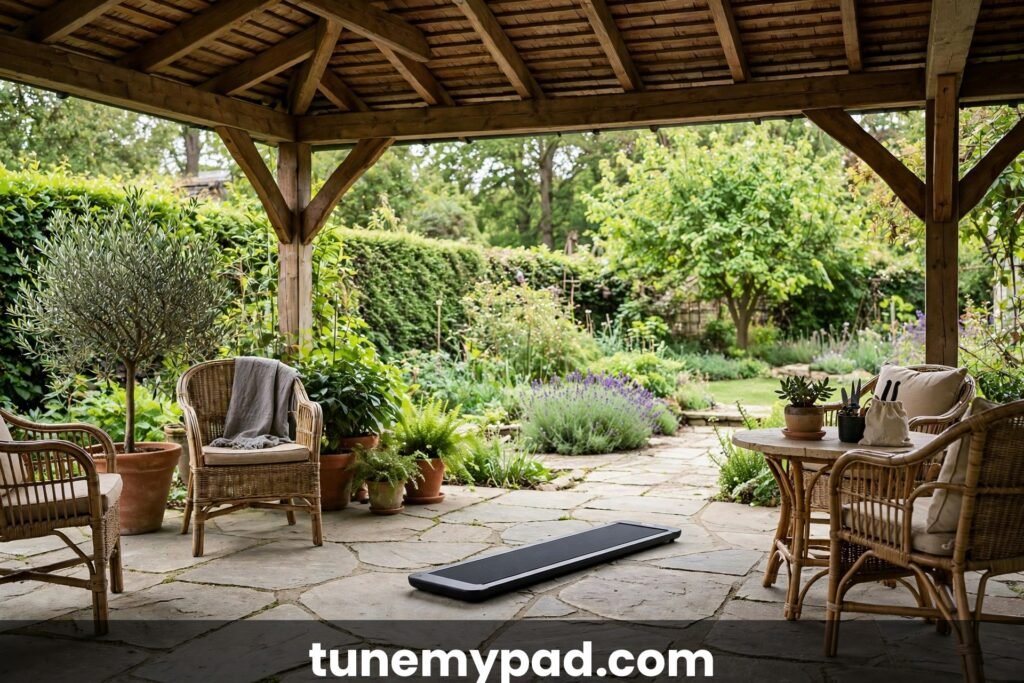
When Outdoor Use Is Relatively Low-Risk
Let’s be realistic: some people will do it anyway. If you’re going to, here’s how to keep the risk as low as possible:
- Covered patio or balcony only — roof overhead, no direct rain exposure, and bring the pad inside afterward. Never store it outside.
- Dry days only — low humidity, no rain in the forecast, surfaces completely dry. Morning sessions beat evening ones (less dew risk if you forget to bring it in promptly).
- Shade, not sun — keep the pad out of direct sunlight entirely.
- Short sessions — an occasional 30-minute patio walk is a different risk profile than daily outdoor use. Frequency is what kills pads, not single exposures.
- Clean it after every outdoor session — wipe down the belt, vacuum around the deck edges, check the vents for debris.
- Flat, stable surface — patios are often slightly sloped for drainage. An unlevel pad wears the belt unevenly and can drift. Shim it level.
- Use a weatherproof cover during the session’s downtime — if it lives on the patio between sessions (not recommended), a fitted cover is the bare minimum. It helps with dust and surprise drizzles but does nothing against humidity.
Even with all of this, understand you’re accepting accelerated wear and a voided warranty. “Low-risk” here means “probably fine for occasional use,” not “manufacturer-approved.”
The Warranty Reality
This deserves plain language: using a walking pad outdoors voids the warranty on virtually every model sold. The manuals uniformly specify indoor use in a climate-controlled environment, and “environmental damage” — moisture, dust ingress, UV, temperature — is a standard warranty exclusion.
Manufacturers can tell. Corrosion on the controller board, dust packed into the motor housing, UV-faded plastics, and water staining are all obvious on inspection. If your pad dies after outdoor use and you file a claim describing indoor use, that’s misrepresentation — and the physical evidence will contradict you anyway.
Practical implication: if your pad is still under warranty (typically 1–2 years), outdoor use is gambling with a free replacement/repair you’d otherwise be entitled to. If it’s out of warranty anyway, the calculation changes — it’s your machine to risk — but the safety caveats about moisture and electricity still apply regardless of warranty status. Know what’s actually covered before you decide: our walking pad warranty guide breaks down the fine print.
The Seasonal Storage Problem
Many owners discover outdoor-adjacent use through storage, not workouts: the pad migrates to the garage for summer, the patio for spring, the shed “just for a week.” Seasonal storage in unconditioned spaces causes the same damage as outdoor use — humidity corrodes, cold stiffens belts, heat bakes lubricants — except nobody’s watching, so the damage compounds silently for months.
If you must store a pad outside the living space, choose the most conditioned spot available (an interior closet beats a garage; a garage beats a shed), wrap it in a breathable cover — never sealed plastic, which traps condensation — and run a full maintenance check before it goes back into service: lubrication, belt tension and centering, vent cleaning, and a careful sniff-and-listen test on first power-up. A pad that survived storage isn’t necessarily a pad that survived unscathed. Storage damage is still environmental damage, which circles back to why can you use a walking pad outdoors voids warranties even without a single outdoor workout.
Better Alternatives to Outdoor Walking-Pad Use
You want fresh air and movement. You don’t need to risk a $300 appliance to get it:
- Just walk outside. Revolutionary, we know. The walking pad’s superpower is making work hours active — for dedicated exercise time, real walking on real ground is better exercise anyway (varied terrain, fresh air, vitamin D, no electricity).
- Pad by an open window or balcony door. You get airflow and outdoor sounds with the machine safely indoors. A fan pointed at you completes the effect.
- Pad on the balcony, brought inside after. If the balcony is covered and you carry the pad out and back each time, the exposure is limited to the session itself. It’s a hassle — which is exactly why most people stop doing it, which is fine.
- A manual/outdoor-rated option for outside. If you genuinely want powered walking outdoors regularly, you’re shopping for the wrong product — look at outdoor-rated treadmills (a rare, expensive category) or simply run/walk unpowered.
- Move the whole setup seasonally. Some owners put the walking pad near the patio doors in summer for the breeze and back to the office in winter. The pad stays indoors; you get the ambiance.
Real Owner Experiences With Outdoor Use
The forums tell a consistent story in three acts. Act one: “Used it on the patio all summer, works great!” Act two (months later): “It started making a weird noise / the display flickers / it just died.” Act three: “Manufacturer denied the warranty — said there was moisture damage.” The pattern is so reliable you can set your watch by it: occasional covered-patio users mostly get away with it, daily outdoor users mostly don’t, and the failure always looks sudden even though the corrosion took months. Every forum thread asking can you use a walking pad outdoors eventually becomes one of these three-act stories.
The happiest outdoor-adjacent owners are the ones who compromised: pad by the open sliding door, fan on, breeze in, machine safely inside. They report 90% of the patio-walking joy with 0% of the corrosion. When someone asks can you use a walking pad outdoors, that compromise — the indoor pad in the outdoor breeze — is the answer that survives contact with reality. It’s the most useful possible answer to can you use a walking pad outdoors: the breeze without the corrosion.
Can You Use a Walking Pad Outdoors? FAQs
Can I use my walking pad on a balcony?
A covered balcony for occasional dry-day sessions is the least-bad outdoor option — but bring the pad inside afterward, keep it out of direct sun, and clean it after. Daily balcony use with the pad stored outside will shorten its life and void the warranty just like any outdoor use. Even the least-bad option only works when you remember can you use a walking pad outdoors is a question about calculated risk, not a permission slip.
What happens if my walking pad gets rained on?
Unplug it immediately (dry hands, don’t stand in water). Bring it indoors, dry all surfaces, and let it air-dry 24–48 hours before even thinking about powering it on. If water entered the motor housing — you’ll sometimes hear sloshing or see drips from vents — do not power it on; contact the manufacturer. Powering a wet pad risks shorting the controller or worse.
Can cold weather damage a walking pad?
Yes. Cold thickens lubricant, stiffens the belt, and makes the motor work harder; freeze-thaw cycles cause internal condensation. Don’t operate below ~50°F (10°C), and never store the pad anywhere it can freeze. A garage-kept pad needs a full maintenance check (lubrication, belt tension, cleaning) before spring use.
Does outdoor use void the warranty even on a covered patio?
In practice, yes — if the failure shows environmental damage, the “covered” distinction won’t save the claim. Warranties specify indoor, climate-controlled use. A covered patio is still outdoors for humidity, dust, and temperature purposes, and inspectors know it. That fine print is the real answer to can you use a walking pad outdoors — ‘covered’ is still outdoors to every inspector.
Can I hose down my walking pad to clean it?
Absolutely not. Never introduce water to clean a walking pad — wipe with a slightly damp cloth at most, and keep all moisture away from the motor area, vents, and display. Hosing it down is a fast track to a dead controller board.
Are there any walking pads rated for outdoor use?
Not in the mainstream market. Every major walking pad is indoor-only. A few full-size treadmills claim covered-outdoor tolerance, but nothing in the slim under-desk category carries an outdoor or weather-resistance rating. If a listing claims “outdoor-safe,” treat it as marketing until you see an actual IP rating in the specs. Until a manufacturer ships one, can you use a walking pad outdoors will always end with the same advice: keep it inside.
Can I leave my walking pad on a covered patio overnight? Overnight is when dew forms, which is why can you use a walking pad outdoors and leave it there are two very different questions.
Don’t make a habit of it. A single dry night won’t kill a pad, but overnight is when dew forms — even under a roof, temperature drops condense moisture onto cool metal and electronics. Bring it inside after each session. The five minutes of carrying beats a corroded controller board.
Will morning dew damage a walking pad?
Yes, with repetition. Dew is distilled water sitting directly on the belt, deck seams, and any exposed metal — exactly where you don’t want it. A pad left out through dewy mornings accumulates moisture damage invisibly. If yours got dewed on, wipe it down thoroughly and let it air-dry indoors before use. Repeat dew exposure is one of the quietest ways can you use a walking pad outdoors turns into a repair bill.
Is it safe to use a walking pad in a garage gym?
Reasonably, with conditions: dry floor, no standing water, decent ventilation, temperatures above ~50°F, and the pad stored indoors or covered when not in use. Garages are the most forgiving gray-zone space, but they’re still dustier and more humid than living rooms — double your cleaning frequency and watch for the warranty implications.
Conclusion
Can you use a walking pad outdoors? The motor will spin and the belt will move — but it’s an indoor machine, and the outdoors bills you in corrosion, dust wear, voided warranties, and genuine electrical risk. An occasional dry, shaded, covered-patio session with a good cleaning afterward is a calculated risk most pads survive; making it a habit is a slow-motion way to kill the machine. Keep the pad indoors, open a window, and take your real walks outside — that’s what the outdoors is for. So can you use a walking pad outdoors? Physically yes, practically no — the pad was built for living rooms, and living rooms are where it should stay.
External references: CDC guidance on the benefits of outdoor physical activity (why real outdoor walking beats patio-pad sessions), OSHA electrical safety guidance (why mains-powered devices and moisture don’t mix), and Mayo Clinic on walking for fitness (getting the most from plain outdoor walking).