
Recovering from a cesarean birth while caring for a newborn is a balancing act, and many new mothers wonder whether gentle indoor walking can be part of it. A walking pad after c-section recovery sounds appealing — weather-independent, baby-monitor-close, adjustable to the slowest shuffle — but major abdominal surgery changes the rules, and the right answer depends on your body, your birth, and your clinician’s guidance.
This article gives you general information about using a walking pad after c-section recovery — not personal medical advice. Every recovery is different: an uncomplicated planned cesarean and an emergency cesarean after a long labor are different surgeries with different healing timelines, and complications like infection or heavy bleeding change everything. Nothing here replaces your doctor or midwife. The single most important sentence in this whole guide is this: get explicit clearance from your own clinician before stepping on a walking pad after c-section surgery.
With that caveat front and center, let us walk through the seven safety facts every new mom should know about a walking pad after c-section recovery, the red flags that mean stop and call your provider, and what a cautious, clinician-approved starter plan can look like.
One more note on how to use this guide: think of it as background reading for a conversation with your clinician, not a substitute for one. The facts below about a walking pad after c-section recovery are general information meant to help you ask better questions at your appointments — and the best question of all is simply, “What is safe for me, specifically?” Asked about a walking pad after c-section use with your own history in hand, that question gets you an answer no article can.
Table of Contents
Quick Answer: Walking Pad After C-Section
| Question | Answer |
|---|---|
| Can I use a walking pad after a c-section? | Many clinicians approve gentle walking early in recovery, but a walking pad after c-section use should only begin with your own doctor’s or midwife’s explicit clearance — timing is individual. |
| When do most providers discuss it? | Activity guidance is typically reviewed at the postpartum check (often around 6 weeks), though some clinicians clear gentle walking sooner. Ask at every visit, not just one. |
| What speed is safe to start? | General information only: if cleared, most guidance favors starting very slowly (a gentle stroll pace) for very short sessions (a few minutes), stopping at any discomfort. Your clinician sets your numbers. |
| What are the red flags to stop for? | Heavy bleeding, incision pain or opening, fever, dizziness, foul-smelling discharge, calf pain or swelling, chest pain, or trouble breathing — stop and contact your provider promptly. |
| Is a walking pad better than outdoor walks? | It has practical advantages (no weather, no curbs or hills, instant stop, baby nearby) and one caution: the moving belt removes your natural ability to slow down instantly, so use the safety clip and hand support. |
| Do I need anything special? | Supportive footwear, water nearby, the safety key attached, a charged phone within reach, and ideally someone else home during early sessions. |

Walking Pad After C-Section: Why Clinician Clearance Comes First
A cesarean is major abdominal surgery through multiple tissue layers — skin, fat, fascia, and the uterus itself. Healing is not just about the visible incision; the deeper layers need weeks to regain strength, which is why lifting restrictions (often nothing heavier than the baby) are standard for the first several weeks. General postpartum guidance, such as Mayo Clinic’s overview of what to expect after delivery, emphasizes listening to your body and progressing gradually — and a walking pad after c-section plan should follow that same conservative spirit.
Here is why clearance is non-negotiable rather than optional:
- Your clinician knows your specific surgery. Operative details (vertical vs. transverse incision, blood loss, whether labor preceded the surgery, any complications) all affect activity guidance. General articles cannot know these.
- Complications change the timeline. Infection, wound separation, blood clots, or heavy bleeding each come with their own restrictions that override any general walking plan.
- The 6-week check is a conversation, not a finish line. Many providers review activity at the postpartum visit (commonly around 6 weeks), but clearance can be earlier, later, or staged — gentle walking cleared at 2 weeks does not automatically mean longer or faster sessions are fine.
- “Walking is encouraged” does not mean “unlimited walking.” Hospital teams routinely encourage short hallway walks within a day of surgery to aid circulation — that is very different from 30-minute belt sessions.
Practical tip: bring the question to your clinician specifically. “I have a walking pad at home — when may I start using it, at what pace, and for how long?” gets you a far more useful answer than a generic “when can I exercise?” If you are cleared with conditions (for example, “short slow walks only, stop if the incision pulls”), write those conditions down and treat them as your personal rules for any walking pad after c-section sessions.
It also helps to ask what “clearance” covers: walking only, or also the slightly faster paces a walking pad makes tempting? Clinicians sometimes clear gentle walking while still restricting anything that raises the heart rate significantly — knowing exactly where your boundary sits keeps a walking pad after c-section routine inside the safe zone instead of drifting past it.
Safety Fact 1: Start Slower and Shorter Than You Think
New mothers consistently overestimate what “gentle” means in the early weeks. If your clinician clears walking, the general principle is: begin with sessions so short and slow they feel almost pointless. A few minutes at a gentle stroll pace, once or twice a day, is a sensible shape for early sessions — your clinician may give you exact numbers, and theirs override any example here.
Why so conservative? Three reasons. First, post-surgical fatigue is real and cumulative — you may feel fine at minute 3 and depleted at minute 10, and the belt keeps moving regardless. Second, the incision area can feel fine while walking and ache hours later; short sessions limit that delayed payback. Third, early overdoing it is the most common cause of setbacks that then require more rest, not less.
A useful self-check during any walking pad after c-section session: you should be able to talk in complete sentences comfortably, feel no pulling at the incision, and finish feeling like you could have done a little more. “Could have done more” is exactly where you want to stop in the early weeks.
Resist the urge to “make it count” — early postpartum fitness is built on consistency at trivial intensity, not on heroic sessions. A calm five minutes you repeat daily does more for a walking pad after c-section recovery than one ambitious twenty-minute session that leaves you sore for three days.
Safety Fact 2: The Incision Needs Your Attention, Not Just Your Eyes
The external incision usually looks closed within a couple of weeks, but comfort and integrity matter more than appearance. Before and after early walking sessions, pay attention to:
- Pulling or tugging sensations at the incision while walking — a signal to slow down or stop for the day.
- Increased tenderness afterward — if the area is sorer in the evening than the morning, the session was too much.
- Swelling, redness spreading outward, warmth, or any opening of the wound — stop walking and contact your clinician; these are not “walk it off” symptoms.
- Clothing friction — waistbands rubbing the incision can irritate it during movement. High-waisted, soft, seamless bottoms or a loose dress reduce friction on a walking pad after c-section sessions.
Keep the incision clean and dry per your discharge instructions, and do not apply creams, oils, or “scar treatments” unless your clinician approves — early wound care is about protection, not cosmetics. If you notice any drainage, odor, or separation, skip the walking pad and call your provider instead. Incision vigilance is one of the least glamorous but most important parts of any walking pad after c-section routine.
It is also worth knowing that internal healing lags behind the visible incision — feeling “healed” on the outside does not mean the deeper layers are ready for more. That mismatch is exactly why walking pad after c-section progression stays conservative even when you feel good.
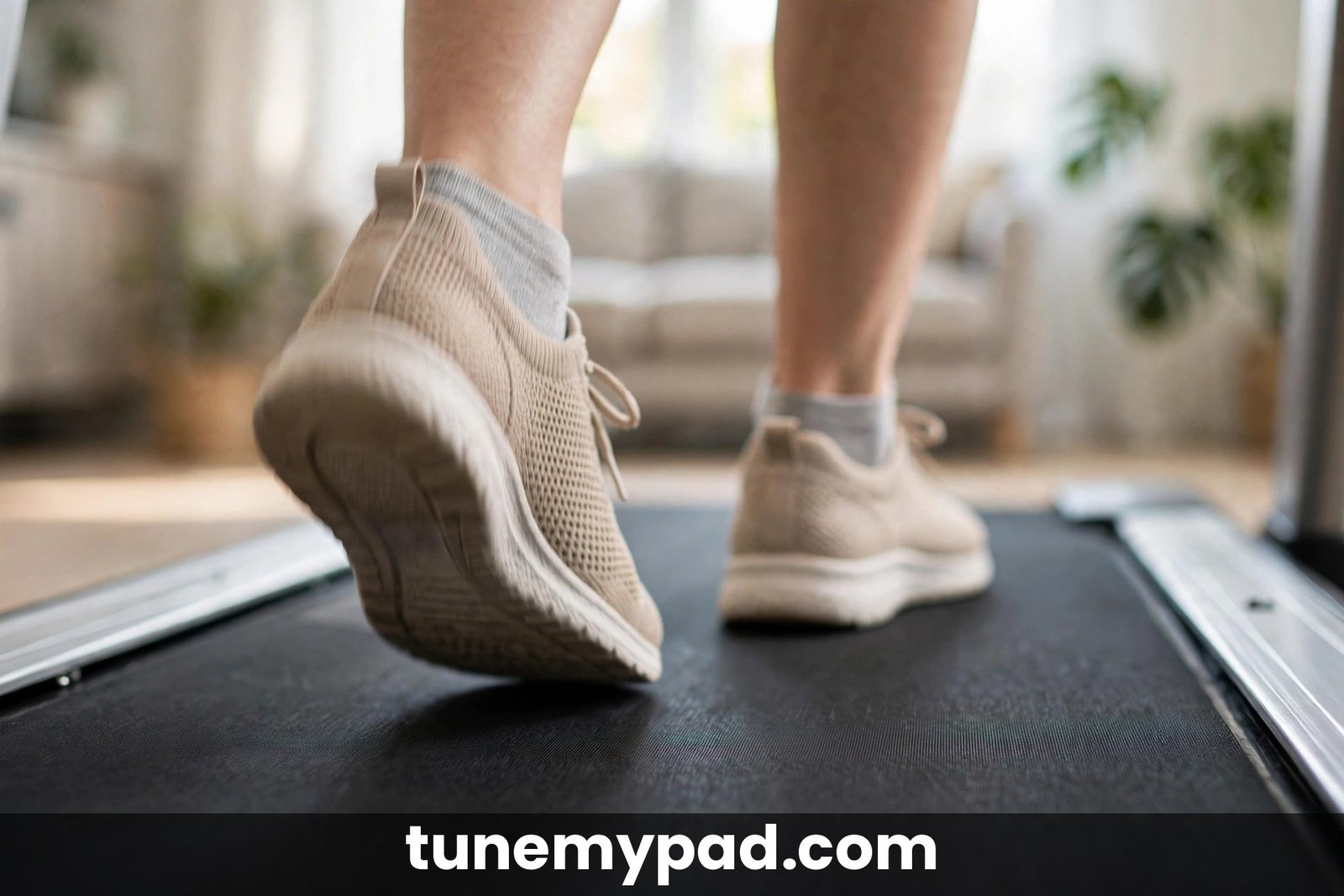
Safety Fact 3: Your Pelvic Floor Went Through a Lot Too
Cesarean birth is sometimes assumed to “spare” the pelvic floor, but nine months of pregnancy itself loads those muscles heavily, and surgery, reduced early mobility, and newborn care (lifting, carrying, feeding postures) all add strain. Pelvic-floor considerations belong in any walking pad after c-section discussion:
- Heaviness, pressure, or a dragging sensation in the pelvic area while walking is a sign to stop and mention it to your clinician — it can indicate pelvic-floor overload.
- Leaking urine when walking is common postpartum but worth reporting; it is a symptom to discuss, not just an inconvenience to tolerate.
- Impact and speed matter. Slow, flat walking is far gentler on the pelvic floor than fast walking or any incline. If your pad has an incline feature, keep it flat unless your clinician says otherwise.
- Breathing pattern helps. Exhaling on effort and avoiding breath-holding or bearing down protects both the incision and the pelvic floor.
Many clinicians refer postpartum patients to a pelvic-health physiotherapist when symptoms persist — that referral is a sign of good care, not of something being “wrong” with you. If walking consistently provokes pelvic symptoms, pause the walking pad after c-section sessions and get assessed before resuming. General information like this cannot evaluate your pelvic floor; a clinician can.
Even without symptoms, mentioning your walking plans at a pelvic-health visit is smart — a quick assessment can confirm that your walking pad after c-section pace and duration suit your recovery, giving you confidence instead of guesswork.
Safety Fact 4: Hydration, Fuel, and Breastfeeding Change the Equation
Postpartum bodies — especially breastfeeding ones — run on tight margins. Walking, even gently, draws on fluid and energy reserves that are already stretched by milk production and sleep deprivation:
- Drink water before, during, and after. Keep a full bottle on the desk or a nearby table, not across the room. Thirst is a late signal; sip on a schedule.
- Do not walk fasted if you are breastfeeding. A small snack beforehand (and one after, if hungry) supports both milk supply and your energy. Dizziness while walking is often under-fueling plus dehydration.
- Watch for warning signs of under-fueling: lightheadedness, headache, unusual fatigue, or a dip in milk supply after increasing activity. Any of these means scale back and talk to your clinician.
- Electrolytes can help if you are sweating or nursing frequently — plain water is fine for short gentle sessions, but longer-term, discuss options with your clinician.
A walking pad after c-section session done dehydrated and under-fed is where most “I felt awful after” stories come from — not from the walking itself. Treat fuel and water as part of the workout equipment, as essential as the safety key.
If you are unsure whether your intake is keeping up with nursing plus walking, your clinician or a lactation consultant can review it with you — another good reason to keep your walking pad after c-section plans on the agenda at follow-up visits rather than treating activity and feeding as separate topics.
Safety Fact 5: Support Garments Are a “Discuss With Your Clinician” Topic
Belly binders, postpartum support belts, and compression garments are popular, and many mothers wonder whether to wear one while walking. The honest general-information answer: opinions and evidence vary, and this is firmly a question for your clinician, because the right answer depends on your incision type, healing progress, and any complications.
Points to raise in that conversation:
- What it may help with: some mothers report less incision tugging and better posture awareness with gentle support during early walks.
- What to watch for: binders worn too tight or too long can affect breathing mechanics and, in some views, pelvic-floor recovery — which is why “all day, as tight as possible” is not a plan to self-prescribe.
- Fit during movement matters: a garment that feels fine standing still may dig or shift once you are walking. If cleared to try one, test it on a very short session first.
- It is not a substitute for healing time. No garment makes a 2-week incision ready for a 30-minute walk; only time and your clinician’s assessment do that.
If your clinician is neutral or unfamiliar with binders, a pelvic-health physiotherapist is the next best person to ask. Either way, keep any walking pad after c-section support-garment experiment short, comfortable, and clinician-aware.
And remember that comfort is the test: if a garment makes breathing feel restricted or increases pelvic pressure during a walk, it is working against you regardless of what the packaging promised. A walking pad after c-section session should feel easier with support, never harder.
Safety Fact 6: Set Up the Pad and the Room for Postpartum Safety
A walking pad is a piece of powered machinery, and postpartum life adds specific hazards: exhaustion, a baby who needs you mid-session, and slower reaction times. Set up defensively:
- Attach the safety key/clip to your clothing every time. If you stumble or need to rush to the baby, the belt stops. This is the single most important habit.
- Keep one hand near a stable support (standing desk, sturdy chair back, wall rail) during early sessions. Dizziness can arrive without warning in the postpartum period.
- Clear the area of toys, nursing pillows, and clutter — trip hazards around a moving belt are how falls happen.
- Keep your phone within arm’s reach and, ideally, have another adult home during early sessions. If you feel faint, you need help fast, not after fumbling across the room.
- Lock the remote away from toddlers if you have older children — a walking pad left powered on is an attractive nuisance. Unplug the pad when not in use.
- Good lighting and ventilation. Overheating is more likely when you are sleep-deprived and possibly anemic; a cool, bright room is safer and more pleasant.
Electrical safety matters too: inspect the cord for damage, plug directly into a wall outlet (not a daisy-chained power strip), and unplug after use. The U.S. Consumer Product Safety Commission’s resources at cpsc.gov cover home fitness equipment safety basics. A safe setup is the unglamorous foundation every walking pad after c-section plan rests on.
One last setup thought: position the pad where you can see the baby (bassinet nearby, monitor in view) so you are never torn between finishing a session and checking on a crying newborn. Peace of mind is part of safety, and a walking pad after c-section routine you can interrupt calmly is a routine you will actually keep.

Safety Fact 7: Progression Has a Shape — Slow, Staged, and Reversible
If your clinician clears walking and you tolerate short gentle sessions well, progression over the following weeks generally follows a pattern: a little longer before a little faster, one variable at a time, with easy pullback at any sign of trouble. This is general information describing a common shape, not a prescription — your clinician’s specific guidance always wins.
The typical shape looks like this:
- Stage 1 (once cleared): very short sessions (a few minutes), very slow pace, once or twice daily. Goal: tolerance, not fitness.
- Stage 2 (when stage 1 feels easy for several days): add a few minutes per session. Keep the pace the same.
- Stage 3 (when longer sessions feel easy): nudge the pace up slightly — still conversational, still comfortable.
- Stage 4 (later, with clinician agreement): build toward a regular daily walk that fits your life — for many mothers this becomes a pleasant work-from-desk habit.
The “reversible” part matters most: any return of incision pain, bleeding changes, pelvic heaviness, or unusual fatigue means dropping back a stage (or pausing entirely) and checking in with your clinician. Progress is not a straight line after surgery, and a walking pad after c-section journey that includes a step back is still a successful one. For keeping the machine itself in good shape as your sessions grow, our walking pad maintenance schedule and silicone oil guide cover the basics.
Think of progression as a conversation with your body rather than a ladder to climb: each session answers the question “was that okay?” and the next session is shaped by the answer. That responsive approach is what makes a walking pad after c-section plan sustainable through the unpredictable weeks of newborn life.
Red Flags: Stop Walking and Call Your Provider
Stop your session immediately and contact your clinician or seek care if you experience any of the following during or after using a walking pad after c-section recovery:
- Heavy vaginal bleeding — soaking a pad in an hour or less, passing large clots, or bleeding that suddenly increases after it had tapered off.
- Incision problems — opening of the wound, increasing redness or swelling, warmth, pus, or foul-smelling drainage.
- Fever of 100.4°F (38°C) or higher, or chills.
- Dizziness, faintness, or feeling like you might pass out.
- Chest pain, trouble breathing, or a racing heartbeat.
- Calf pain, swelling, or redness (possible blood clot signs) — especially in one leg.
- Severe headache or vision changes.
- Foul-smelling vaginal discharge.
- Intense incision or abdominal pain that is new, worsening, or not relieved by rest.
This list is general information, not a complete catalog of postpartum emergencies — if something feels seriously wrong, do not wait to match it to a list. Call your provider, your local urgent-care line, or emergency services. No walking session is worth pushing through a red flag, and pausing a walking pad after c-section routine for a medical check is always the right call. When in doubt, the conservative choice — stop, rest, call — is the correct one for any walking pad after c-section question.
A Gentle Starter Framework (Example Only — Not Medical Advice)
The table below is an illustrative example of how a cautious progression might be shaped after clinician clearance — it is not a recommendation for you personally. Your clinician may clear you earlier, later, slower, or with entirely different parameters. Treat this as a conversation starter for your appointment, not a plan to follow.
| Stage | Illustrative session shape | Self-checks before advancing |
|---|---|---|
| 1 — First cleared walks | A few minutes, very slow pace, once or twice daily | No incision pulling, no increase in bleeding, comfortable conversation |
| 2 — Building time | Add a few minutes per session; pace unchanged | Several easy days in a row; no evening soreness |
| 3 — Building pace | Slightly brisker, still fully conversational | No pelvic heaviness or leaking; energy stable |
| 4 — Routine | A regular daily walk that fits your schedule | Clinician agrees at follow-up; red-flag-free throughout |
Rules that apply at every stage: stop at any red flag, drop back a stage if symptoms return, skip sessions when you are ill or severely sleep-deprived, and re-check with your clinician at your postpartum visits rather than assuming continued clearance. If you track your sessions, our notes on whether walking pad calorie estimates are accurate are worth a read — postpartum is not the season for chasing calorie numbers.
Remember: this framework illustrates a shape, not a schedule. Your actual walking pad after c-section timeline is written by your clinician and your body together — the table just gives you vocabulary for that conversation.
Frequently Asked Questions
How soon after a c-section can I use a walking pad?
There is no universal answer — it depends on your surgery, healing, and complications. Hospital teams often encourage short hallway walks within a day of surgery for circulation, but a walking pad after c-section routine at home needs your own clinician’s explicit clearance, which is typically discussed at postpartum visits (often around 6 weeks, sometimes sooner or later). Ask directly: “When may I start my walking pad, and at what pace and duration?” That specific question about a walking pad after c-section use gets you a far more actionable answer than a general “when can I exercise?”
Is walking on a walking pad after c-section better than walking outside?
Each has trade-offs. A walking pad offers weather independence, a flat predictable surface, instant stop, and the baby stays within sight — real advantages for a recovering mother. Outdoor walks offer fresh air and natural pace control (you slow down automatically when tired; a belt does not). Neither is medically “better” in general — the right choice is whichever your clinician supports and whichever you will do safely and consistently.
Will walking hurt my incision or cause it to open?
Gentle walking as cleared by your clinician does not normally damage a healing incision, and early mobilization is widely encouraged after surgery. But pain, pulling, or any sign of wound opening means the activity exceeded what your body was ready for — stop, rest, and contact your clinician. A walking pad after c-section plan that respects pain signals protects the incision; one that pushes through them risks setbacks. When in doubt about any walking pad after c-section symptom, a quick call to your provider beats a week of anxious guessing.
Can I use the incline feature on my walking pad?
General information only: incline increases abdominal and pelvic-floor loading, so most cautious approaches keep the pad flat in the early weeks unless a clinician says otherwise. If incline is ever introduced, it should be minimal, late in recovery, and clinician-approved. When in doubt, flat and slow is the safe default for a walking pad after c-section use.
What should I wear for postpartum walking pad sessions?
Supportive, well-fitting athletic shoes (not socks or bare feet — stability matters when you are fatigued), soft high-waisted bottoms that do not rub the incision, a supportive bra (especially if breastfeeding — feed or pump before longer sessions for comfort), and the safety clip attached to your clothing. Keep water and your phone within reach.
I feel dizzy when I step off the walking pad. Is that normal?
Brief lightheadedness when stopping can happen — the belt was doing some of the work and your circulation is adjusting — and postpartum factors (blood loss recovery, dehydration, low iron, poor sleep) make it more likely. Slow the belt gradually before stepping off, hold a support, and sit if needed. But recurrent or severe dizziness is a red flag: stop the sessions and talk to your clinician rather than pushing through a walking pad after c-section routine that repeatedly makes you dizzy.
When should I stop postpartum walking and call my doctor?
Stop and call for any red flag: heavy bleeding, incision opening or signs of infection, fever, dizziness or faintness, chest pain or trouble breathing, calf pain or swelling, severe headache or vision changes, or foul-smelling discharge. Also check in for non-urgent concerns like persistent pelvic heaviness, leaking, or incision pain that does not settle. Trust your instincts — you know your body.
The Bottom Line
A walking pad after c-section recovery can be a genuinely useful tool — gentle, weather-proof movement with the baby nearby — but it is a tool that needs a clinician’s green light first. Get explicit clearance with your own pace and duration limits, start slower and shorter than feels necessary, watch the incision and the red-flag list, stay hydrated and fueled, set up the room defensively, and progress one small step at a time with easy pullback built in.
This article is general information, not medical advice, and it cannot account for your surgery, your healing, or your complications. Your doctor or midwife can. Bring them the question, follow their answer over any example you read here, and let your recovery — not a schedule — set the pace. Used wisely and with clearance, a walking pad after c-section healing can support a steadier, calmer return to movement in the demanding weeks of new motherhood — and a well-planned walking pad after c-section routine is one more way to take care of yourself while you take care of your baby.