
A chewed, frayed, or melted power cord is one of the few walking pad problems you should never ignore — and never “fix” with electrical tape. Walking pad power cord replacement is straightforward when you follow the right process: identify the damage, get an exact-spec cord, swap it with the pad unplugged, and verify everything before your next walk. If you are facing a walking pad power cord replacement for the first time, the single most important thing to know is that the cord is a safety component, not an accessory — treat it with the same seriousness as the repair deserves.
This guide covers the safety rules first, the signs your cord is done, how to read the voltage and amperage specs on your pad, where to source the right replacement, and a step-by-step replacement process — plus the dangerous shortcuts to avoid.
Table of Contents
Quick Answer: Walking Pad Power Cord Replacement
| Question | Answer |
|---|---|
| Can you do a walking pad power cord replacement yourself? | Yes — but only with a cord that matches the pad’s voltage, amperage, and plug specs exactly. |
| Can you repair it with tape or a splice? | No. Never splice, tape, or “patch” a damaged mains cord — replace it. |
| Where do you get the right cord? | Start with the manufacturer’s support or parts store; generics only if every spec matches. |
| Is it safe to DIY? | Swapping a detachable cord is safe with the pad unplugged. Hardwired cord? Contact the manufacturer instead of opening the unit. |
| When should you call a pro? | Burning smell, melted plug, scorch marks on the outlet, or any damage you’re unsure about — stop and call the manufacturer or an electrician. |

Safety First: The Non-Negotiable Rules
Electricity doesn’t give second chances. Unplug the pad before you touch the cord — not just switched off, but physically removed from the wall. Switches can fail; an unplugged cord can’t energize anything.
Never splice a power cord. Twisting wires together and wrapping them in tape is not a repair — it’s a fire waiting to happen. Splices create resistance, resistance creates heat, and heat inside a taped bundle has nowhere to go. The same goes for liquid electrical tape and wire nuts on a mains cord. If the cord is damaged, the only safe fix is a full walking pad power cord replacement.
Match the specs exactly. The replacement must match the original’s voltage rating, current rating, wire gauge, and plug type. A cord rated for less current than the pad draws will overheat. When in doubt, the manufacturer’s own replacement part is the safest choice.
Call for help when unsure. If the cord is hardwired into the housing, if you see scorch marks, or if anything confuses you, stop. Contact the manufacturer’s support or a licensed electrician. A dead walking pad is an inconvenience; a botched electrical repair is a hazard. No walking pad power cord replacement is worth a shock or a fire — when in doubt, let a professional handle it. For the broader picture, read whether a walking pad can catch fire.
Signs Your Power Cord Needs Replacing
Cords fail gradually, then suddenly. Act on the first warning sign — don’t wait for the second. Most walking pad power cord replacement jobs start with one of these surprises:
- Visible fraying or exposed copper. Anywhere the insulation is cut, cracked, or worn through to bare wire, the cord is done.
- Kinks, flat spots, or crushed sections. Internal wires break inside intact-looking insulation, creating hot spots you can’t see.
- A plug that runs warm or hot. Warmth at the plug means resistance — from a loose outlet grip, damaged prongs, or internal wire damage.
- Discoloration or melting. Brown marks on the plug, cord, or outlet are heat damage. Stop using the pad immediately.
- Intermittent power. If the pad cuts out when the cord is wiggled, a conductor is broken inside. This arcing is a genuine fire risk.
- Pet chew damage. Teeth puncture insulation deep into the wire bundle. Even “minor” chew marks mean replacement, not tape.
- Burning smell near the cord. Overheating insulation has a distinctive acrid odor. Unplug and do not reuse.
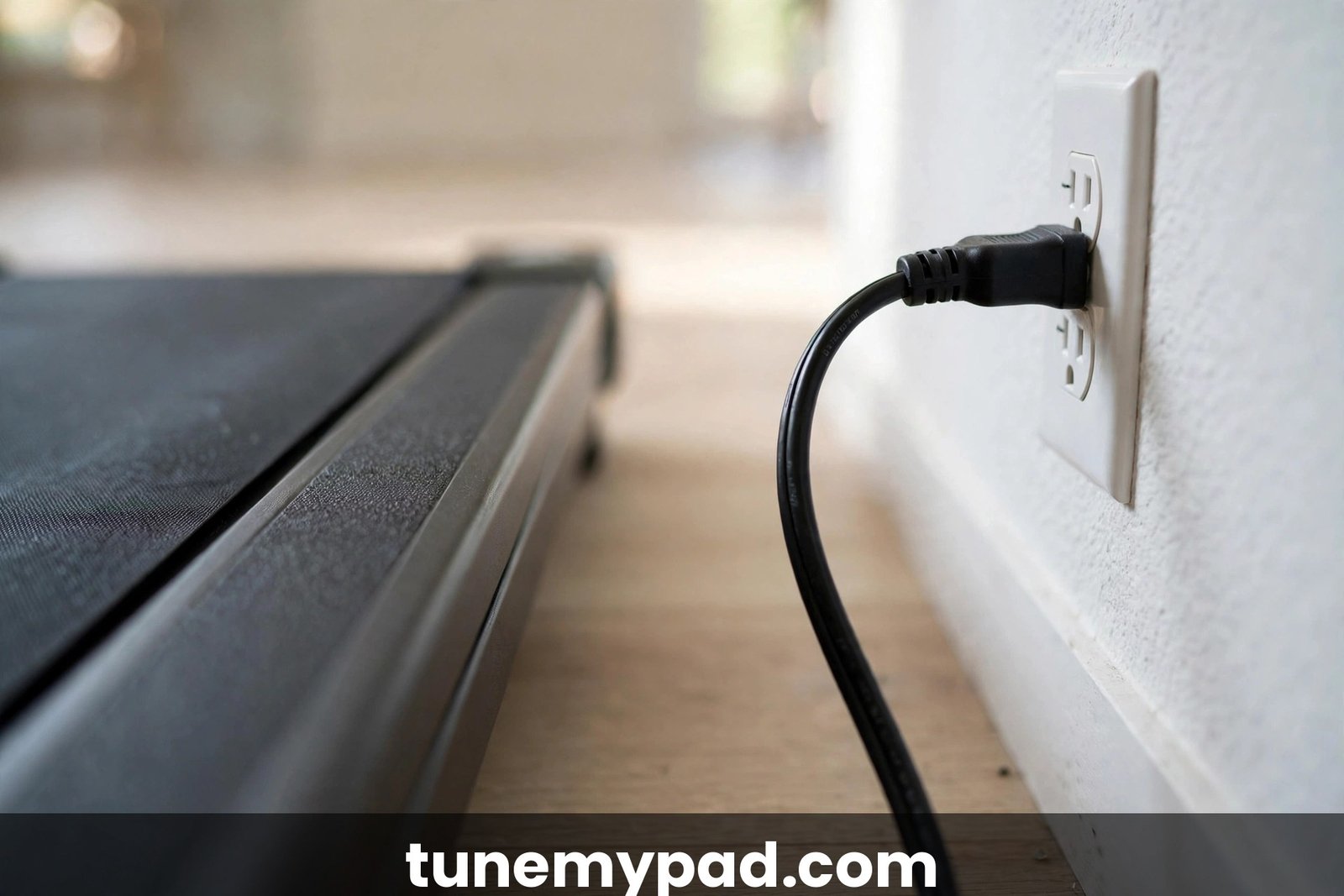
Why Does a Walking Pad Power Cord Fail?
Cords don’t fail randomly — they fail from specific abuse, and knowing the causes helps your walking pad power cord replacement last longer than the original did:
- Repeated bending at the plug. The few inches of cord right behind the plug flex every time you move the pad. Internal copper strands break one by one until only a few carry the full current — then heat builds fast.
- Pinching under the pad or furniture. A cord trapped under a pad foot or desk leg gets crushed every session. Internal damage from crushing is invisible from outside, which is why a crushed-feeling section means replacement even if it “looks fine.”
- Rolling over it with chair wheels. Desk-chair casters are cord killers in treadmill-desk setups. Route the cord along the wall, never across the chair’s rolling zone.
- Pet chewing. Dogs and cats love cord insulation. This is one of the most common reasons a walking pad power cord replacement becomes necessary in pet households.
- Heat and age. Cords near heating vents, in sunlit spots, or simply ten-plus years old get brittle. Old insulation cracks, and cracked insulation is a shock risk.
- Yanking the plug by the cord. Pulling the cord instead of the plug head stresses the internal connections. Always grip the plug itself.
The pattern: almost every cord failure is mechanical damage plus time. A well-routed cord in a pet-free room can last the life of the pad; a cord that gets yanked, pinched, and chewed might not survive a year. Understanding these causes also tells you what to fix alongside your walking pad power cord replacement — there is no point installing a perfect new cord into the same chair-wheel gauntlet that killed the old one.
Repair vs Replace: What to Do
For a damaged mains cord there’s exactly one correct answer: a full walking pad power cord replacement. Here’s how the options compare:
| Approach | Safe? | Verdict |
|---|---|---|
| Full cord replacement with exact-spec cord | Yes | The correct fix, every time |
| Manufacturer replacement part | Yes | Safest option — guaranteed spec match |
| Electrical tape over damage | No | Hides the problem; traps heat |
| Splicing / wire nuts / solder + heat shrink | No | Creates resistance and hot spots |
| A thinner or lower-rated spare cord | No | Can overheat under the pad’s load |
| Continuing to use a damaged cord | No | Fire and shock risk |
Note that many walking pads use a detachable cord (often an IEC-style connector at the pad end) that simply unplugs from the unit — replacement is literally plug-and-play. If yours is hardwired into the motor housing, do not open the unit; the manufacturer or an authorized service center should handle it. Opening the housing can also void your coverage — check what a walking pad warranty covers first.
Hardwired vs Detachable Cords: Know Which You Have
Before you order anything, look at where the cord meets the pad. This thirty-second check decides whether your walking pad power cord replacement is a fifteen-minute DIY job or a call to the manufacturer:
| Feature | Detachable cord | Hardwired cord |
|---|---|---|
| Connection at pad | Plugs into a socket (often IEC C13/C14 style) | Disappears into the housing with a strain-relief grommet |
| DIY replacement | Yes — unplug, swap, done | No — do not open the housing |
| Spec matching | Still required (voltage, amps, gauge) | Done by the manufacturer or authorized service |
| Warranty impact | None for the swap itself | Opening the unit usually voids coverage |
If the cord pulls out of the pad with a firm tug (after unplugging from the wall), it’s detachable. If it runs through a rubber grommet straight into the motor cover with no plug, it’s hardwired — stop here and contact the manufacturer. The most common and dangerous mistake in any walking pad power cord replacement is opening a hardwired unit to “just rewire it,” which combines shock risk with a voided warranty. Identify your cord type before you spend a cent on parts.
How to Find the Right Cord for Your Walking Pad Power Cord Replacement
Getting the right cord is spec-matching, not guesswork. Here’s where to find each spec:
| Spec | Where to find it | Why it matters |
|---|---|---|
| Voltage (V) | Rating label on the pad’s underside or rear | Must match your country’s mains and the pad’s design |
| Current (A) or power (W) | Same rating label; also the original cord’s jacket printing | Replacement must meet or exceed this rating |
| Wire gauge (AWG) | Printed on the original cord jacket | Thicker (lower AWG number) is safer; never go thinner |
| Plug type | Look at the wall plug and the pad-end connector | Must physically match both the outlet and the pad |
| Length | Measure the original | Longer cords add resistance; stay close to original length |
The jacket tells the truth. Read the printing on the original cord — you’ll typically see a voltage rating, a gauge like “18AWG” or “16AWG,” and certification marks. Your replacement must meet or exceed every rating. A 16 AWG cord can safely replace an 18 AWG cord; the reverse is never acceptable.
Start with the manufacturer. Most walking pad brands sell replacement cords or can point you to the exact spec — the path with zero guesswork, especially since some pads use proprietary connectors that generic cords won’t fit. One email to support with your model number and a photo of the jacket printing resolves most walking pad power cord replacement questions in a single reply.
Generic cords are a maybe. A standard detachable cord (like the IEC C13/C14 type used on computers) is fine if every spec matches or exceeds the original. “Close enough” is not a standard — if you can’t verify all the specs, don’t buy it. This spec discipline is the entire difference between a safe walking pad power cord replacement and a dangerous one.
How to Read the Specs Printed on Your Cord’s Jacket
That tiny text molded into the cord’s insulation is the spec sheet for your walking pad power cord replacement. Here’s how to decode a typical marking like “300V 18AWG 105°C”:
| Marking | Meaning | What to match |
|---|---|---|
| 300V | Maximum voltage rating | Must meet or exceed your mains voltage (120V in the US) |
| 18AWG / 16AWG | Wire gauge (lower number = thicker wire) | Replacement must be same gauge or thicker (lower AWG number) |
| 105°C | Maximum insulation temperature | Must meet or exceed the original’s rating |
| UL / ETL / CSA | Safety certification marks | Look for at least one recognized certification |
| FT2 / VW-1 | Flame-resistance rating | Match or exceed; VW-1 is the stricter rating |
Take a clear photo of the full jacket printing before you throw the old cord away — you’ll reference it when ordering, and support teams love a photo. If the printing is worn off (common on older cords), fall back on the pad’s rating label: it lists the voltage and either amps or watts, from which any electrician or the manufacturer can derive the right cord. When any marking is unreadable and the manufacturer can’t help, don’t guess — that uncertainty is exactly what a proper walking pad power cord replacement process is designed to eliminate. A five-minute photo now prevents a wrong-spec order later.
7 Proven Safe Steps for Walking Pad Power Cord Replacement
Follow these in order. The whole job takes about fifteen minutes, most of it spent verifying specs. Read through all seven steps of this walking pad power cord replacement walkthrough before touching anything — knowing the full sequence prevents mid-job surprises.
- Unplug everything. Remove the damaged cord from the wall and from the pad. Confirm the outlet is dead with a lamp or phone charger.
- Photograph the original cord and its specs. Capture the jacket printing, both connectors, and the pad’s rating label for ordering or support calls.
- Inspect the pad’s socket and the wall outlet. Look for scorch marks, melting, or looseness at both ends. If either is damaged, stop — that’s an electrician or manufacturer-support job, not a cord swap.
- Source the exact-spec replacement. Order the manufacturer’s part, or a generic cord that meets or exceeds every spec on the original jacket. This sourcing step is the heart of a safe walking pad power cord replacement — rush it and nothing else matters.
- Compare side by side before connecting. Same plug shapes, same or thicker gauge, same or higher ratings? Only then proceed.
- Connect pad end first, wall end last. Seat the pad-end connector firmly, route the cord away from the belt and walking area (never under the pad), then plug into the wall.
- Test with a supervised short walk. Power on, walk five minutes at low speed, then unplug and feel the plug and cord. Cool everywhere means success. Any warmth — stop and recheck your specs.
If the pad keeps tripping the breaker with a new cord, the issue is the circuit — see why a walking pad keeps tripping the circuit breaker.
What Does a Walking Pad Power Cord Replacement Cost?
A walking pad power cord replacement is one of the cheapest repairs you’ll ever do on fitness equipment — the expensive version is the one where you skip it and something burns:
| Option | Typical cost | Notes |
|---|---|---|
| Manufacturer replacement cord | $15–$40 | Guaranteed spec match; may include shipping wait |
| Generic IEC cord (spec-verified) | $8–$15 | Only if every rating matches or exceeds the original |
| Spare cord from an old appliance | $0 | Acceptable only with verified matching specs — check the jacket printing |
| Electrician visit (hardwired cord) | $75–$150 | For hardwired units; manufacturer service may be cheaper |
| New walking pad | $200–$500+ | Only if the cord failure damaged the pad’s internals |
Most people land in the $15–$40 range with the manufacturer’s part, which is cheap insurance against the fire risk of a wrong-spec cord. If the price of a replacement cord approaches the value of an aging pad with other problems, weigh it against our advice on where to buy walking pad replacement parts — and be honest about whether the pad itself is worth saving. Either way, budgeting for a walking pad power cord replacement beats budgeting for the consequences of ignoring a damaged cord.
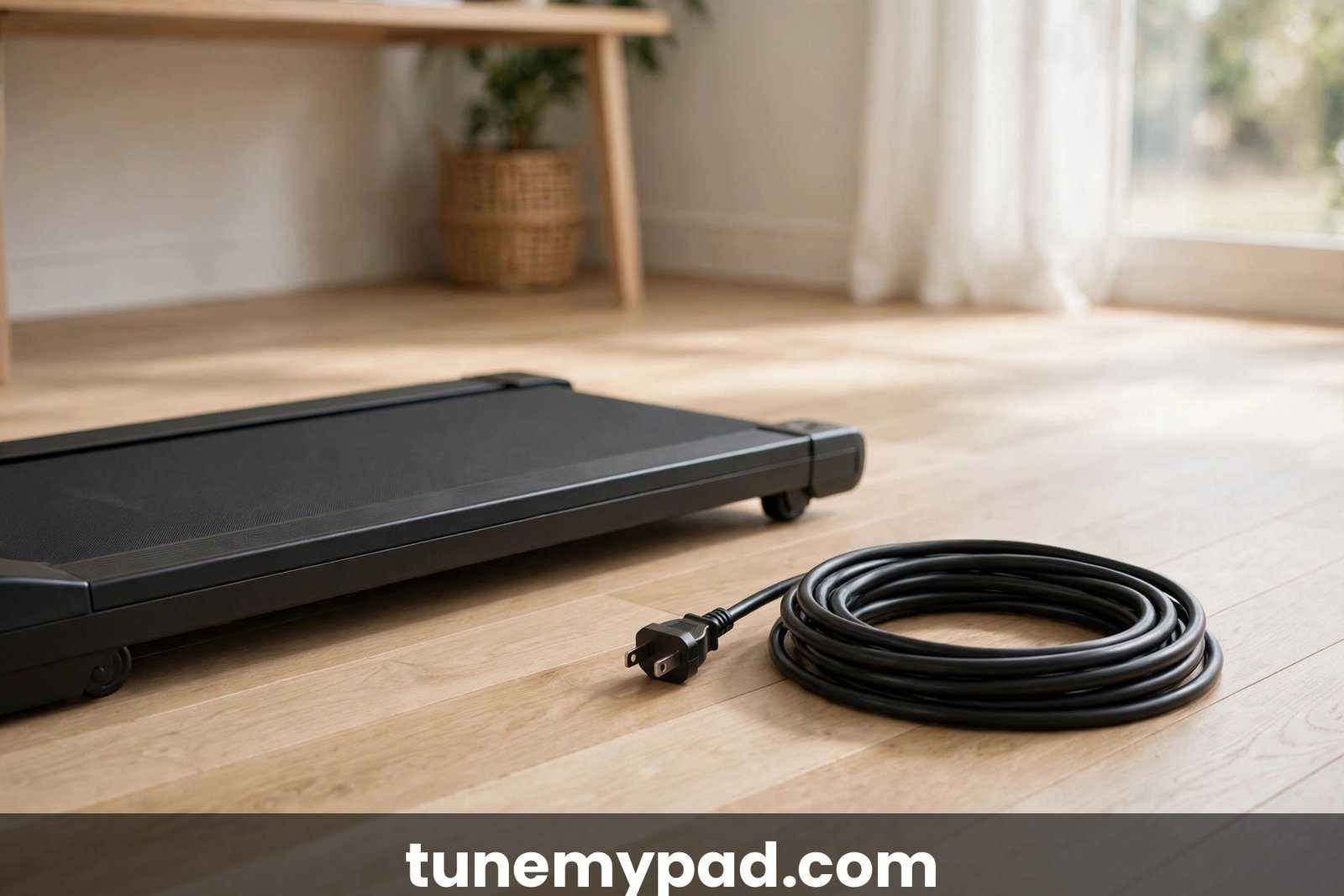
What NOT to Do With a Damaged Cord
Every shortcut below has caused real fires. A walking pad power cord replacement done right costs under $40; done wrong, it can cost you the room:
- Don’t wrap it in electrical tape and keep walking. Tape hides damage and traps heat.
- Don’t splice, solder, or wire-nut the conductors back together. Mains cords are not repairable.
- Don’t borrow a thinner cord from a lamp or phone charger. Undersized cords overheat.
- Don’t use a damaged cord “just for a few more days.” Intermittent conductors arc, and arcing starts fires.
- Don’t open the motor housing to rewire a hardwired cord yourself. That’s manufacturer-service territory.
Power Cord Maintenance: Making Your Replacement Last
Your new cord should outlast the old one — if you treat it better. These habits prevent a second walking pad power cord replacement:
- Leave a service loop. Give the cord a gentle curve near the plug instead of pulling it taut. A cord under constant tension fails at the plug first.
- Route along the wall. Keep the cord out of chair-wheel zones, away from the belt, and never underneath the pad. A cord channel or a few adhesive cable clips costs almost nothing.
- Unplug by the plug head. Train yourself (and everyone in the house) to grip the plug, never yank the cable.
- Protect it from pets. Bitter-apple spray, cord covers, or simply routing the cord where animals can’t reach. One chewed cord is a lesson; two is a pattern.
- Inspect quarterly. Every three months, unplug and run your hand along the full cord, checking for kinks, flat spots, warmth at the plug, and discoloration. It takes two minutes.
- Don’t coil it tightly for storage. If you fold the pad away, loop the cord loosely — tight coils stress the same spots every time.
A cord that lives a gentle life fails from old age, not from abuse — and age-related failure gives you plenty of warning if you’re doing those quarterly checks. Good maintenance is the difference between a walking pad power cord replacement you plan on your own schedule and one forced on you by a burning smell at 6 a.m.
FAQs: Walking Pad Power Cord Replacement
Can I replace a walking pad power cord myself? That detachable-versus-hardwired split is the first question in any walking pad power cord replacement job — it decides whether you’re doing DIY or calling the manufacturer.
If the cord detaches from the pad, yes — safe DIY as long as the pad is unplugged and the replacement matches all specs. If it’s hardwired into the housing, don’t open the unit; contact the manufacturer or an authorized service center.
What happens if I use the wrong replacement cord?
An underrated cord can overheat, melt its insulation, and start a fire. A wrong connector simply won’t fit — the safe failure mode. Always match or exceed the original’s voltage, current, and gauge ratings.
Can I use an extension cord with my walking pad? During a walking pad power cord replacement, treat any extension as a temporary exception, not the new normal.
Only a short, heavy-duty one (14 AWG or thicker) rated for the pad’s amperage, fully uncoiled. Light-duty cords and power strips are a common overheating cause. A direct wall outlet is always best.
How do I know the amperage rating my cord needs?
Check the rating label on the pad’s underside or rear for volts and amps (or watts). Your replacement must meet or exceed that current rating, with jacket printing confirming gauge and voltage.
My dog chewed the cord. Is tape enough until the replacement arrives? Chew damage is one of the most common reasons a walking pad power cord replacement becomes urgent — route the new cord where teeth can’t reach.
No — don’t use the pad until the cord is replaced. Chew damage punctures insulation deep into the wire bundle, and even small nicks can arc under load. Unplug and wait for the proper replacement.
Will replacing the cord myself void the warranty?
Swapping a detachable cord almost never voids anything, but opening the housing for a hardwired cord often does. Check your warranty terms or ask support before opening anything.
How long is a standard walking pad power cord?
Most are 5–8 feet (roughly 1.5–2.5 meters) — long enough to reach a nearby wall outlet without an extension. If your walking pad power cord replacement ends up longer than the original, that’s fine up to a point, but avoid going dramatically longer: extra length adds a small amount of resistance, and excess cord coiled on the floor becomes a trip and pinch hazard. Measure your outlet distance before ordering.
Can I use a computer power cord on my walking pad?
Sometimes — many walking pads use the same IEC C13/C14 connector as desktop computers and monitors. But a walking pad power cord replacement still has to pass the spec check: the computer cord’s voltage, amperage, and wire gauge must meet or exceed the original cord’s ratings. Office PC cords are often 18 AWG, which may be thinner than your pad needs. Check the jacket printing on both cords before swapping.
My new replacement cord feels slightly warm — is that normal?
A barely-perceptible warmth at the plug during a long walk can be normal — connections have tiny amounts of resistance. But “warm” should never become “hot,” and the cord body itself should stay cool. If the plug is noticeably warm to the touch after your walking pad power cord replacement, unplug and recheck: loose outlet grip, an underrated cord, or a loose pad-end connection are the usual suspects. When in doubt, stop using it and call the manufacturer.
How often should I inspect my walking pad’s power cord?
Give it a quick visual and tactile check every three months: run your hand along the cord feeling for kinks or flat spots, check the plug for warmth and discoloration, and confirm it isn’t pinched under anything. Do it monthly if you have pets or if the cord runs through a high-traffic area. Catching damage early is what turns a walking pad power cord replacement into a planned $20 part instead of an emergency. Put a recurring reminder on your phone — the inspection only works if it actually happens.
Conclusion
Walking pad power cord replacement stays simple because the rules are strict: unplug first, never splice, match every spec, and call the manufacturer or an electrician the moment anything looks off. Follow that, and a damaged cord becomes a fifteen-minute fix instead of a fire hazard. Treat every future walking pad power cord replacement with the same discipline — electricity rewards careful people and punishes improvisers. Keep that checklist and walking pad power cord replacement stays a fifteen-minute fix: unplug, match the specs, and never improvise with electricity.
External References
- OSHA Electrical Safety — U.S. Occupational Safety and Health Administration guidance on safe use of electrical equipment, cords, and outlets.
- Electrical Safety Foundation International — Nonprofit safety resources on extension cords, damaged wiring, and home electrical hazards.
- U.S. Consumer Product Safety Commission — Federal product safety guidance and recall information for consumer electrical products.