
You step onto your Sperax 4-in-1, press start, and instead of the belt gliding forward you get a Sperax 4-in-1 walking pad motor error on the display — sometimes with a code like E-something, sometimes just a warning icon and a dead belt. It is alarming, but here is the reassuring truth: a Sperax 4-in-1 walking pad motor error is usually the machine protecting itself, not dying. The error means the control board detected something wrong — overheating, overload, a loose connection, or a jammed belt — and stopped the motor before damage happened.
Because the error is a symptom rather than a diagnosis, fixing a Sperax 4-in-1 walking pad motor error is a process of elimination: cool it down, reduce the load, check the belt, inspect connections, and reset the system. Only a minority of cases end at a genuinely failed motor.
This guide gives you 8 fixes in the order to try them, explains what the error can (and cannot) tell you, and lays out exactly when to stop DIY and contact the seller or a technician.
A note on error codes: manufacturers change code meanings between production batches, and Sperax does not publish a universal code table. This guide will not invent definitions for specific codes like “E2” or “E7” — any site that claims a universal Sperax code list is guessing. Instead, you get diagnostic steps that work regardless of which code your Sperax 4-in-1 walking pad motor error shows.
Table of Contents
Quick Answer: Sperax 4-in-1 Walking Pad Motor Error
| Question | Answer |
|---|---|
| What does a Sperax 4-in-1 walking pad motor error mean? | The control board stopped the motor because it detected abnormal current, heat, or resistance. It is a protective shutdown, not necessarily a dead motor. |
| What clears a Sperax 4-in-1 walking pad motor error most often? | A 30–60 minute cool-down with the pad unplugged, then a belt-tension and lubrication check. Heat and friction cause the majority of cases. |
| Can I keep using the pad if the error clears? | Yes, if it clears after cooling and does not return under normal use. If the Sperax 4-in-1 walking pad motor error returns every session, stop using it until diagnosed. |
| Is the motor actually broken? | Usually not. Genuine motor failure is the diagnosis of exclusion — only after cooling, belt, load, and connection checks all pass and the error persists. |
| When is it unsafe to keep trying? | If you smell burning, see smoke, hear grinding, or the error returns instantly on a cold pad. Unplug and contact support. |

What a Sperax 4-in-1 Walking Pad Motor Error Is Really Telling You
Think of the error as the pad’s circuit breaker tripping. The motor controller constantly monitors current draw and temperature. When current spikes beyond safe limits — because the belt is too tight, the deck is dry, the user is too heavy for the rating, or the motor is overheating — the board cuts power and raises the Sperax 4-in-1 walking pad motor error to tell you why it stopped.
This protective design is good news: it means the board is doing its job. The bad news is that the same error message covers many different root causes, so you cannot skip the elimination process. Work through the fixes below in order — they go from most common and easiest to least common and most involved.
The four families of causes
Almost every Sperax 4-in-1 walking pad motor error falls into one of these buckets:
- Heat: motor overheated from long sessions, poor ventilation, or high ambient temperature.
- Friction: dry deck, over-tight belt, or debris under the belt raising resistance.
- Load: user weight near/above the rated limit, or the pad on soft carpet that flexes under load.
- Electrical: loose internal connector, damaged power cord, voltage problems, or a failing control board.
Your job is to rule them out in that order, because heat and friction are both the most common and the easiest to fix.
Fix 1: The Full Cool-Down (Do This First, Every Time)
If the Sperax 4-in-1 walking pad motor error appeared mid-workout or right after a long session, heat is suspect #1. Motors have thermal protection that trips around high winding temperatures, and walking pads — with their small motors and enclosed housings — heat up faster than full-size treadmills.
- Stop trying to restart the pad. Repeated restarts on a hot motor just re-trip the protection.
- Unplug the power cord from the wall (not just the pad’s switch).
- Let the pad sit for 30–60 minutes in a ventilated spot. If the room is hot, point a fan at the motor housing area.
- While you wait, check the environment: is the pad pushed against a wall blocking its vents? Is it on thick carpet that insulates the underside? Is the room above ~30°C (86°F)? Fix what you can.
- Plug back in and try a short, slow test walk — 5 minutes at low speed, no incline accessories.
If the error clears and stays clear during normal use, heat was your culprit. Skip to the prevention section at the end so a Sperax 4-in-1 walking pad motor error doesn’t become your regular workout companion. If the error returns within minutes on a cool pad, continue to Fix 2 — heat was a symptom, not the cause.
Fix 2: Check Belt Tension and Centering
An over-tight belt is the #2 cause of a Sperax 4-in-1 walking pad motor error. Excess tension multiplies friction, current draw climbs, and the board trips. A belt that has drifted to one side and rubs the frame does the same thing.
The lift test: with the pad off, try to lift the belt in the center of the deck. You should be able to lift it roughly 5–8 cm (2–3 inches). If you can barely get fingers under it, it’s too tight. If it lifts excessively and slips during use, it’s too loose (which causes its own error family — slipping belts can also trip current protection).
Centering check: look at the gap between the belt edges and the side rails. It should be roughly even on both sides. If the belt rubs one rail, it needs centering via the rear roller adjustment bolts (quarter-turn adjustments, testing between each — your manual shows the exact location).
Adjustment rules:
- Adjust in quarter-turn increments only, then test.
- Right-side bolt clockwise typically moves the belt right; left-side counterclockwise moves it left — but verify with your manual, as designs vary.
- Never loosen the belt so much that it slips underfoot; a slipping belt is a fall hazard.
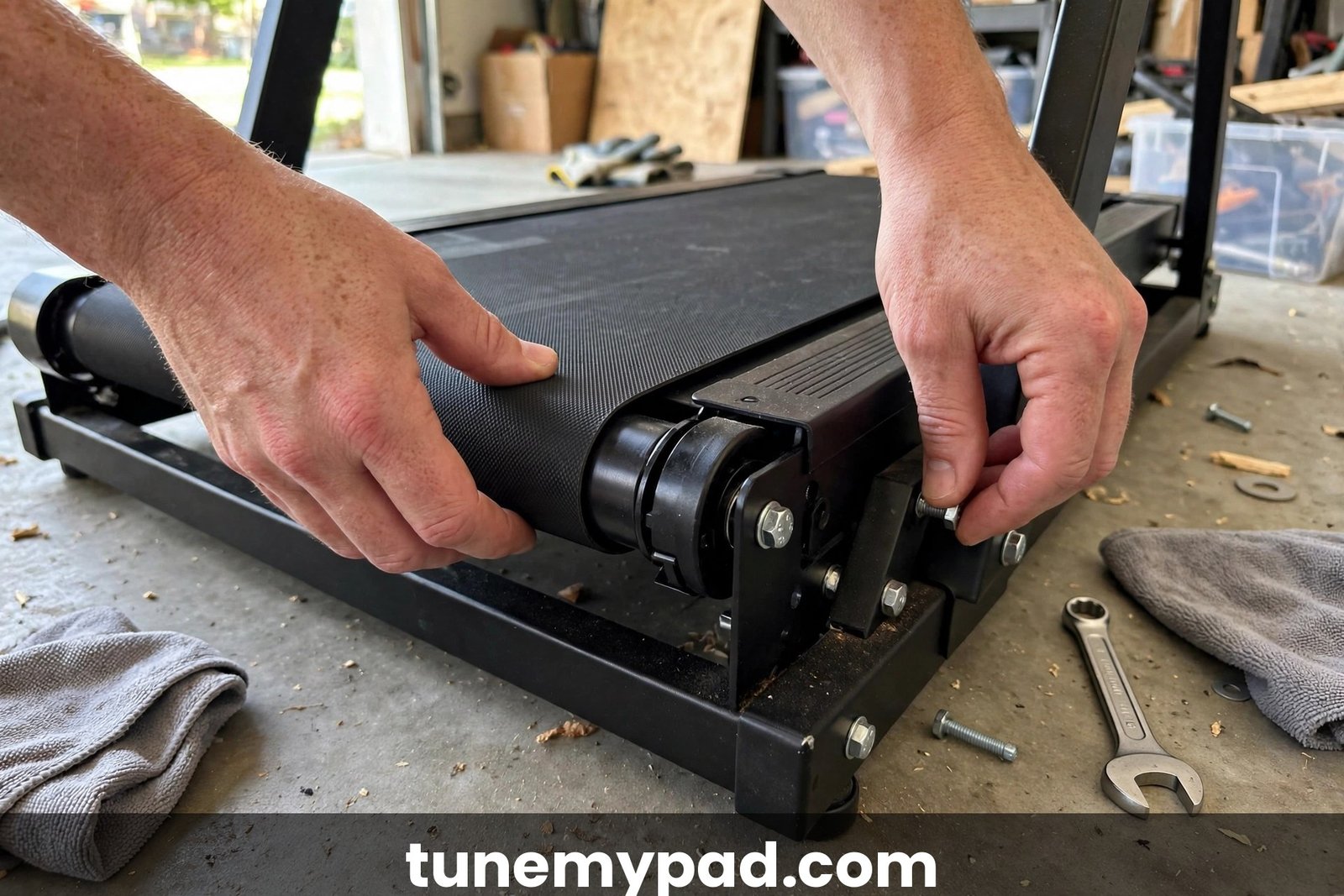
After adjusting, do the 5-minute slow test walk. Many owners clear a recurring Sperax 4-in-1 walking pad motor error permanently at this step and never learn which of heat vs. tension was the true cause — which is fine, because both fixes are now in place.
Fix 3: Lubricate the Deck
A dry deck is silent friction. Walking pad decks need periodic silicone lubrication (check your manual for the interval — commonly every 1–3 months of regular use), and a pad that has never been lubricated will eventually throw a Sperax 4-in-1 walking pad motor error as friction climbs past the board’s limits.
- Use 100% silicone lubricant made for treadmills. Never use WD-40, oil, or grease — they degrade the belt and deck.
- With the pad off and unplugged, lift the belt and apply the lubricant in an S-pattern under the belt across the deck surface, per your manual’s quantity guidance.
- Plug in, run the belt at the lowest speed for 3–5 minutes with no one on it to spread the lubricant evenly.
- Wipe any excess from the belt edges and the floor.
If you have never lubricated the pad and it’s more than a couple of months old, do this even if Fix 2 seemed to solve things — dryness and tension compound each other, and the Sperax 4-in-1 walking pad motor error will return with the next heat wave if the deck is still dry. For a deeper dive on lubrication technique, see our guide on silicone oil for walking pads.
Fix 4: Reduce the Load
Every walking pad has a maximum user weight rating, and the Sperax 4-in-1’s compact motor has less headroom than a full-size treadmill’s. A Sperax 4-in-1 walking pad motor error that appears only with heavier users — or only when the pad sits on soft, thick carpet — is a load problem.
- Check the rating: find the max user weight in your manual or on the label. If you’re within ~10% of it, you’re in the zone where the motor works hardest; keep sessions shorter and speeds moderate.
- Surface matters: thick carpet lets the pad flex and sink, which increases rolling resistance dramatically. Move the pad to a hard floor or a firm equipment mat. This single change resolves a surprising number of load-related Sperax 4-in-1 walking pad motor error cases.
- Session length: small motors need duty cycles. If your error appears at minute 45 of every walk, the motor is telling you its thermal limit. Split long walks into two sessions with a cool-down between.
- Speed vs. load: high speed + high load = maximum current. If you’re near the weight rating, keep speeds moderate rather than pushing the top end.
Be honest with yourself here: a pad rated for 100 kg carrying 115 kg on plush carpet in a warm room is not a warranty case — it’s physics. Matching the machine to the use is part of owning a compact walking pad.
Fix 5: Inspect Power, Cord, and Outlet
An underpowered or flaky electrical supply can cause current spikes the board reads as a motor fault — a Sperax 4-in-1 walking pad motor error with an electrical root cause.
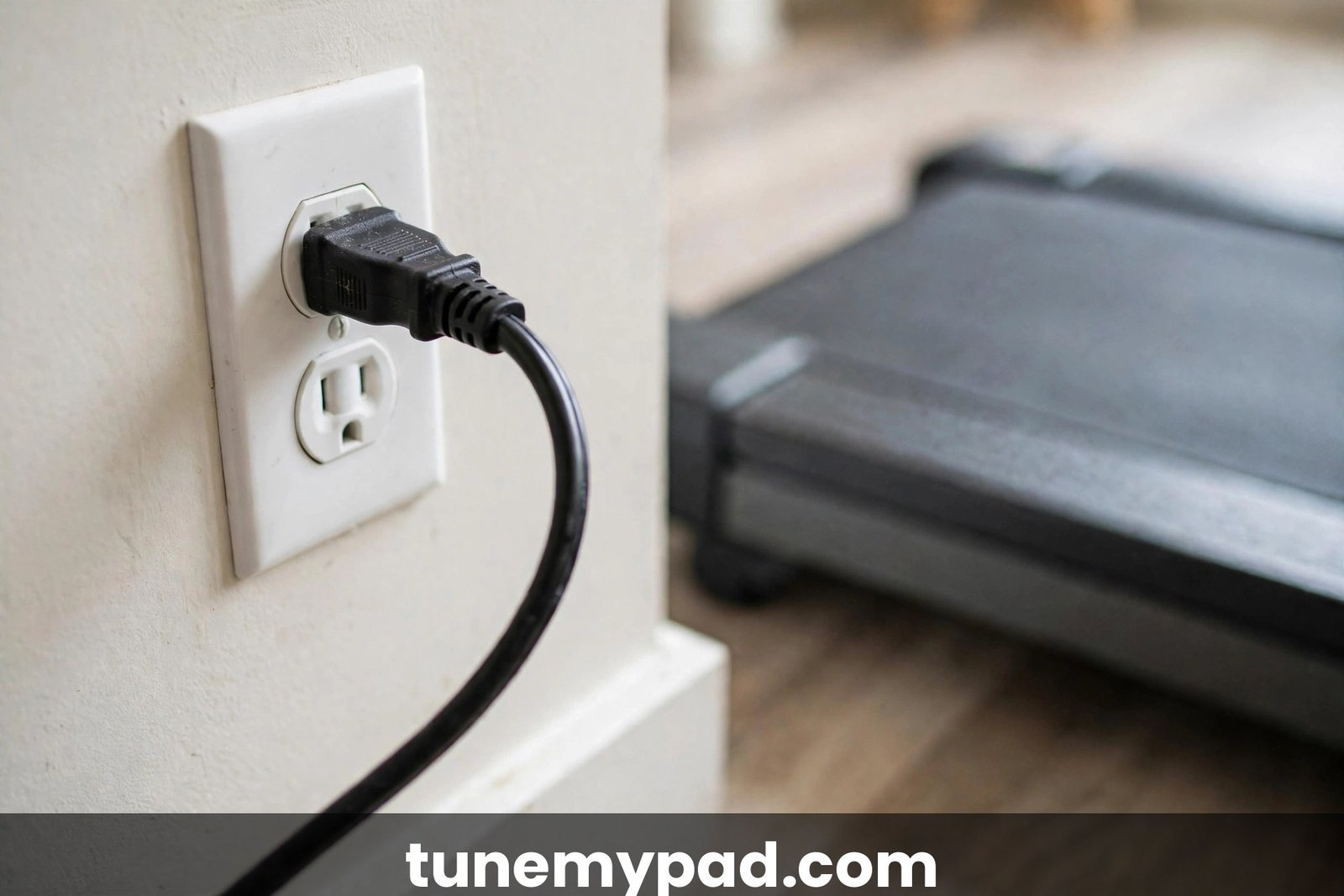
- Plug the pad directly into a wall outlet, not a power strip, extension cord, or multi-plug adapter. Strips with surge protection can starve motors during startup surges.
- Try a different outlet on a different circuit, ideally one you know is lightly loaded.
- Inspect the full length of the power cord for nicks, kinks, or crushed sections. If the cord is damaged, stop using the pad — a damaged mains cord is a shock and fire risk, and no Sperax 4-in-1 walking pad motor error is worth that.
- Check that the plug seats firmly; a loose plug arcing in the socket can cause voltage dips that trip the board.
- If your home has frequent brownouts or the lights dim when the pad starts, consider having an electrician check the circuit — chronic undervoltage shortens motor life.
If the error disappears on a different circuit with a direct wall connection, your pad is fine and your wiring was the problem. A tripping breaker alongside the error points the same way.
Fix 6: Clear Debris and Check for Mechanical Jams
Anything that physically resists the belt raises motor current: a surprising amount of household debris ends up under walking pads.
- Unplug the pad.
- Tilt or lift it (get help — even compact pads are awkward) and check underneath for toys, cables, rug edges, or packaging material wedged against the belt or rollers.
- Look at the gap between the belt and the deck for grit, pet hair mats, or small stones that migrated in on shoes.
- Spin the belt by hand (pad unplugged). It should move with steady, moderate resistance. If it catches, grinds, or locks at one spot, there’s a mechanical obstruction or a damaged roller — do not force it.
- Check the rear roller end caps; a cracked cap can let the roller shift and bind.
Pet owners, take note: hair wrapping around the front roller is a classic hidden cause of a recurring Sperax 4-in-1 walking pad motor error. It builds up invisibly, friction climbs over weeks, and then the error appears “out of nowhere.” A quarterly peek underneath prevents it.
Fix 7: The Control-Board Reset Sequence
If heat, belt, lube, load, power, and debris are all ruled out, reset the electronics. This clears corrupted fault latches — situations where the board keeps reporting a Sperax 4-in-1 walking pad motor error from memory even though the physical cause is gone.
- Unplug the pad from the wall.
- Wait a full 10 minutes (longer than the Fix 1 cool-down — this is about draining the board, not cooling the motor).
- While unplugged, press and hold the pad’s power button for 15 seconds to discharge residual power.
- Plug directly into a wall outlet, power on, and test with a short slow walk.
- If your model has a console reset combination in the manual, use it now — but only the combination from your manual, not one from a video about a different brand.
If the Sperax 4-in-1 walking pad motor error returns instantly on a cold, unloaded, well-lubricated pad with a centered belt, you’ve eliminated every external cause. What remains is internal: a failing motor, a dying control board, or a damaged internal connector.
Fix 8: When It’s Actually the Motor (Diagnosis of Exclusion)
You’ve earned the right to suspect hardware only after Fixes 1–7. Signs pointing to a genuine motor or board failure:
- The Sperax 4-in-1 walking pad motor error appears within seconds on a cold pad with no one standing on it.
- You hear humming or buzzing from the motor area with no belt movement — the board is sending power but the motor can’t turn (possible seized bearing or shorted winding).
- A burning smell or visible scorch marks near the motor housing. Unplug immediately and do not use the pad again.
- The error persists across outlets, circuits, and a full reset sequence.
At this point, your options are warranty claim (check your purchase date and the seller’s terms first), professional repair, or replacement. Do not attempt to replace the motor yourself unless you are experienced with mains-powered appliances: capacitors on the control board can hold a dangerous charge long after unplugging, and incorrect wiring is a fire risk. If you’re weighing the economics, our motor replacement cost guide breaks down typical part and labor ranges.
Safety red lines — stop immediately and unplug if you ever see: smoke, sparks, a burning smell, a hot or discolored power cord, or the pad moving on its own. These are not troubleshooting scenarios; they are “unplug and call support” scenarios. The CPSC’s guidance on home exercise equipment safety is worth a read: cpsc.gov.
Preventing the Next Sperax 4-in-1 Walking Pad Motor Error
| Habit | Why it matters |
|---|---|
| Lubricate every 1–3 months | Keeps friction (and current draw) low |
| Keep belt centered and correctly tensioned | Prevents edge-rub current spikes |
| Hard floor or firm mat, not plush carpet | Reduces flex-related resistance |
| Ventilated placement, vents unblocked | Lets the motor shed heat |
| Respect the weight rating and duty cycle | Keeps current within design limits |
| Quarterly underside check for hair/debris | Catches silent friction buildup |
| Direct wall outlet, no daisy-chained strips | Stable voltage, no starvation |
A Sperax 4-in-1 walking pad motor error that you’ve fixed once is a message about maintenance, not a curse. Pads that get lubrication, sensible placement, and cool-down respect run for years without repeating it.
Frequently Asked Questions
What does the E-code on my Sperax 4-in-1 walking pad motor error mean?
Sperax does not publish a universal code table, and meanings vary by production batch — so treat any specific code as “the board detected a motor-system anomaly” rather than a precise diagnosis. The elimination process in this guide (heat → belt → lube → load → power → debris → reset) is the correct response regardless of which code your Sperax 4-in-1 walking pad motor error displays. If a code persists after all steps, report the exact code to support — they can map it for your batch.
My Sperax 4-in-1 walking pad motor error only happens after 30+ minutes. Is the motor dying?
Probably not — that’s the classic thermal-protection signature. The motor heats gradually, trips the protection at its thermal limit, and works fine again once cool. Shorten sessions, improve ventilation, lubricate the deck, and confirm the belt isn’t over-tight. A motor that runs 30 minutes before tripping is a motor asking for better conditions, and a recurring Sperax 4-in-1 walking pad motor error on a strict timer is one of the most fixable patterns there is.
Can I reset a Sperax 4-in-1 walking pad motor error by just unplugging it for a few seconds?
A few seconds isn’t enough. Capacitors on the control board hold charge and keep the fault latch alive — that’s why this guide specifies 60 seconds minimum for a cool-down and 10 minutes for a full board reset. If your Sperax 4-in-1 walking pad motor error “resets” with a quick unplug but returns within minutes, the underlying cause (heat, friction, load) is still there; the reset just cleared the symptom temporarily.
The belt moves by hand but the motor won’t drive it. What does that mean?
If the belt spins freely by hand (pad unplugged) but the motor can’t drive it and throws a Sperax 4-in-1 walking pad motor error, the mechanical path is fine and the problem is electrical: motor, control board, or the connection between them. You’ve effectively completed Fixes 1–6 with one test. Proceed to the reset sequence (Fix 7), and if that fails, it’s a support/repair conversation (Fix 8).
Is it safe to keep walking on a pad that throws a Sperax 4-in-1 walking pad motor error occasionally?
An occasional error that clears with cooling and doesn’t recur under normal conditions is the protection system working as designed — annoying, not dangerous. But “occasional” should become “never” once you apply the prevention habits. If the Sperax 4-in-1 walking pad motor error becomes frequent, or ever comes with smells, sounds, or heat, stop using the pad until it’s diagnosed. Protection systems are a backstop, not a maintenance plan.
How long do walking pad motors last?
With reasonable maintenance — lubrication, correct belt tension, ventilation, and respect for the weight rating — small walking-pad motors typically last several years of regular home use. The motors that die young are almost always killed by chronic overheating or chronic overload, both of which announce themselves first as a Sperax 4-in-1 walking pad motor error. Heed the early warnings and the motor lasts; ignore them and it doesn’t.
The Bottom Line
A Sperax 4-in-1 walking pad motor error is your pad’s way of saying “something’s wrong, and I stopped before it got expensive.” In most cases that something is heat, belt tension, a dry deck, or excessive load — all fixable in an afternoon with no parts and no tools beyond what came in the box. Work the eight fixes in order, respect the safety red lines, and don’t invent meanings for error codes that the manufacturer never published.
If you reach the end of the ladder and the Sperax 4-in-1 walking pad motor error still appears on a cold, empty, well-maintained pad, you’ve done the diagnostic work that makes a warranty claim or repair quote straightforward. And if the fixes worked, the prevention table above is your insurance policy against ever seeing that error message again. For more walking pad guides and troubleshooting, visit the TuneMyPad homepage.