
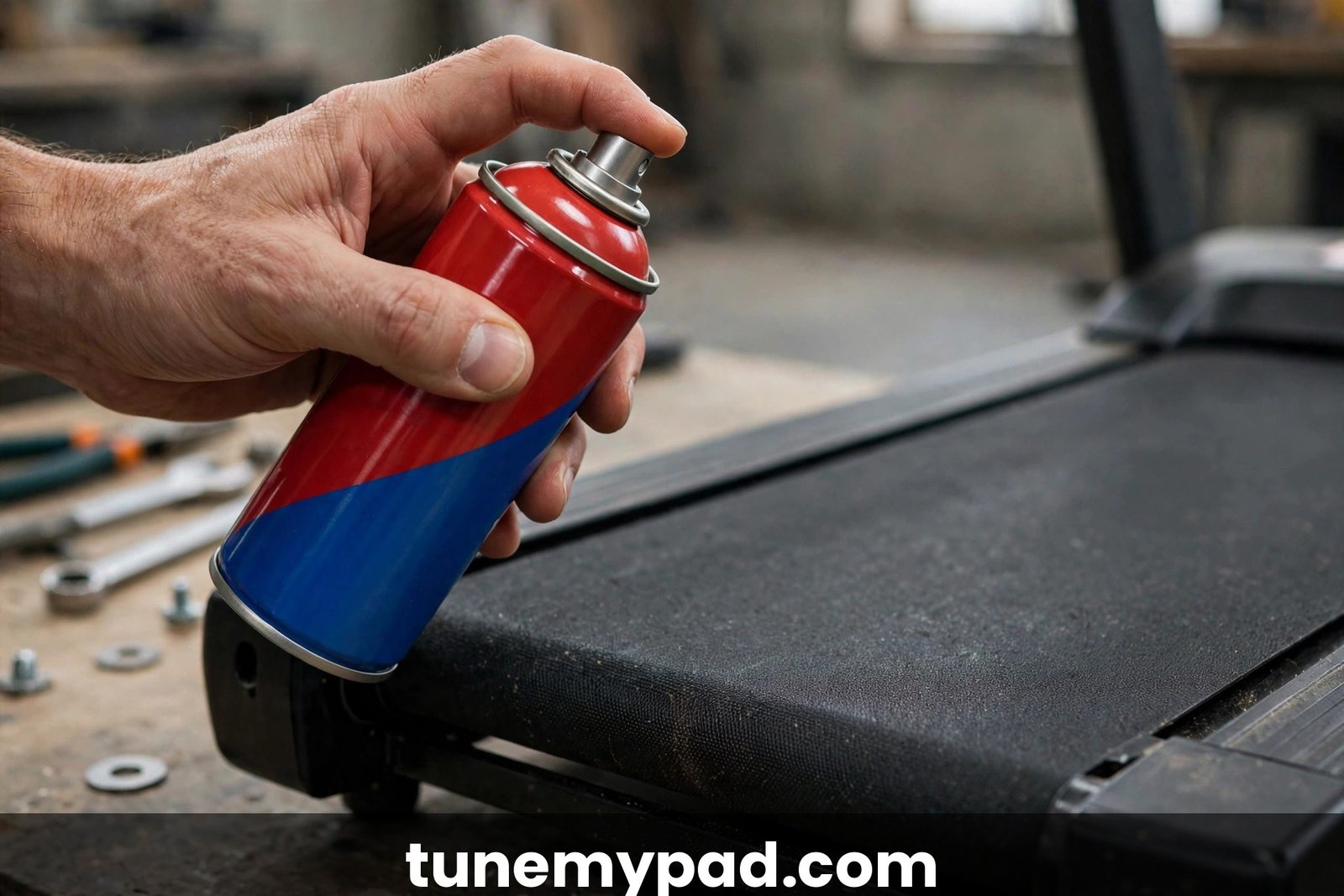
It’s sitting in the garage, it fixes squeaks on door hinges, and someone on a forum swears by it. So when your walking pad starts squeaking or the belt feels dry, reaching for the blue-and-yellow can feels natural. Don’t. Regular WD-40 is one of the fastest ways to shorten your walking pad’s life — and the reason comes down to what WD-40 actually is.
Quick Answer: Can You Use WD-40 on a Walking Pad?
| Question | Answer |
|---|---|
| Can I spray regular WD-40 on the belt or deck? | No. It’s a petroleum-based solvent, not a lasting lubricant — it degrades rubber, attracts dirt, and creates a fire risk near motor heat. |
| What should I use instead? | 100% silicone oil (silicone treadmill lubricant), 5–10 ml under the belt every ~3 months. |
| What about WD-40 Specialist Contact Cleaner? | It’s for electronics only (control board contacts) — still never for the belt or deck. |
| Can WD-40 go on roller bearings or screws? | A tiny amount on a rusty external screw is tolerable, but wipe it off — and never near the belt or motor. |
| I already sprayed WD-40 on my belt — now what? | Wipe it off thoroughly, clean the deck, and apply proper silicone oil. Act fast. |
Why Regular WD-40 Damages Walking Pads
WD-40’s original formula is roughly half petroleum-based solvent with light lubricating oil — it’s designed to displace water, penetrate rust, and then largely evaporate. That chemistry is wrong for a walking belt in four ways:
1. It attacks the belt. Walking belts are rubber (often with cotton or polyester undersides). Petroleum solvents break down rubber compounds and the cotton fibers on the belt’s underside. Treadmill technicians describe the result as “cotton candy belt” — the underside fibers disintegrate into clumps under the belt and around the motor, friction skyrockets, and the belt is ruined. Belt and deck surfaces are engineered to work with silicone lubricants, nothing else.
2. It attracts dirt. WD-40 leaves a thin, tacky residue that grabs dust, floor grit, and carpet fibers — exactly the debris that accelerates belt wear. Silicone oil, by contrast, forms a slick, dry-feeling film that doesn’t trap particles the same way.
3. It’s a fire risk. Petroleum solvents are flammable, and a walking pad’s motor compartment generates heat. Spraying a flammable solvent near a warm motor and its electrical contacts is a genuinely bad combination.
4. It doesn’t last. WD-40 evaporates quickly — the squeak may vanish for a day and return worse, because the solvent stripped away whatever silicone film was left. You end up reapplying more often, compounding the damage.
The short version from every treadmill maintenance authority: steer clear of WD-40 and similar products on the belt, because the materials can dissolve or degrade.
WD-40 vs. Silicone Oil: What’s Actually Different
| Regular WD-40 | 100% silicone oil | |
|---|---|---|
| Base chemistry | Petroleum solvent + light oil | Pure silicone (dimethicone/methyl silicone) |
| Effect on belt rubber | Degrades and swells rubber over time | Safe — what belts are engineered for |
| Lubrication longevity | Evaporates in days | Lasts ~3 months / 30–50 hours of use |
| Dirt attraction | Leaves tacky residue that traps grit | Slick film, minimal residue |
| Fire risk near motor | Flammable solvents | High heat resistance (stable to ~200°C+) |
| Warranty standing | Use can void belt/deck warranty | The manufacturer-recommended lubricant |
This is why the answer is never “WD-40 is fine if you’re careful.” The products do fundamentally different jobs.
The One Narrow Exception: WD-40 Specialist Contact Cleaner
There is exactly one WD-40-branded product with a legitimate walking-pad use: WD-40 Specialist Electrical Contact Cleaner — and only on the control board and electrical contacts, e.g., when cleaning corrosion off a board during a deep repair. It evaporates fast, leaves no residue, and is designed for electronics.
Even then: never spray it on the belt, deck, rollers, or anywhere near the walking surface — overspray migrates. And never confuse it with regular WD-40 on electronics, which can cause permanent damage. If you’re opening the motor cover for board-level work, you already know enough to handle it carefully; if you’re not, this exception doesn’t apply to you.
What to Use Instead: 100% Silicone Oil
The correct lubricant is 100% silicone treadmill oil — non-toxic, odorless, and stable at the temperatures a motor compartment reaches. Most walking pads ship with a small bottle; when it runs out, any 100% silicone treadmill lubricant works (around $8–$20 online or at sporting goods stores).
The routine: unplug the pad, lift each belt edge, apply a thin line of silicone oil onto the deck under the belt — 5–10 ml total per application — then run the pad slowly for 3–5 minutes to distribute it. Every 3 months or 30–50 hours of use. Full walkthrough in our lubrication guide, and the detailed dosing math in how much silicone oil a walking pad needs.
Other acceptable options: dry Teflon (PTFE) spray or paraffin wax, if your manual specifies them. Never: cooking oils, 3-in-1 oil, sewing machine oil, motor oil, or any petroleum product — they all share WD-40’s problems.
I Already Sprayed WD-40 on My Walking Pad — Damage Control
Don’t panic, but don’t wait either. The longer petroleum solvent sits on the belt, the more it degrades the rubber.
- Unplug the pad and move it somewhere ventilated.
- Wipe the belt surface thoroughly with a clean, dry cloth, then a slightly damp cloth with a drop of mild dish soap, then a plain damp cloth. Repeat — you want the residue gone, not spread.
- Clean the deck under the belt the same way: lift the edges, wipe down what you can reach.
- Let it air-dry completely (a few hours) so no solvent remains.
- Apply proper 100% silicone oil (5–10 ml) and run slowly for 5 minutes to re-establish the protective film.
- Watch for symptoms over the next weeks: squeaking that returns fast, a tacky belt surface, or visible fiber shedding underneath. If the belt’s underside is already disintegrating (“cotton candy” clumps), the belt needs replacing — no lubricant fixes that.
If the WD-40 went into the motor compartment, let it evaporate fully in a ventilated space before powering on, and watch for odd smells on first use.
Safety Stop-Points
- Never spray any aerosol near an open motor compartment — flammable propellants plus electrical contacts are a fire hazard. Unplug and let the area cool first.
- Burning or chemical smells after using any spray: unplug immediately, ventilate, and don’t power on until the source is identified.
- If the belt is already shedding fibers or feels tacky and degraded, stop using the pad — a failing belt can slip or tear underfoot. Inspect or replace it before walking again.
Can You Use WD-40 on a Walking Pad FAQs
Can I use WD-40 to stop my walking pad from squeaking?
It might silence the squeak for a day, but it strips the remaining silicone film and degrades the belt, so the squeak comes back worse. A squeaky belt is asking for silicone lubrication — fix the cause, not the symptom. If squeaking persists after lubrication, see our squeaking noise fix.
Is WD-40 silicone spray OK for a walking pad?
WD-40 Specialist Silicone is silicone-based, but it’s formulated as a general waterproofer, not a treadmill belt lubricant — viscosity and additives differ from 100% silicone treadmill oil. In a pinch it’s less harmful than regular WD-40, but proper treadmill silicone oil is cheap and purpose-made. Use the right product.
Can I use WD-40 on walking pad roller bearings?
Bearings are sealed on most walking pads — spray won’t reach them anyway, and overspray will hit the belt. If a bearing is genuinely failing (grinding or clicking), it needs replacement, not spray. Keep WD-40 away from the belt path entirely.
What about 3-in-1 oil or sewing machine oil?
Same problem as WD-40: petroleum-based, wrong viscosity, degrades belt materials and attracts dirt. Treadmill belts are engineered for silicone (or wax, on wax-system decks) — nothing else.
Will using WD-40 void my warranty?
Very likely, if the manufacturer can tell. Belt and deck warranties assume the recommended silicone lubricant; chemical damage from unapproved lubricants is a standard exclusion. Check your manual — most state the approved lubricant explicitly.
What’s the cheapest proper alternative?
A bottle of 100% silicone treadmill oil costs roughly $8–$20 and lasts a year or more at 5–10 ml per quarterly application. That’s cheaper than one month of the belt damage WD-40 causes.
Conclusion
Regular WD-40 has no place on a walking pad’s belt or deck: it’s a petroleum solvent that degrades rubber, attracts dirt, evaporates in days, and brings a fire risk near motor heat. Use 100% silicone oil instead — the full how-to is in our lubrication guide, with exact dosing in how much silicone oil your walking pad needs. The only WD-40 product with any walking-pad role is the Specialist Contact Cleaner, and only on electronics. External references: BarBend’s treadmill lubrication guide (why to avoid WD-40 — materials can dissolve), TrackTrekkers’ walking pad lubrication guide (WD-40 vs. silicone oil, over-lubrication signs), and TreadmillDoctor’s lubrication instructions (correct silicone application).