
Choosing the best mat under walking pad for noise is the highest-impact purchase most walking pad owners will ever make. A good mat can cut perceived noise in half, protect your floors from scratches and dents, and keep your pad from creeping across the room. A bad mat does almost nothing except lighten your wallet.
The problem is that most “treadmill mats” on the market are designed for full-size treadmills or yoga, not for the specific job of the best mat under walking pad for noise. They are too thin, too soft, or too small. In this guide we explain what actually blocks vibration, review 7 picks that work in real homes, and call out the mats you should avoid.
Whether you are trying to keep downstairs neighbors happy or just want a quieter workout room, finding the best mat under walking pad for noise starts with understanding density, thickness, and size. Let us find yours.
Quick Answer: Best Mat Under Walking Pad for Noise
The best mat under walking pad for noise is a dense 3/4-inch rubber mat that extends at least 6 inches beyond the pad on all sides. Rubber horse-stall mats offer the best value: they are cheap, extremely dense, and built to absorb impact. Interlocking high-density EVA foam gym tiles are the easiest to install and a close second for the best mat under walking pad for noise. Avoid thin yoga mats and soft memory-foam mats; they compress underfoot and block almost no vibration.
Table of Contents
What Makes a Mat Good at Blocking Noise
Before the picks, a quick physics lesson, because it explains every recommendation for the best mat under walking pad for noise. Vibration from your footsteps travels as energy through the floor. A mat fights it three ways: mass (heavy material resists moving), damping (the material turns vibration into tiny amounts of heat), and decoupling (layer boundaries break up the vibration path).
This is why density beats softness. A soft, squishy mat feels nice but bottoms out under your weight, leaving a thin compressed layer that transmits vibration almost as well as the bare floor. A dense mat stays thick under load and keeps absorbing. When judging the best mat under walking pad for noise, press your thumb in hard: if it barely dents, it will block noise. If your thumb sinks easily, keep shopping.
Thickness and size multiply the effect. Every extra quarter inch of dense material absorbs more energy, and a mat that extends well beyond the pad catches the vibration spreading outward from each footstrike. The best mat under walking pad for noise is therefore dense, thick, and generously sized, in that order of importance.
The three specs that matter
- Density: rubber or high-density EVA; avoid soft foams
- Thickness: 1/2 inch minimum, 3/4 inch ideal for hard floors
- Size: at least 6 inches larger than the pad on every side
- Beveled or tapered edges to prevent tripping
- Low odor if the pad lives in a bedroom
Pick 1: Rubber Horse-Stall Mat (Best Value)
The best mat under walking pad for noise on a budget is not sold as a treadmill accessory at all. Rubber horse-stall mats from farm supply stores are 3/4 inch thick, incredibly dense, nearly indestructible, and often cost less than half of branded treadmill mats. They were designed to cushion thousand-pound animals on concrete, so a human walking at 2 mph barely registers.
The standard 4 x 6 foot size fits most walking pads with room to spare, which is exactly what the best mat under walking pad for noise needs. The weight, often 80 to 100 pounds, means it never slides or bunches. Cut it to size with a utility knife and straight edge if needed, though most people use it as-is.
Two caveats: new stall mats can smell strongly of rubber for a week or two, so air yours out in a garage first. And the weight that makes them stable also makes them a two-person job to move. Neither issue changes the verdict: for pure noise blocking per dollar, the best mat under walking pad for noise is the humble stall mat.
Pick 2: Interlocking High-Density EVA Foam Tiles
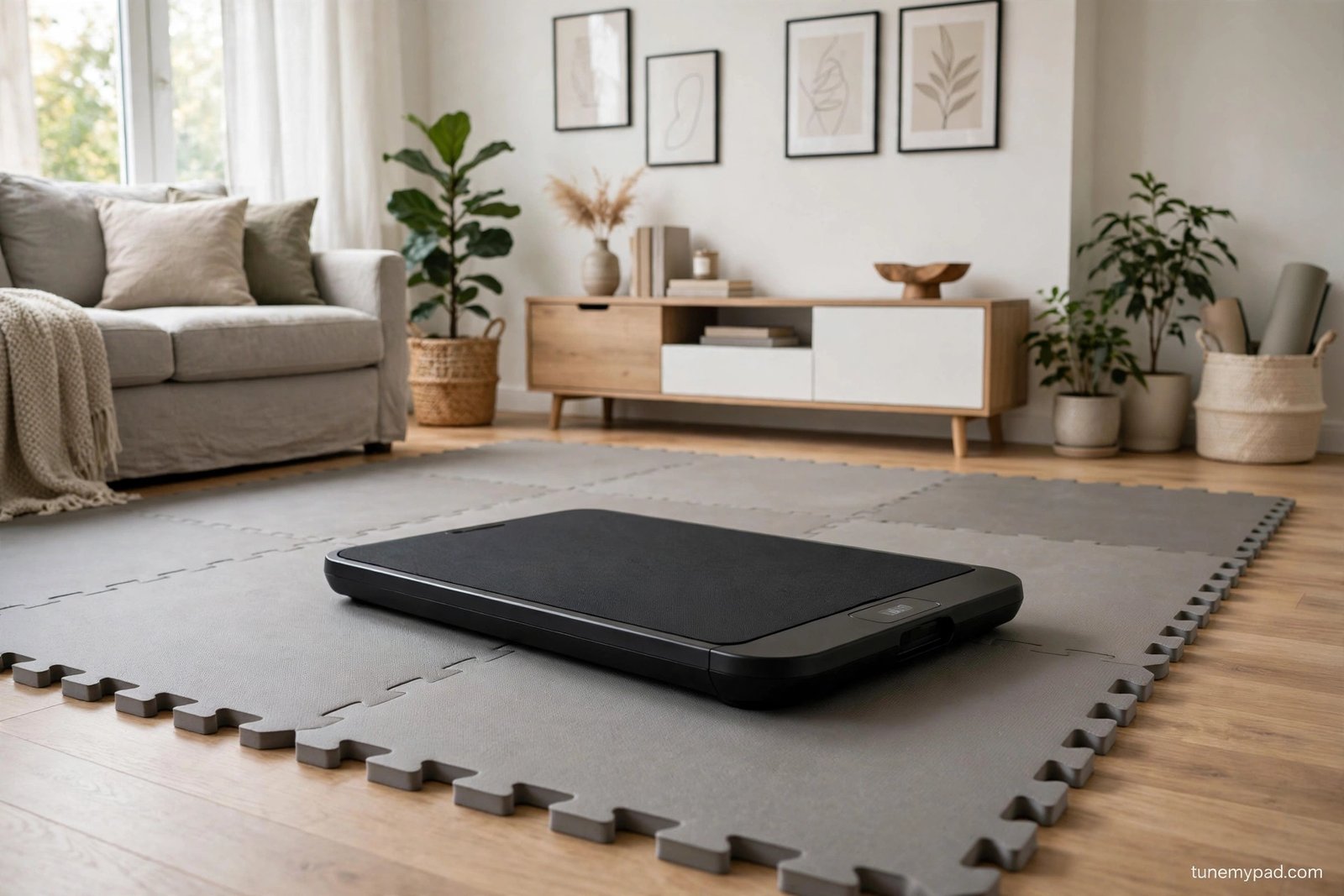
If you want the easiest installation, interlocking EVA foam gym tiles are the best mat under walking pad for noise for renters and anyone who rearranges often. They snap together like puzzle pieces, weigh almost nothing, and can be pulled up in minutes when you move. Look for tiles rated for gym or martial arts use at 3/4 inch or 1 inch thick; the thin playroom tiles sold for kids are too soft.
The interlocking edges are a real advantage for the best mat under walking pad for noise because you can build exactly the size you need, even wrapping the coverage wider on the sides where you step on and off. Buy a pack that covers at least 3 x 6 feet under the pad itself.
The trade-off is durability. Foam tiles dent under heavy furniture and can separate at the seams over time with daily walking. Replacing a single worn tile costs little, though, and for most walkers under 220 pounds, quality tiles last years. For convenience plus solid noise reduction, this is many people’s best mat under walking pad for noise.
Pick 3: Purpose-Built Treadmill Mat
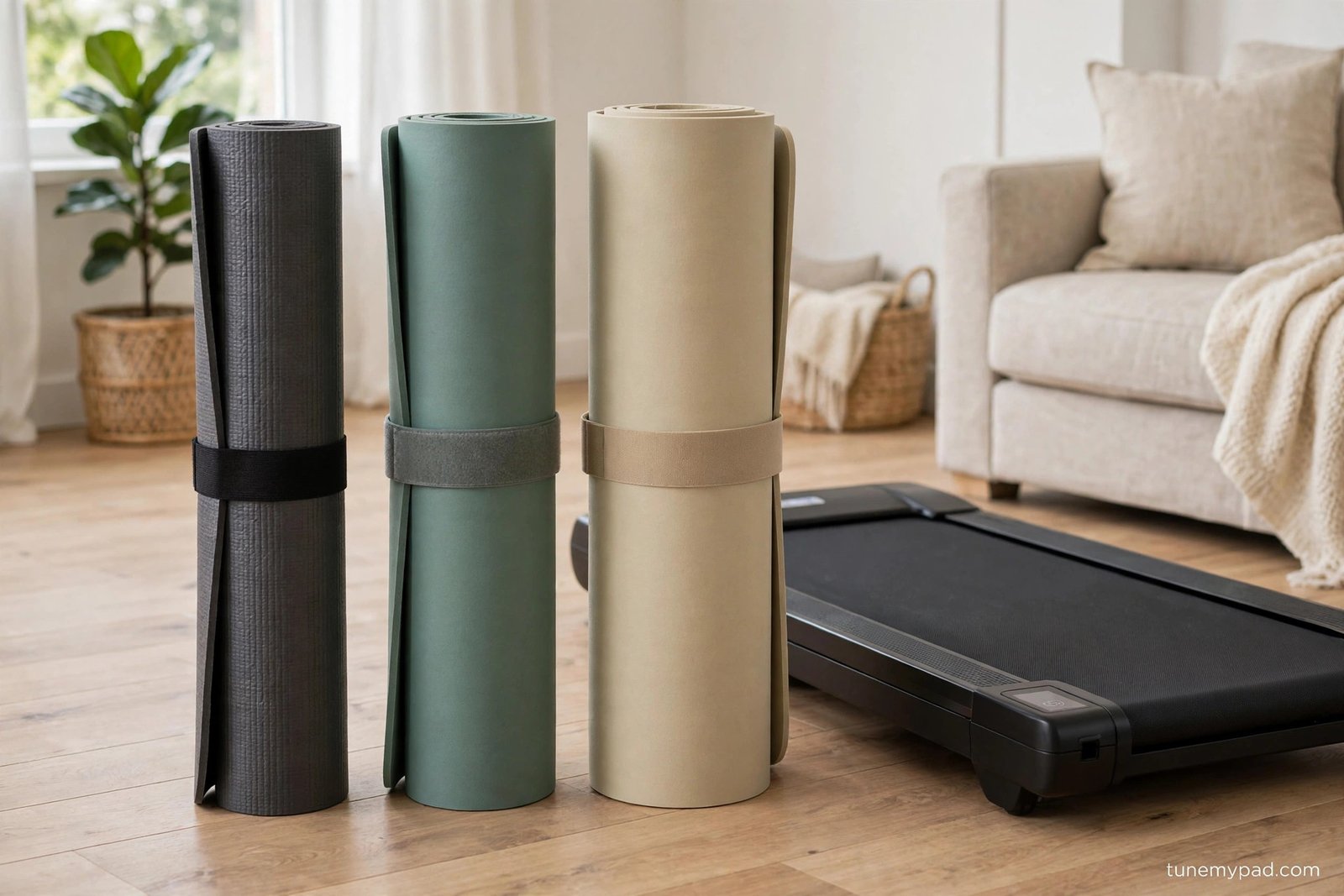
Purpose-built treadmill mats are the obvious candidate for the best mat under walking pad for noise, and the good ones earn it. The best versions use dense PVC or rubber at 1/4 to 3/8 inch thick with a textured non-slip surface. They are sized for equipment, lie perfectly flat, and look tidy in a home office.
The catch is thickness. Many branded mats marketed as the best mat under walking pad for noise are only 1/4 inch thick, which helps with floor protection and sliding but does modest work on vibration. If you go this route, choose the thickest option from a reputable brand and pair it with realistic expectations: it is good, not miraculous, on its own.
Where purpose-built mats shine is as the top layer of a sandwich. A branded mat over interlocking foam tiles, or over a stall mat, gives you a clean look with serious damping underneath. As a standalone, it is a decent best mat under walking pad for noise for carpeted rooms, but thin for bare hardwood.
Pick 4: Commercial Rubber Flooring Roll
Commercial gym flooring, sold in rolls, is the premium answer to the best mat under walking pad for noise. These rolls are 3/8 to 1/2 inch of dense vulcanized rubber, designed for dropped weights. Cut a 3 x 6 foot section and you have a seamless, professional-looking mat with no puzzle seams to separate.
Seamless coverage is genuinely better for noise: every seam is a weak point where vibration sneaks through. A single unbroken sheet is the ideal form of the best mat under walking pad for noise. The rolls are also easy to clean and essentially last forever under walking loads.
The downsides are price and availability. Rolls are sold in large quantities, so you may pay for more material than you need, and cutting thick rubber cleanly takes patience and a sharp blade. If you are outfitting a dedicated workout space and want the best-looking best mat under walking pad for noise, this is it.
Pick 5: Cork-Rubber Composite Mat
Cork-rubber composites are the eco-friendly contender for the best mat under walking pad for noise. They blend recycled rubber with cork, giving a firm but slightly springy surface that damps vibration well. They also look far nicer than black rubber, with a natural speckled finish that suits living rooms and bedrooms.
At 1/2 inch thick, a good composite mat performs close to pure rubber for the best mat under walking pad for noise while weighing less and smelling like nothing. That matters in bedrooms and small apartments where a stall mat’s rubber smell would be unwelcome. They also stay put on hard floors without additional grip pads.
Expect to pay more per square foot than basic rubber. And like all composite materials, quality varies between brands, so check reviews for compression complaints. For a mat that guests will actually see, this is the most attractive best mat under walking pad for noise you can buy.
Related: Walking Pad in an Upstairs Bedroom? 7 Best Noise Fixes
Pick 6: Double-Layer DIY Sandwich
Sometimes the best mat under walking pad for noise is not one mat but two. Layering a 1/2-inch foam tile base with a 1/4-inch dense rubber top creates a vibration sandwich: the foam absorbs, the rubber adds mass, and the boundary between them breaks up the waves. This combination often outperforms any single mat at a similar price.
Build it with the foam tiles on the bottom for cushioning and the rubber mat on top for a stable walking surface. Tape the foam seams with duct tape on the underside so they do not separate. The total stack is about 3/4 inch, and the layered construction is genuinely excellent as the best mat under walking pad for noise in apartments with thin floors.
The only real cost is an extra inch of step-up height getting on and off the pad. Use beveled-edge tiles or add a small ramp edge of foam at the front. For renters who cannot modify floors, this DIY best mat under walking pad for noise is hard to beat.
Pick 7: Carpet Tiles (Budget-Friendly)
For the tightest budgets, interlocking carpet tiles can serve as the best mat under walking pad for noise when nothing else is affordable. They add mass, trap some vibration in their fibers, and protect floors from scratches. A set covering 3 x 6 feet often costs less than a takeaway dinner.
Be realistic: carpet tiles are the weakest noise blocker on this list. They compress, they are thin, and they do little for low-frequency thump. But as the best mat under walking pad for noise under strict budget constraints, they beat a bare floor clearly, and they are far better than a thin yoga mat.
Choose low-pile commercial carpet tiles, not plush residential ones, and tape the seams underneath. Replace them yearly if they compress. Think of this pick as a starter best mat under walking pad for noise while you save for dense rubber.
What Thickness Actually Works
Shoppers get conflicting advice on thickness, so here is the straight answer for the best mat under walking pad for noise. On carpet with padding, 1/4 to 3/8 inch is enough because the carpet already does half the job. On hardwood, laminate, or tile, you want 1/2 inch minimum and 3/4 inch ideally. On concrete, thickness matters less since concrete barely transmits vibration anyway.
There is a point of diminishing returns around 1 inch. Beyond that, extra thickness adds stability problems and trip hazards without much extra quiet. The best mat under walking pad for noise is thick enough to stay uncompressed under your weight, and no thicker.
| Floor type | Recommended thickness | Notes |
|---|---|---|
| Carpet with pad | 1/4 – 3/8 inch | Carpet does half the work |
| Hardwood / laminate | 1/2 – 3/4 inch | Dense rubber strongly preferred |
| Tile / stone | 1/2 – 3/4 inch | Add non-slip layer underneath |
| Concrete | 1/4 inch | Mainly for floor protection |

How to Test a Mat Before You Commit
You can judge a mat in the store in under a minute. First, the thumb test: press your thumb hard into the material. If it barely dents, the density is right. If your thumb sinks in easily, the mat will bottom out under your full weight and block little vibration. Second, the knock test: lay the sample on the hard store floor, knock on it with your knuckles, then knock on the bare floor beside it. A good sample sounds dull and dead; a poor one rings almost like the bare floor.
At home, run a before-and-after test with a free sound meter app on your phone. Measure your pad on the bare floor at your normal speed, then measure again on the new mat. Also have someone listen in the room below during both tests, since their ears matter more than any number. Keep receipts and packaging until you have done this test; a mat that looks great but changes nothing downstairs should go back.
Give any new rubber mat a few days to air out before the final verdict, especially in bedrooms. The initial rubber smell fades, but your impression of the mat should be based on weeks of walking, not the first session. A mat that stays flat, stays put, and keeps the thump down after a month of daily use is a keeper.
Mats to Avoid
Not every mat deserves a place under your pad. Thin yoga mats, typically 1/8 to 1/4 inch of soft PVC, compress to paper thickness underfoot and contribute nothing to the best mat under walking pad for noise. They are designed for grip during stretching, not impact absorption.
Memory-foam mats are worse in a subtle way. They feel impressively soft at first, then bottom out completely under sustained weight, leaving you effectively standing on the floor through a thin warm layer. Softness without density is the enemy of the best mat under walking pad for noise.
Also skip anything too small. A mat that barely fits the pad’s footprint lets vibration escape around the edges and gives you no safe step-off zone. Whatever you buy in pursuit of the best mat under walking pad for noise, size it generously. And avoid mats with strong chemical smells that never fade; off-gassing in a bedroom is not worth any amount of quiet. If equipment safety is on your mind generally, the CPSC offers useful guidance on home exercise equipment.
Quick reject list
- Thin yoga or pilates mats
- Soft memory-foam anti-fatigue mats (too soft for impact)
- Mats smaller than the pad footprint plus 6 inches per side
- Interlocking kids’ play tiles (too soft, too thin)
- Anything that slides around on your floor type
- Foam bath mats or bath rugs (they flatten within days)
When you are unsure, remember the thumb test: density you can feel with your thumb is density that will work under your feet. Marketing claims fade, but physics does not.
Related: How Loud Is a Walking Pad? 7 Honest Answers in Decibels
Frequently Asked Questions
What is the best mat under walking pad for noise in an apartment?
The best mat under walking pad for noise in an apartment is a 3/4-inch dense rubber mat, ideally a horse-stall mat, sized at least 3 x 6 feet. Apartments have the thinnest floors and the closest neighbors, so this is no place to skimp. Pair it with slow walking speeds and soft shoes for the full effect.
Can I use two mats stacked for more noise reduction?
Yes, and it often beats a single mat. Stacking works because the boundary between layers disrupts vibration. The best mat under walking pad for noise as a stack is foam tiles below and dense rubber on top. Just watch the total height so stepping on and off stays safe.
Will a mat protect hardwood floors from scratches?
A proper mat absolutely protects floors. The best mat under walking pad for noise also prevents the small scratches and finish wear that pads cause over months of use. Make sure the mat itself has a non-slip, non-marking underside; some cheap rubber can leave marks on light floors, so test a corner first.
How do I stop the mat from sliding?
Weight is the best anti-slide feature, which is another reason dense rubber wins the best mat under walking pad for noise title. For lighter mats, add a non-slip rug pad underneath or use double-sided carpet tape on the underside edges. Check monthly, since mats can creep over time.
Do I need a mat on carpet?
On thick carpet with padding, a mat is optional for noise but still useful for stability and belt protection. The carpet already provides much of what the best mat under walking pad for noise offers. A thin treadmill mat on carpet mainly keeps the pad level and makes it easier to slide the pad for cleaning.
How often should I replace my mat?
Dense rubber mats last 5 to 10 years under walking loads. Foam tiles last 2 to 4 years before compression sets in. When your mat no longer springs back, or the best mat under walking pad for noise starts feeling like a hard floor again, it is time to replace it. Inspect yearly by pressing hard with your thumb.
Can a mat eliminate noise completely?
No mat eliminates all noise, but the best mat under walking pad for noise plus slow speeds and soft shoes can reduce perceived noise by half or more. The remaining sound is mostly gentle motor hum, which rarely bothers anyone. Total silence is not the goal; a peaceful home is.
Are expensive branded treadmill mats worth it?
Sometimes. The best branded mats use genuinely dense materials and fit well, but many are overpriced for their thickness. Compare specs, not marketing: a 3/4-inch stall mat usually beats a 1/4-inch branded mat for the best mat under walking pad for noise at half the price. Pay for density, not logos.
The Bottom Line on Noise Mats
The best mat under walking pad for noise is dense, thick, and generously sized. Rubber horse-stall mats win on value, interlocking EVA tiles win on convenience, and commercial rubber rolls win on looks. Whatever you choose, pair it with slower speeds and regular maintenance for the quietest possible setup.
Start by measuring your pad, then buy the densest mat that fits your floor type and budget. Your downstairs neighbors, your floors, and your own ears will all thank you. A quality mat is one of those rare purchases that pays for itself in household peace within the first week.
And do not overthink the final choice. Any dense, thick, generously sized mat from the picks above will transform your setup compared to a bare floor. Order it this week, run the before-and-after listening test with someone downstairs, and enjoy the quiet. Your daily steps just got a whole lot more peaceful.
Workplace noise guidance from OSHA confirms that walking pad noise levels are far below any hearing-risk threshold; this is purely about comfort and courtesy. As with any fitness routine, check with your doctor if you have health concerns before starting.
1 thought on “Best Mat Under a Walking Pad for Noise: 7 Picks That Work”