
A walking pad interval workout for fat loss is the most time-efficient way to burn calories on a walking pad. Instead of walking at one steady speed, you alternate bursts of fast walking with recovery periods, which burns 15 to 25 percent more calories than steady walking in the same time and keeps your metabolism elevated after you step off. If your weight loss has stalled on steady walks, or you only have 30 minutes to train, intervals are the upgrade that changes everything.
This guide gives you seven complete plans for a walking pad interval workout for fat loss, from a gentle beginner session to an advanced 40-minute burner. Each plan lists exact speeds, interval lengths, and total time, plus who it suits and how to progress. You will also learn why intervals work, how to warm up safely, and the mistakes that cause most interval injuries. Check with your doctor before starting interval training if you have heart disease, high blood pressure, or joint problems.
Quick Answer: Walking Pad Interval Workout for Fat Loss
The simplest walking pad interval workout for fat loss: warm up 5 minutes at 2 mph, then repeat 6 rounds of 2 minutes fast (3.2 to 3.8 mph) and 2 minutes easy (2.0 mph), and cool down 4 minutes at 2 mph. Total: 33 minutes, roughly 280 to 350 calories for a 160-to-180-pound person. Do intervals 2 to 3 times per week on non-consecutive days, with steady walking on the other days.
Table of Contents
| Plan | Level | Time | Work / recovery |
|---|---|---|---|
| 1. Gentle starter | Beginner | 25 min | 1 min at 2.8 mph / 2 min at 2.0 mph |
| 2. Classic 2:2 | Beginner+ | 33 min | 2 min at 3.2 mph / 2 min at 2.0 mph |
| 3. Pyramid | Intermediate | 35 min | 1-2-3-2-1 min at 3.5 mph / equal recovery |
| 4. Tabata-style | Intermediate | 24 min | 30 sec at 3.8 mph / 90 sec at 2.0 mph |
| 5. Hill simulation | Intermediate | 36 min | Cadence surges at 3.0 mph with arm drive |
| 6. 30-20-10 | Advanced | 30 min | 30/20/10 sec blocks at 3.5-4.0 mph |
| 7. Endurance mixer | Advanced | 45 min | 5 min at 3.4 mph / 3 min at 2.2 mph |
Every walking pad interval workout for fat loss follows the same skeleton: warm up, alternate hard and easy, cool down. The seven plans below just tune the dials. Pick the plan that matches your current fitness, run it for two to three weeks, then move up one level when the fast intervals start feeling manageable.

Why Intervals Burn More Fat Than Steady Walking
The science behind a walking pad interval workout for fat loss comes down to three effects. First, the fast intervals push you into a higher heart-rate zone where total calorie burn per minute peaks; even though the recovery periods are easy, the average intensity across the session exceeds what most people sustain steadily. Second, intervals create excess post-exercise oxygen consumption (EPOC), the “afterburn” that keeps calorie burn elevated for hours after the workout ends.
Third, and most important for fat loss, intervals improve insulin sensitivity and metabolic flexibility more than steady cardio at the same total volume. Your muscles learn to switch between fuel sources efficiently, which means more fat oxidized during the easy periods and at rest. This is why a walking pad interval workout for fat loss keeps working even on days you do not train: the metabolic adaptations persist.
The Mayo Clinic’s review of interval training notes that it can produce similar or greater fitness gains in less time than continuous moderate exercise. On a walking pad, where top speeds are limited to about 4 mph, intervals are the main tool for raising intensity without needing a bigger machine.
Plan 1: The Gentle Starter (25 Minutes, Beginner)
This first walking pad interval workout for fat loss is for true beginners or anyone returning after a long break. Warm up 5 minutes at 1.8 mph. Then do 6 rounds of 1 minute at 2.8 mph followed by 2 minutes at 2.0 mph. Cool down 4 minutes at 1.8 mph. Total time: 25 minutes, and you will barely believe how different the fast minute feels from the easy two.
The 1:2 work-to-recovery ratio is deliberately generous. Your cardiovascular system gets a taste of higher intensity while your muscles and joints stay well within safe limits. Run this walking pad interval workout for fat loss twice a week for two to three weeks; when the 2.8 mph minute feels easy by round six, you are ready for Plan 2.
Form cues matter even at beginner speeds. Stand tall, swing your arms naturally, and land mid-foot rather than heel-striking hard. If your shins ache during the fast minute, shorten your stride and increase cadence instead of reaching forward; overstriding is the top cause of beginner interval discomfort.
Plan 2: The Classic 2:2 (33 Minutes, Beginner+)
The classic walking pad interval workout for fat loss uses equal work and recovery: 2 minutes fast, 2 minutes easy. Warm up 5 minutes at 2 mph, then complete 6 rounds of 2 minutes at 3.2 mph and 2 minutes at 2.0 mph, and cool down 4 minutes at 2 mph. Thirty-three minutes total, and a 170-pound person burns roughly 300 calories.
Two-minute intervals hit a sweet spot: long enough to raise your heart rate into the fat-burning zone, short enough that the effort stays repeatable. This walking pad interval workout for fat loss is the workhorse plan most people will use for months. It is challenging but sustainable, and it fits neatly into a lunch break.
Progress this plan by raising the fast speed 0.1 mph each week rather than adding rounds. Small speed increments keep the session length constant while steadily increasing the stimulus, which is the essence of progressive overload. When 3.5 mph feels manageable for all six rounds, graduate to Plan 3 or 4.
Related: What Speed on a Walking Pad to Lose Weight? 7 Fat-Burn Zones
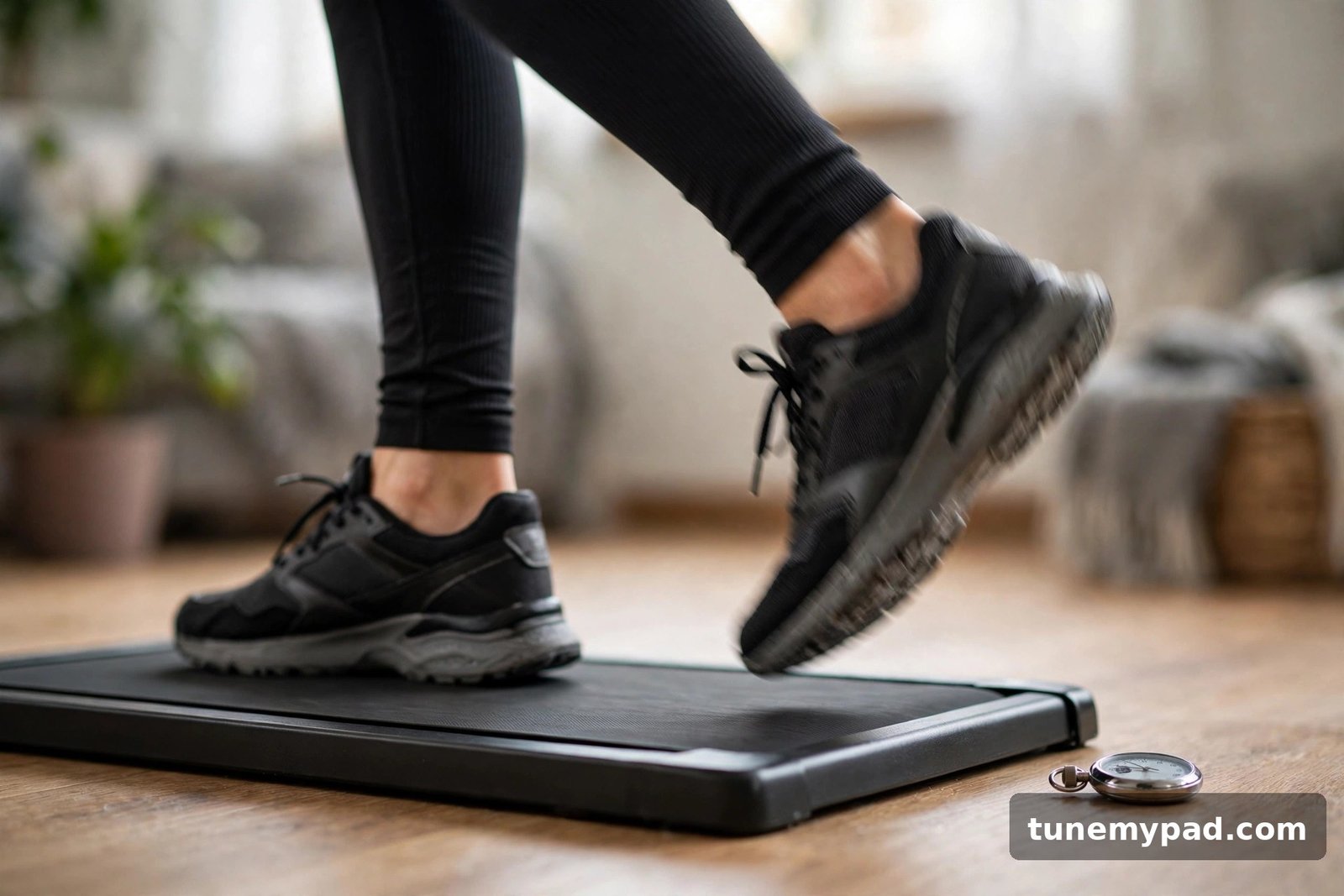
Plan 3: The Pyramid (35 Minutes, Intermediate)
Pyramids vary the interval length to train both stamina and speed in one session, making this walking pad interval workout for fat loss a favorite for breaking plateaus. Warm up 5 minutes at 2 mph. Then climb: 1 minute at 3.5 mph, 1 minute easy at 2.2 mph, 2 minutes at 3.5 mph, 2 minutes easy, 3 minutes at 3.5 mph, 3 minutes easy, then descend 2 minutes fast with 2 easy and 1 minute fast with 1 easy. Cool down 5 minutes at 2 mph.
The 3-minute peak interval is the money segment: it is long enough to fully engage fat metabolism at high output, teaching your body to burn fat under sustained demand. Because the pyramid descends after the peak, the session feels psychologically manageable; the hardest work is behind you at the halfway point. This walking pad interval workout for fat loss takes 35 minutes and burns roughly 330 to 380 calories for most adults.
Run pyramids once a week as your hard session, with easier steady walks or Plan 2 on other days. The varied structure also fights boredom, which is an underrated fat-loss factor; the plan you enjoy is the plan you repeat, and repetition is what burns fat over months.
Plan 4: Tabata-Style Bursts (24 Minutes, Intermediate)
Short, sharp, and brutally effective, this walking pad interval workout for fat loss borrows the Tabata concept: very hard efforts with incomplete recovery. Warm up 6 minutes, building from 2 to 3 mph. Then do 8 rounds of 30 seconds at 3.8 to 4.0 mph followed by 90 seconds at 2.0 mph. Cool down 5 minutes. Total: 24 minutes.
Thirty seconds at near-max walking speed will spike your heart rate dramatically; that spike is the point. The incomplete 90-second recovery keeps your heart rate elevated between bursts, so average intensity stays high across the whole session. A walking pad interval workout for fat loss built on Tabata-style bursts delivers the biggest afterburn of any plan on this list relative to its duration.
Respect this plan. Do it once a week at most, never on consecutive days, and skip it entirely if you have any joint pain. The 4 mph top end is aggressive on a narrow belt, so stay centered, keep your stride quick rather than long, and stop if you feel dizzy. Beginners should master Plans 1 and 2 before attempting this one. Healthline’s Tabata guide explains the protocol’s origins and intensity demands.
Plan 5: Hill Simulation (36 Minutes, Intermediate)
Most walking pads lack incline, but you can simulate hills with cadence and effort, which makes this walking pad interval workout for fat loss perfect for flat-belt owners. Warm up 5 minutes at 2 mph. Then repeat 6 rounds of 3 minutes at 3.0 mph with exaggerated arm drive and a slight forward lean (the “climb”), followed by 2 minutes easy at 2.0 mph. Cool down 5 minutes.
The trick is intent: during the climb minutes, drive your elbows back forcefully, lift your knees slightly higher, and lean forward about five degrees from the ankles. This recruits the glutes and calves the way an incline would, raising calorie burn 10 to 15 percent above normal 3 mph walking. This walking pad interval workout for fat loss proves you do not need an incline motor to train like you have one.
Hill simulation is joint-friendly compared to true speed intervals, because the belt speed stays moderate while muscular effort rises. It is an excellent choice for heavier walkers or anyone with a history of shin splints who still wants interval-level calorie burn. Do it once or twice weekly.

Plan 6: 30-20-10 (30 Minutes, Advanced)
The 30-20-10 method, developed by Danish researchers, is a ruthlessly efficient walking pad interval workout for fat loss. Warm up 5 minutes at 2.2 mph. Then repeat 4 blocks of: 30 seconds at 3.5 mph, 20 seconds at 3.8 mph, 10 seconds at 4.0 mph, followed by 2 minutes easy at 2.0 mph. After the fourth block, cool down 5 minutes. Thirty minutes total.
Each one-minute work block escalates through three gears, finishing with a 10-second near-sprint that floods your system with lactate and growth hormone signals. The research behind 30-20-10 showed significant improvements in running performance and cardiovascular markers with just three weekly sessions; adapted to walking, this walking pad interval workout for fat loss delivers similar metabolic disruption in a joint-friendly package.
This is an advanced plan: attempt it only after two months of consistent interval training. The 10-second top gear at 4 mph demands full attention, so clear distractions, face forward, and keep a hand near the rail (without leaning on it). One session per week is enough; pair it with steady Zone 2 walking on other days.
Plan 7: The Endurance Mixer (45 Minutes, Advanced)
The final walking pad interval workout for fat loss blends endurance and intervals for maximum weekly calorie burn. Warm up 5 minutes at 2.2 mph. Then do 5 rounds of 5 minutes at 3.4 mph followed by 3 minutes at 2.2 mph. Cool down 5 minutes. Total: 45 minutes, roughly 420 to 500 calories for a 170-to-200-pound person.
Five-minute work intervals train your body to sustain high fat oxidation for extended periods, which is exactly the capacity that drives long-term fat loss. This walking pad interval workout for fat loss is the session to use when you have time and want the biggest single-session burn of the week. Do it once weekly, ideally on a weekend when you are rested and fueled.
Fuel matters for this one: eat a normal meal two to three hours beforehand, hydrate during the session, and eat protein within a couple of hours after. Long interval sessions deplete glycogen significantly, and proper recovery nutrition determines whether the session builds fitness or just builds fatigue.
Related: Walking Pad Desk Workout Schedule While Working: 7 Plans
Related: The 30-Day Walking Pad Challenge: 7 Rules That Work
How to Warm Up and Cool Down for Intervals
Every walking pad interval workout for fat loss needs bookends. Warm up with 5 minutes of easy walking starting at 1.8 mph and building to 2.5 mph, adding leg swings or ankle circles in the final minute. A proper warm-up raises muscle temperature, lubricates joints, and gradually elevates heart rate, cutting injury risk dramatically.
Cool down with 4 to 5 minutes of easy walking at 2 mph or below, letting your heart rate descend gradually rather than stopping abruptly. Follow with 3 to 5 minutes of gentle stretching: calves against a wall, a standing quad stretch holding your desk, and a hip flexor lunge. Skip the stretching and the next day’s soreness will remind you; this five-minute investment pays for itself.
5 Interval Mistakes That Stall Fat Loss
Even a perfect walking pad interval workout for fat loss fails when these mistakes creep in. Mistake one: skipping the warm-up, which spikes injury risk and makes the first intervals feel awful. Mistake two: making the “fast” intervals too easy; if you can hold a full conversation during the work bout, nudge the speed up 0.2 mph. The work intervals should feel hard by the final 20 seconds.
Mistake three: doing intervals every day. A walking pad interval workout for fat loss is a stressor, and daily stress without recovery leads to plateau, fatigue, and overuse injuries. Mistake four: eating back the burn with a post-workout reward that exceeds the 300 calories you just spent. And mistake five: never progressing; if you have done the same plan at the same speeds for two months, your body has fully adapted. Move up a plan, raise the fast speed, or shorten the recoveries.
Frequently Asked Questions
How many times per week should I do a walking pad interval workout for fat loss?
Two to three times per week on non-consecutive days is the sweet spot. A walking pad interval workout for fat loss stresses your muscles, tendons, and nervous system more than steady walking, and the adaptations happen during recovery. Fill the other days with easy steady walking or rest.
Can beginners do interval training on a walking pad?
Yes, with the right plan. Plan 1 above was designed for beginners: short 1-minute efforts at a modest 2.8 mph with long recoveries. The key is matching the interval intensity to your current fitness; a walking pad interval workout for fat loss only works if you can complete all the rounds with good form.
Will intervals on a walking pad hurt my knees?
Intervals increase impact forces compared to slow walking, so anyone with knee issues should be cautious. Start with Plan 5 (hill simulation), which raises effort without raising speed, keep sessions short, wear supportive shoes, and stop for sharp pain. If you have diagnosed knee arthritis, get your doctor’s or physical therapist’s clearance first.
Should I eat before a walking pad interval workout for fat loss?
For sessions under 30 minutes, training on a light stomach is fine if that feels good; have a small banana or toast 30 to 60 minutes prior if you feel weak. For the 45-minute Plan 7, eat a normal balanced meal 2 to 3 hours beforehand. Never do hard intervals completely fasted if you feel dizzy or shaky; performance and safety both suffer.
Can I do intervals while working at my treadmill desk?
Not really. A walking pad interval workout for fat loss demands speeds and effort levels incompatible with typing, reading, or calls. Treat intervals as dedicated workout time separate from desk walking. Many people do intervals before work and easy desk walking during work, which combines the best of both.
How long until I see fat loss from interval training?
Most people notice improved fitness (easier intervals, lower heart rate) within two to three weeks, and visible fat loss within four to six weeks when combined with sensible eating. A walking pad interval workout for fat loss accelerates the timeline versus steady walking, but diet still decides the outcome; intervals cannot out-train a large calorie surplus.
What is the best walking pad speed for intervals if my pad maxes at 3.5 mph?
Use 3.2 to 3.5 mph as your fast gear and 1.8 to 2.0 mph for recovery; the contrast between gears matters more than the absolute top speed. Shorten work intervals to 60 to 90 seconds to keep intensity high. Every walking pad interval workout for fat loss in this guide can be scaled down 0.3 mph without losing its structure.
Do I need special shoes for walking pad intervals?
Supportive walking or running shoes are strongly recommended. Intervals multiply foot-strike forces, and cushioned, stable shoes protect your feet, shins, and knees. Replace shoes every 300 to 500 miles of use; worn-out cushioning is a common hidden cause of interval-related aches.
Is a walking pad interval workout for fat loss better than running intervals?
Running intervals burn more calories per minute, but a walking pad interval workout for fat loss wins on joint-friendliness and convenience. For overweight beginners or anyone with joint concerns, walking intervals deliver 70 to 80 percent of the metabolic benefit with a fraction of the impact. The best interval program is the one your body tolerates three times a week for months.
Can I combine intervals with incline on my walking pad?
If your pad has manual incline legs, absolutely; incline plus intervals is a potent combination. Raise the incline for the work intervals only, keeping recoveries flat. If your pad is flat-only, use Plan 5’s hill-simulation technique instead. Either way, introduce incline gradually, because it sharply increases calf and Achilles loading.
Conclusion: Pick a Plan, Then Progress
A walking pad interval workout for fat loss turns 30 minutes into a serious training session. Start with Plan 1 or 2, run it two to three times weekly for a few weeks, then climb the ladder as the fast intervals start feeling routine. The plans work because they are progressive, repeatable, and honest about recovery.
Remember the hierarchy: consistency first, then intensity, then variety. The best walking pad interval workout for fat loss is the one you will actually do on a rainy Tuesday. Choose your plan, warm up properly, and let the intervals do what steady walking cannot, because the fastest results belong to walkers who train with intent rather than just accumulating aimless miles.