
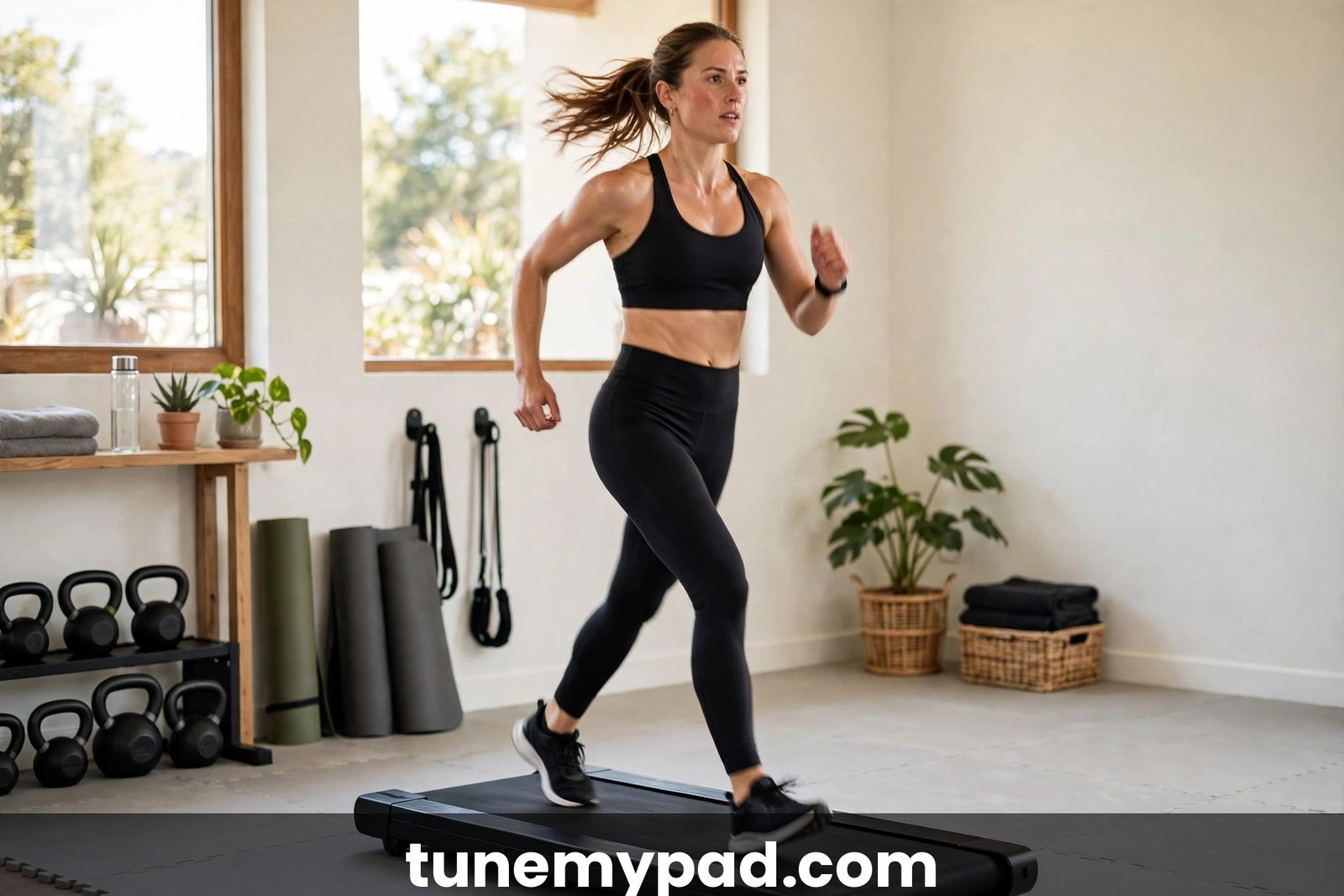
If you are asking how fast do walking pads go, you probably want to know whether a walking pad can keep up with your fitness goals or whether it tops out at a slow stroll. Most buyers are surprised by the answer: how fast do walking pads go is usually 0.5 to 4 miles per hour, which covers everything from a gentle desk-walking shuffle to a brisk power walk, but stops well short of a true run. Understanding the speed range matters because it decides what workouts are possible, whether you can jog, and how the pad fits into a weight-loss or 10,000-step plan. For a deeper look at matching pace to goals, see our guide on what speed on a walking pad to lose weight.
This guide answers how fast do walking pads go with seven best speed facts: the standard speed range, why the top speed is capped where it is, how speed settings actually work on the console and remote, the difference between walking pads and under-desk treadmills on speed, what each speed feels like in real life, how speed accuracy compares to the display, and when you should choose a faster machine instead. You will find a quick answer up front, a speed-to-activity conversion table, and a FAQ section. All speeds are in miles per hour unless noted, with kilometer equivalents where it helps.
Quick Answer: How Fast Do Walking Pads Go?
For most shoppers, how fast do walking pads go has a simple answer: 0.5 to 4 mph, a range confirmed by nearly every major brand’s spec sheet today. The slowest setting, usually 0.5 mph, is a barely-moving shuffle meant for walking while typing. The top speed of 3.7 to 4 mph on most models is a brisk power walk that gets your heart rate up but never becomes a run. A few hybrid models marketed as “2-in-1” or “3-in-1” walking pads unfold a handlebar and reach 7 to 7.5 mph, which allows a light jog. If your plan involves actual running, how fast do walking pads go on a standard flat model will disappoint you, and a traditional treadmill is the better buy.
Table of Contents
| Speed (mph) | Speed (km/h) | What it feels like | Typical use | |
|---|---|---|---|---|
| 0.5 – 1.0 | 0.8 – 1.6 | Barely moving shuffle | Walking while typing or on calls | |
| 1.5 – 2.0 | 2.4 – 3.2 | Slow, relaxed stroll | All-day desk walking, beginners | |
| 2.5 – 3.0 | 4.0 – 4.8 | Purposeful brisk walk | Weight loss, cardio sessions | |
| 3.5 – 4.0 | 5.6 – 6.4 | Power walk, arms pumping | Max effort on a standard walking pad | |
| 5.0 – 7.5 | 8.0 – 12.0 | Light jog | Hybrid 2-in-1 models with handlebar up only |
The short version is simple: how fast do walking pads go is fast enough for walking workouts and slow enough to stay safe without a handlebar. The seven facts below explain the range, the reasons behind it, and how to pick the right top speed for your goals. Bookmark this range when you compare models.
Related: What Speed on a Walking Pad to Lose Weight? 7 Fat-Burn Zones
Fact 1: The Standard Range Is 0.5 to 4 mph
Almost every flat walking pad on the market, from budget Amazon models to mid-range brands, answers how fast do walking pads go with the same range: a minimum of about 0.5 mph and a maximum of 3.7 to 4 mph. The low end exists for treadmill-desk work, where speeds under 1 mph let you type and mouse accurately while moving. The high end is set by the motor size and the belt length; a 500 to 750-watt motor can only push the belt so fast, and a 40 to 50-inch belt only gives you so much room for a long stride. When reviewers test how fast do walking pads go in practice, the display usually matches the stated range within a tenth of a mile per hour.
The 4 mph ceiling is not an accident. Above 4 mph, most people transition from a walk to a jog, which changes the impact forces dramatically. Jogging without a handlebar or an emergency stop cord is a fall risk, so manufacturers cap the speed where walking ends. That design decision is also why how fast do walking pads go is lower than a gym treadmill’s 10 to 12 mph: the walking pad is engineered for a different job. If you see a flat walking pad advertising 7 mph with no handlebar, be skeptical, because safe jogging needs something to grab and a longer belt than flat pads provide.
Fact 2: Speed Increments Are Usually 0.1 mph
How fast do walking pads go is only half the story; how precisely you can adjust the speed matters just as much. Most walking pads adjust in 0.1 mph steps using the remote control or the phone app, and some consoles offer 0.5 mph quick-jump buttons. The fine increments are genuinely useful: the difference between 1.8 and 2.0 mph is the difference between comfortable typing and sloppy typing for many desk workers. Runners used to treadmill consoles that jump in whole numbers sometimes find 0.1 mph steps fussy, but for walking, small steps are the right granularity.
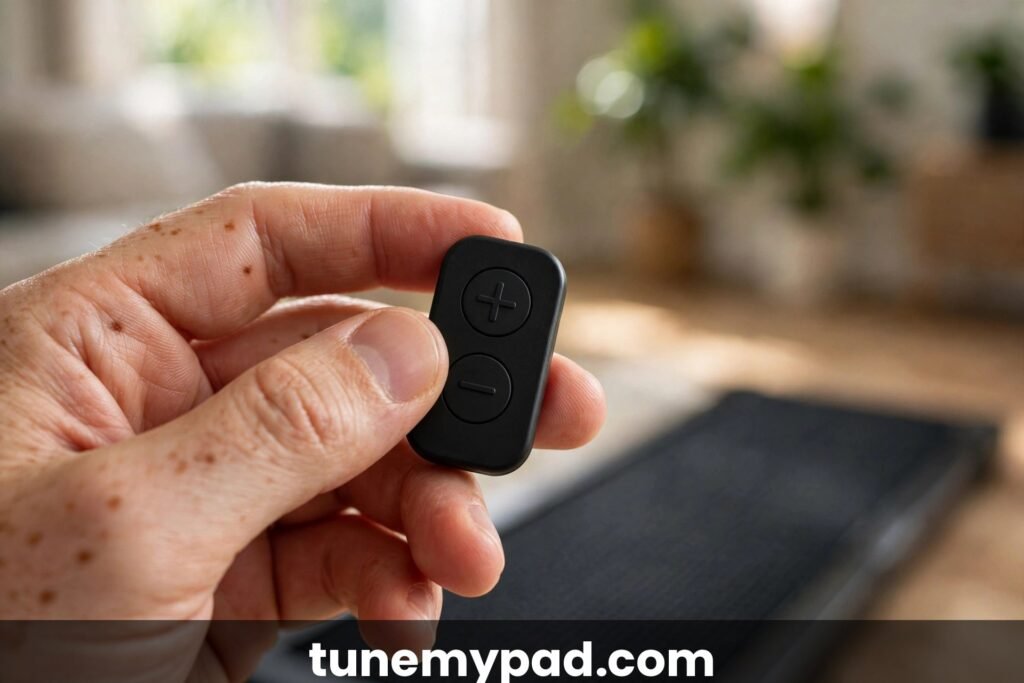
Remote controls are the primary speed interface on most walking pads, and they usually have plus and minus buttons plus a few preset speeds. A common complaint in reviews is that the remote’s presets jump too far, for example from 2 to 4 mph with nothing in between, so check whether the model you are considering allows fine adjustment from the remote or only from the app. How fast do walking pads go matters less than whether you can dial in the exact speed your workout needs, and 0.1 mph control is the feature that makes the range usable.
Fact 3: Hybrid 2-in-1 Models Reach 7 to 7.5 mph
There is an exception to the 4 mph rule: hybrid walking pads with a folding handlebar. When the handlebar is folded flat, these machines behave like a normal walking pad and answer how fast do walking pads go the usual way, capped around 4 mph. Raise the handlebar into its upright running position, and the controller unlocks a higher range, typically up to 7 or 7.5 mph, which is a genuine light jog for most people. The handlebar gives you something to hold, the belt is usually a few inches longer, and the motor is often a stronger 750-watt to 1,000-watt unit.
The catch is that the jogging mode is still a compromise. A 7.5 mph top speed is a slow jog, not a run; the belt is shorter and narrower than a gym treadmill; and there is no incline on most hybrids. If your goal is couch-to-5K training, how fast do walking pads go even on a hybrid will feel limiting within a few months. But if you want one machine that handles slow desk walking on weekdays and light jogging on weekends, the hybrid’s two speed ranges are a clever solution. Just confirm the top speed is only available with the handlebar raised, because running on a flat pad with no handhold is exactly the fall risk the speed cap is meant to prevent.
Fact 4: Displayed Speed Is Usually Accurate Within 5 Percent
Shoppers often wonder whether the speed on the display is real, and independent testing says it mostly is. When reviewers measure how fast do walking pads go with a tachometer or a GPS foot pod, the belt speed typically lands within 5 percent of the displayed number at walking speeds. A display reading 3.0 mph usually means a true belt speed of 2.9 to 3.1 mph. That is accurate enough for calorie estimates, pace planning, and workout programming. The small error comes from belt stretch, voltage sag under load, and the controller’s speed-sensing resolution.
Accuracy can drift as the machine ages. A loose belt slips slightly under load, which makes the true speed lower than the display; a dry belt adds drag with a similar effect. Heavier users may notice the belt slowing a fraction on each footstrike at high speed, which is the motor struggling to hold the set pace. These are maintenance issues, not design flaws: tension and lubricate the belt on schedule and the answer to how fast do walking pads go stays honest. If you train by heart rate rather than pace, the small display error does not matter at all.
Related: How Long Should You Walk on a Walking Pad Per Day? 7 Proven Answers
Fact 5: Each Speed Has a Best Use Case
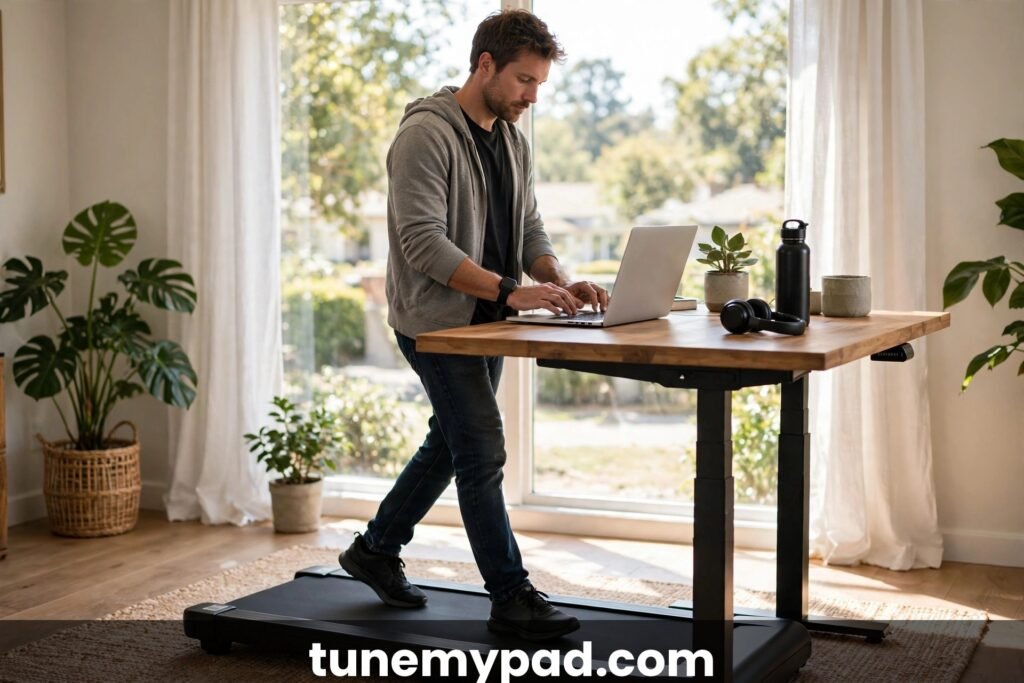
Knowing how fast do walking pads go is only useful if you know what to do with each speed. At 0.5 to 1.5 mph, you are in desk-walking territory: slow enough for accurate typing, mouse work, and video calls. At 1.5 to 2.5 mph, you get the classic all-day walking pace that racks up steps without breaking a sweat, ideal for hitting 10,000 steps across a workday. At 2.5 to 3.5 mph, you are doing deliberate cardio: heart rate climbs into the fat-burning zone, conversation gets slightly breathy, and 30 to 45 minutes counts as a real workout. At 3.5 to 4 mph, you are power walking at the machine’s limit, which most people can only sustain for 20 to 40 minutes.
Matching speed to task is the skill that separates happy owners from disappointed ones. The most common mistake is trying to work at 3 mph, getting frustrated that typing falls apart, and concluding the pad is useless, when the fix is simply dropping to 1.5 mph for work hours and saving 3 mph for a dedicated session. How fast do walking pads go gives you the full range; using the right part of the range at the right time gives you the results. Many owners end up living at two speeds, a slow work speed and a brisk workout speed, and rarely touch the rest of the dial.
| Your goal | Best speed | Session length | |
|---|---|---|---|
| Walk while working (typing) | 1.0 – 1.8 mph | 2 – 4 hours through the day | |
| Hit 10,000 steps | 2.0 – 2.5 mph | 3 – 4 hours total | |
| Lose weight | 2.5 – 3.5 mph | 45 – 60 minutes | |
| Quick cardio burst | 3.5 – 4.0 mph | 20 – 30 minutes | |
| Light jog (hybrid only) | 5.0 – 6.0 mph | 20 – 30 minutes |
Fact 6: Speed Affects Noise, Safety, and Belt Wear
How fast do walking pads go has side effects beyond fitness. Noise rises with speed: a pad whispering at 1.5 mph can become a noticeable hum at 4 mph, because the motor spins faster and each footstrike lands harder. If you share walls with neighbors or take calls while walking, the top speed is the loudest and least call-friendly setting. Safety also scales with speed: at 1 mph you can step off casually, while at 4 mph you need the side rails and a practiced step-off, and you should never step on or off at top speed. Belt wear accelerates too, since higher speeds mean more friction heat per minute.
These trade-offs explain why experienced owners spend most of their time in the middle of the range. How fast do walking pads go at their maximum is a spec-sheet number; how fast they go during 90 percent of real use is 1.5 to 2.5 mph. The top speed is there for workouts, not for living. If noise is a concern in your home, test the pad at your planned workout speed before committing to a routine, and consider a mat underneath, which damps both vibration and the higher-speed hum.
Related: Best Mat Under Walking Pad for Noise: 7 Best Picks
Fact 7: When You Need More Speed, Buy a Treadmill
The honest closing fact: if how fast do walking pads go leaves you wanting more, that is the machine telling you that you are a runner, not a walker. Runners need 8 to 12 mph, a 55-inch-plus belt, incline options, and a safety key, none of which a flat walking pad offers. Buying a walking pad and then being frustrated that it will not let you run is like buying a bicycle and being frustrated that it will not go on the highway. The product category is optimized for walking, and it is excellent at that job.
There is a middle path for the undecided. If you mostly walk but want the option to jog occasionally, a hybrid 2-in-1 with a 7 mph top speed covers both. If you already run outdoors and want a walking pad for bad-weather days and desk work, the standard 4 mph cap is plenty, because your running happens elsewhere. But if your primary goal is running training, skip the walking pad entirely and buy a folding treadmill with a proper top speed. Knowing how fast do walking pads go before you buy is what keeps the purchase from becoming a regret.
How Fast Do Walking Pads Go in Km/h?
For readers outside the United States, how fast do walking pads go converts to roughly 0.8 to 6.4 km/h on standard models, and up to 12 km/h on hybrids. Many walking pads sold internationally let you switch the display between mph and km/h in the settings or the app. A comfortable desk-walking pace of 2 mph is 3.2 km/h; a brisk 3 mph workout is 4.8 km/h; the 4 mph maximum is 6.4 km/h. If your model’s manual lists speeds in km/h and you think in mph, divide by 1.6 for a quick conversion.
One caution for international buyers: some budget models display a speed number without clearly labeling the unit, and a pad showing “6.0” might mean 6 km/h (3.7 mph) rather than 6 mph. If how fast do walking pads go seems impossibly high for the price, check the unit. True 6 mph walking pads do not exist in the flat category; that number is almost certainly kilometers per hour.
How to Test Your Walking Pad’s True Speed at Home
You do not need lab equipment to check how fast do walking pads go on your specific machine. The simplest home test uses your phone’s stopwatch and a piece of tape: mark the belt with a small tape flag, start the pad at 3 mph, and count how many times the mark passes a fixed point in 60 seconds. Multiply the count by the belt length in feet, multiply by 60, and divide by 5,280 to get true miles per hour. If the math says 2.85 when the display says 3.0, your pad is within the normal 5 percent tolerance. A phone GPS will not work indoors, but a Bluetooth foot pod paired with a running app gives a second opinion on how fast do walking pads go under your feet.
Speed matters for health targets too. The CDC physical activity guidelines define brisk walking, around 3 mph, as moderate-intensity aerobic activity, and 150 minutes a week of it meets the adult guideline. That makes how fast do walking pads go a health question as much as a spec question: a pad that reaches 3 to 3.5 mph can deliver guideline-meeting cardio, while one capped at 2 mph cannot. The American Heart Association recommendations echo the same 150-minute weekly target for moderate activity. Test your machine, note the true top speed, and program your workouts around the real number rather than the display.
Frequently Asked Questions
How fast do walking pads go at maximum?
Most flat walking pads top out at 3.7 to 4 mph. Hybrid 2-in-1 models with an upright handlebar reach 7 to 7.5 mph in jogging mode. How fast do walking pads go at maximum is capped by motor size, belt length, and safety design.
How fast do walking pads go at the slowest setting?
Usually 0.5 mph, slow enough to walk while typing. Some models start at 0.6 or 1 km/h. The slowest setting is designed for treadmill-desk work, where anything faster hurts typing accuracy.
Can you run on a walking pad?
Not on a standard flat model, which caps at about 4 mph, below most people’s jogging threshold. Hybrid models allow a light jog up to 7 mph with the handlebar raised. If running is your goal, how fast do walking pads go will not satisfy you, and a real treadmill is the right purchase.
How fast do walking pads go compared to a normal walking pace?
Average outdoor walking pace is about 3 mph, which sits comfortably inside a walking pad’s range. The pad’s 2 to 3 mph zone feels exactly like a normal purposeful walk. How fast do walking pads go covers normal walking completely; it is running that falls outside the range.
Does walking pad speed affect calories burned?
Yes, significantly. A 160-pound person burns roughly 180 calories per hour at 2 mph and about 300 at 3.5 mph. How fast do walking pads go sets the ceiling on intensity, and faster speeds within the range burn meaningfully more calories per minute.
Why is my walking pad slower than the display says?
A loose or dry belt slips under load, making true speed lower than displayed. Tension and lubricate the belt, and check whether the display is set to km/h instead of mph. If the belt slows noticeably on each footstrike, the motor may be undersized for the user’s weight at that speed.
The Bottom Line
How fast do walking pads go? Standard models run 0.5 to 4 mph, covering desk shuffles to power walks, while hybrid 2-in-1 models unlock 7 to 7.5 mph for light jogging with the handlebar up. The speed adjusts in fine 0.1 mph steps, the display is accurate within about 5 percent, and each part of the range has a best use, from 1.5 mph typing to 3.5 mph fat-burning sessions. Match the machine’s top speed to your goals before you buy: walkers will love the standard range, occasional joggers should look at hybrids, and dedicated runners need a real treadmill. The right speed range is the one you will actually use every day. When you finally step onto the belt and feel how fast do walking pads go at 3 mph with your own stride, the numbers on this page will turn into something simpler: a pace that raises your heart rate, clears your head, and fits into a workday without demanding extra hours you do not have.