

Ask around walking-pad communities and you will hear a recurring story: “I cannot sit still through a meeting, but walking slowly while I work, I finally stay with it.” A walking pad for ADHD focus while working has become a popular experiment among restless desk workers — and many describe the same experiences: less fidgeting, easier task starts, and longer stretches of settled attention.
One note before we go further: this article is not medical advice, diagnoses nothing, and claims no treatment effect. It collects what people report — the setups that work best for focus, the speed sweet spot, day structure, and honest caveats. If ADHD affects your daily life, a clinician is the right person to talk to about strategies that fit you.
Table of Contents
Quick Answer: Walking Pad for ADHD Focus While Working
| Question | Answer |
|---|---|
| What do people report? | Steadier focus, less fidgeting, and easier task starts while walking slowly. These are self-reported experiences, not clinical evidence. |
| What is the best speed? | 1.0–1.8 mph. Slow enough that walking stays in the background; faster speeds start competing for attention. |
| Which tasks pair best? | Listening-heavy work: calls, webinars, videos, reading, email triage, and planning. |
| Is this a treatment for ADHD? | No. Frame it as a personal productivity experiment, not therapy — and keep working with your clinician on your actual care. |
| What is the biggest mistake? | Going too fast, skipping the adaptation period, or using the pad to power through without real breaks. |
| Who should skip it? | Anyone with balance or vertigo issues, persistent motion sickness, or work that demands fine motor precision. |

Why Some People With ADHD Say Walking Helps Them Focus
Nobody fully understands the mechanism, but the pattern in people’s reports is remarkably consistent — and worth describing plainly.
Restlessness gets somewhere to go. Many adults with ADHD describe a background hum of physical restlessness that makes sitting still feel like holding their breath. Walking gives that energy a job — with the body occupied, the mind stops auditioning for distractions.
Rhythmic movement as steady background input. The even rhythm of slow walking works like white noise for the body — constant, undemanding stimulation that satisfies the “I need something happening” feeling without stealing attention from work.
Task initiation gets a physical on-ramp. People report that stepping onto the pad becomes a ritual meaning work begins now — a physical commitment device harder to ignore than a browser tab. The first five minutes of walking often carry them over the starting hump.
Structure without rigidity. A walking block has a natural shape — step on, walk, step off — that chunks the day. For people who struggle with time blindness, these physical transitions make the day’s structure tangible.
Treat all of this as what it is: reported experiences, not proof. Individual responses vary, and the novelty effect of any new setup is real. The honest test is a two-week trial of your own.
What the Research Actually Says (and Does Not Say)
Let us be precise, because this topic attracts hype. There is no solid body of clinical research on walking pads and ADHD specifically — anyone citing “studies prove walking pads treat ADHD” is selling something. What does exist is adjacent research worth knowing about, with the right caveats:
- Acute exercise and attention: a reasonable number of studies find that a bout of moderate exercise temporarily improves attention and executive function in both children and adults, including those with ADHD. But these studies use real exercise intensities — not 1.2 mph desk strolling — so the transfer to slow walking is speculative.
- Movement breaks in classrooms and offices: research on brief activity breaks shows small positive effects on subsequent focus. A walking pad essentially distributes those breaks continuously rather than batching them.
- Standing desks and cognition: studies of sit-stand desks find neutral to slightly positive effects on productivity and engagement — encouraging, but standing is not walking, and none of it is ADHD-specific.
- Fidgeting and arousal: some researchers theorize that fidgeting self-regulates arousal in ADHD — that the restlessness serves a function. If that model is right, walking might satisfy the same need more productively than chair-fidgeting. This is a hypothesis, not a finding.
The honest summary: the science is suggestive but thin, and none of it tests a walking pad for ADHD focus while working directly. That does not make people’s reports worthless — it makes them unverified. Run your own experiment with a walking pad for ADHD focus while working, measure your own output, and let your results be the evidence that matters. And keep your clinician in the loop: if focus problems significantly affect your life, professional support is the main road, and a walking pad is at best a side path.
The Speed Sweet Spot for Focus Walking
Speed is the variable that makes or breaks the focus experiment. Too slow and the belt feels awkward; too fast and walking graduates from background activity to foreground distraction.
| Speed | What it feels like | Focus verdict |
|---|---|---|
| Under 1.0 mph | Shuffling; the belt feels like it is dragging you | Distracting — the awkwardness pulls attention |
| 1.0–1.5 mph | A natural amble; easy to forget you are moving | The focus zone for most people |
| 1.5–2.0 mph | Brisk; you are aware of walking | Works for light tasks; risky for deep work |
| 2.0 mph and up | Exercise | Attention splits — save it for non-focus blocks |
Speed reports from people trying a walking pad for ADHD focus while working cluster tightly around the same zone. Start at 1.2 mph and adjust in 0.1 mph increments over several days. Your sweet spot is the fastest speed at which you periodically forget you are walking. If you keep noticing your feet, slow down — the goal is background motion, not a workout.
Why small speed changes matter so much
At focus-walking speeds, 0.2 mph is a bigger deal than it sounds. The difference between 1.2 and 1.4 mph is roughly a 15% increase in step cadence — enough to cross the line from “background” to “foreground” for some people. This is why the remote lives on your desk, not in a drawer: micro-adjustments throughout the day are part of the practice. Most people settle on two presets — a slower one for reading and calls, a slightly faster one for admin — and toggle between them.
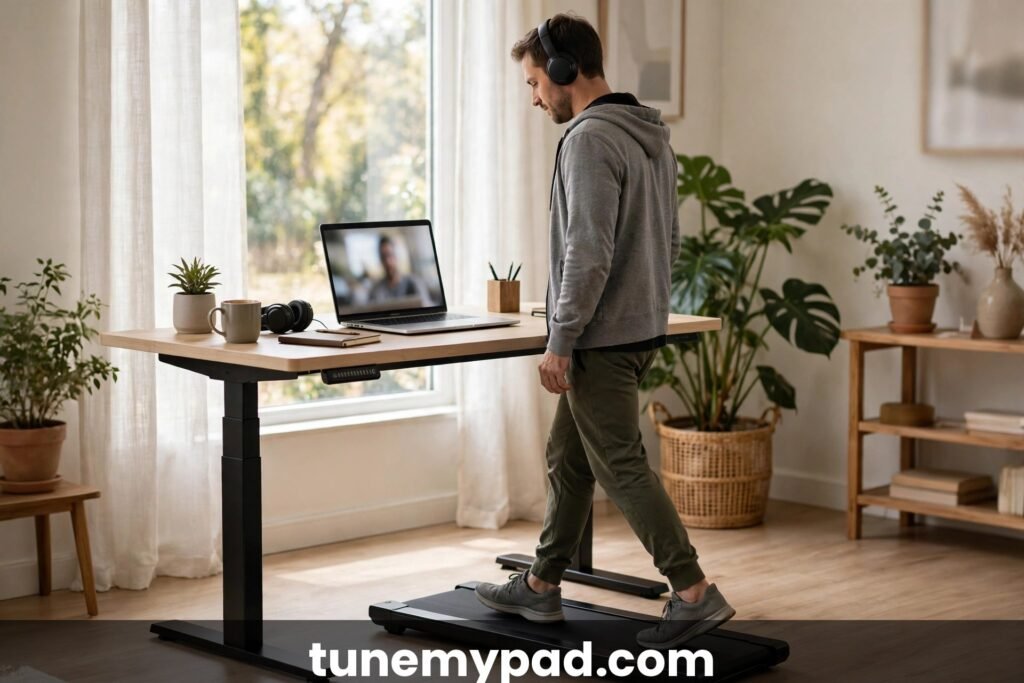
The Best Tasks to Pair With Walking
Not all work walks equally well. Matching task type to walking is the skill that separates people who love the setup from people who abandon it in a week.
Green light — walk freely:
- Phone and video calls where you are mostly listening
- Webinars, training videos, and recorded talks
- Reading articles, reports, and long documents
- Email triage and inbox processing
- Planning, brainstorming, and thinking-through-problems time
- Dictated notes and voice memos
Yellow light — try it and judge honestly:
- Drafting documents and writing first drafts
- Spreadsheets and data review
- Light coding or code review
Red light — sit down:
- Anything requiring precise mouse work or design
- Presenting on video (walking reads as distracted on camera)
- Tasks where you have noticed your error rate climbing
Matching tasks well is what turns a walking pad for ADHD focus while working from a novelty into a daily system. Batch by walking compatibility instead of forcing one mode all day — sit for deep-focus blocks, walk for the rest. The three-method framework in our pomodoro routine guide maps neatly onto this.
The task-sorting habit
Each morning, spend two minutes sorting the day’s tasks into walk/sit piles. People who do this report dramatically better results than people who “just walk whenever.” The sorting itself is a planning ritual — and for ADHD brains, externalizing the plan beats holding it in working memory every time. A sticky note with two columns (WALK / SIT) on the monitor bezel is all the system you need.
Setting Up the Workstation for Focus Walking
A walking pad for ADHD focus while working lives or dies on ergonomics. If the setup fights you, you will blame the concept instead of the desk height.
- Desk height: elbows at roughly 90 degrees, wrists straight, monitor top at or just below eye level. Save it as a preset if your desk has memory buttons — you will toggle between sitting and walking heights daily.
- Monitor distance: slightly farther than when sitting. Walking introduces micro head-bob; a screen that is too close amplifies it. Arm’s length plus a few inches is the starting point.
- Keyboard and mouse: a keyboard tray or a stable, non-bouncy surface matters more while walking. Laptop keyboards on wobbly risers are the top complaint — an external keyboard on a solid desk fixes most of it.
- The remote: docked on the desk at hand’s reach, not in your pocket where you will fumble for it mid-stride. A lanyard works too.
- Footwear: supportive walking shoes, not socks. Foot fatigue is the number-one reason focus-walking sessions end early in week one.
- Water and essentials within reach: every reason to step off the pad is a focus break you did not plan. Bottle, phone, notepad — all within arm’s reach.
Structuring Your Day Around Walking Focus Blocks
A day built around a walking pad for ADHD focus while working has a rhythm. Here is a pattern many people settle into:
- Morning ramp (20–30 min). Start the workday walking at 1.2–1.5 mph with email triage or planning — the block where the day “clicks into gear.”
- Walk the listening hours. Stack calls, webinars, and review reading into mid-morning walking blocks.
- Sit for deep work. Late morning or early afternoon — whenever your sharpest hours fall — go seated for demanding creative or analytical work.
- Walk the slump. The post-lunch dip is prime walking time: low-focus admin tasks at an easy pace instead of a third coffee.
- Hard stop. Stop walking at least 30 minutes before you finish work so body and mind wind down.
| Block | Mode | Task type |
|---|---|---|
| 9:00–9:30 | Walk 1.2 mph | Email triage, day planning |
| 9:30–11:30 | Walk 1.5 mph | Calls, webinars, reading |
| 11:30–1:00 | Sit | Deep work, writing, analysis |
| 1:00–1:30 | Off the pad | Lunch, real break |
| 1:30–3:00 | Walk 1.2 mph | Admin, inbox, light tasks |
| 3:00–5:00 | Sit or short walks | Deep work, then wind-down |
Adjust the skeleton to your own energy curve — the principle is walking for input-heavy hours and sitting for output-heavy ones.
Combining Walking With Pomodoro and Timeboxing
Walking and timeboxing are natural partners for ADHD management — both externalize structure that the brain struggles to generate internally. The combination people report liking best:
- Walk the pomodoro, sit the break. 25 minutes walking at focus speed for the work block, then step off for the 5-minute break. The physical transition marks the boundary more sharply than any timer chime.
- Walking meetings as calendar blocks. If your calendar allows, convert recurring 1:1s and status calls into walking blocks. The meeting provides the structure; the pad provides the movement.
- The “one more lap” rule. When a pomodoro ends mid-thought, allow one extra 5-minute walking block to capture the idea — then stop. This prevents the pad from becoming a procrastination engine.
- End-of-day shutdown walk. A 10-minute easy walk while reviewing tomorrow’s tasks closes the loop — planning done, body tired enough to stop buzzing.
Our walking pad pomodoro routine goes deeper on the three methods and how to adapt them to your energy curve.
The Two-Week Adaptation Curve
Almost nobody loves a walking pad for ADHD focus while working on day one. Knowing the typical adaptation curve for a walking pad for ADHD focus while working prevents quitting during the awkward phase:
| Phase | What it feels like | What to do |
|---|---|---|
| Days 1–3: Novelty | Fun, distracting, everything feels new | Keep sessions to 15–20 min; do not judge focus yet |
| Days 4–7: Awkwardness | Typing suffers, feet ache, motion queasiness possible | Slow down, shorten sessions, fix shoes and desk height |
| Week 2: Calibration | Mechanics fade into background; real patterns emerge | Start the focus log (below); test task pairings honestly |
| Week 3+: Verdict | You know whether it helps you | Keep what works, drop what does not, no guilt either way |
The people who benefit most are usually the ones who almost quit in week one. The people who never benefit usually know by week three. Both outcomes are valid data — the experiment worked even when the answer is “not for me.”
Tracking Your Experiment: The Simple Focus Log
ADHD brains are unreliable narrators of their own productivity — “I feel like I got nothing done” often coexists with a finished project. A tiny log beats vibes:
- Each walking block, note: start/end time, speed, task type, and a 1–5 focus rating.
- Each sitting block, note the same. You need the comparison — walking focus means nothing without a baseline.
- Weekly review (5 minutes): which task types scored highest walking vs sitting? Where did focus ratings cluster?
- Two-week verdict: if walking blocks average even 0.5 points higher on focus for listening-heavy tasks, the setup is earning its floor space.
A notes app, a paper index card, a spreadsheet — the medium does not matter. What matters is capturing the data before your brain rewrites the story. People who log their walking pad for ADHD focus while working experiment are far more likely to keep the habit, because they have proof it works instead of a vague feeling.

What to Watch Out For
A candid list for anyone trying a walking pad for ADHD focus while working — the setup is not all upside:
- Motion sickness. Walking while staring at a screen makes some people queasy in week one. Our treadmill desk motion sickness guide covers the fixes.
- Speed creep. The belt inches up over days until you are exercising, not focusing. Check the display weekly.
- Skipping real breaks. Walking is movement, not rest. Your eyes, posture, and mind still need genuine off-screen breaks.
- Foot and joint fatigue. Feet need conditioning; build walking time gradually and wear supportive shoes.
- Using the pad to avoid bigger questions. If focus problems significantly affect your work or life, a walking pad is a productivity experiment, not a substitute for professional support. Talk to a clinician.
- Noise in shared spaces. The belt hum and your footfalls carry. In open offices or thin-walled apartments, test at your actual walking hours — what is fine at noon may be a problem at 7 a.m.
- Over-scheduling walking. Booking every hour as a walking block leaves no room for the deep seated work that still matters. Walking is a complement to sitting, not a replacement.
Who It May Not Suit
Honesty matters more than enthusiasm here, so a straight list of who a walking pad for ADHD focus while working may not suit:
- You have balance problems, vertigo, or a condition affecting stability — safety first, always.
- You get persistent motion sickness from the walking-plus-screen combination even after the adaptation period.
- Your work demands fine motor precision all day (detailed design, precision editing, lab-style work).
- You find any background movement distracting rather than settling — some people genuinely focus best perfectly still, and that is a valid result of the experiment.
- The belt noise or vibration overstimulates you or bothers people you share space with.
- You are buying it hoping it will fix focus problems on its own. It is a tool in a larger toolkit, not the toolkit.
None of these are failures — they are information about what works for you.
Walking Pad for ADHD Focus While Working FAQs
Is there scientific proof that walking pads help ADHD focus?
No solid body of clinical research covers walking pads and ADHD specifically — be skeptical of anyone claiming otherwise. What exists is self-reported experience plus general research on movement and attention. Treat it as a personal experiment and judge by your own output over two to three weeks.
What speed is best for focusing with ADHD?
Most people testing a walking pad for ADHD focus while working land between 1.0 and 1.8 mph, with 1.2–1.5 mph the most commonly reported sweet spot. The test: if you periodically forget you are walking, the speed is right. If walking keeps grabbing your attention, slow down.
Can a walking pad replace ADHD medication or therapy?
No — and this framing matters. A walking pad is office furniture with a motor, not a treatment. Never adjust medication or skip professional care because a productivity setup feels helpful. Keep your clinician in the loop about any strategies you try.
Will walking distract me more than sitting?
For some people, yes — and that is a legitimate outcome. Common culprits are walking too fast, choosing the wrong tasks (precision work while moving), or simply being someone whose focus works best in stillness. Give it a genuine two-week trial at slow speeds before concluding.
How long should walking focus sessions be?
Start with 15–20 minute sessions and build toward 30–60 minutes. Shorter, more frequent walking blocks work better for focus than one multi-hour march, and are easier on your feet.
Should I tell my employer I am using a walking pad for focus?
Only if you need accommodation or it affects shared space. Many remote workers simply use one — it is office furniture, not a medical device. If you are requesting it as a workplace accommodation, that is a conversation with HR and possibly your clinician, and the framing shifts from “productivity experiment” to documented need.
Does the type of walking pad matter for focus?
Mostly in noise and stability. A quieter belt matters more for focus than any feature — rhythmic hum fades into background, but squeaks and thumps yank attention back. Beyond that, any reliable pad works; the focus benefits people report come from the walking, not the machine’s specs.
What if walking helps my focus but my feet cannot handle it?
Common in the first month. Solutions in order: better shoes (the usual fix), shorter sessions with sitting breaks between, an anti-fatigue mat under the pad, and checking your gait — overstriding hammers feet. If foot pain persists beyond the adaptation period or is sharp rather than achy, see a professional rather than pushing through.
Conclusion
A walking pad for ADHD focus while working is, at its best, a simple bargain: give restlessness somewhere to go, and attention often settles down to business. Keep it slow, pair it with the right tasks, track your own data for two weeks, and run an honest trial. If it helps, you have gained a productivity tool; if not, you have learned how you focus. Either way, it is one experiment among many — and the professionals who understand ADHD are worth talking to regardless.
External References
- The CDC’s data on ADHD diagnosis and treatment in adults (how common adult ADHD is and how often diagnosis comes in adulthood)
- CHADD, the national ADHD resource organization (evidence-based information and support for people affected by ADHD)