
Here’s a question that stops new treadmill-desk owners cold: do you need a chair with a treadmill desk? You’ve just committed to walking while you work — so is the chair obsolete? Or will you regret giving it away the first time you need to concentrate? The answer isn’t as obvious as the marketing suggests, and getting it wrong leads to one of two failure modes: the chair-less setup that collapses the first hard week, or the dusty treadmill beside a chair you never leave.
The honest answer is: no, you don’t need one at the treadmill desk — but most successful walking workers keep seating nearby. The distinction matters. This guide explains why, covers the setups that actually work (sit-stand-walk rotation, the perch stool, the nearby chair), the tasks that genuinely need sitting, and how to arrange your space so both options stay inviting. This is why the question do you need a chair with a treadmill desk deserves a nuanced answer rather than a simple yes or no.
Table of Contents
Quick Answer: Do You Need a Chair with a Treadmill Desk?
| Question | Answer |
|---|---|
| Do you need a chair with a treadmill desk? | Not at the desk itself — you can’t sit and walk simultaneously. But keeping a chair nearby for breaks and sitting tasks makes the setup far more sustainable. |
| Can you walk all day without sitting? | Physically possible, inadvisable. Even enthusiasts cap walking at 3–5 hours; feet, joints, and focus all need sitting breaks. |
| What’s the best setup? | A height-adjustable desk with a walking pad plus a chair (or stool) positioned for quick switching — the sit-stand-walk rotation. |
| Which tasks need sitting? | Precision work, intense writing, long complex calls, and anything where walking degrades your performance. |
| Will keeping a chair kill my walking habit? | Only if the chair is more convenient than the pad. Arrange the space so switching to walking is the path of least resistance. |
Why the Question Is Trickier Than It Looks
The naive logic goes: treadmill desk = walking desk = no chair needed. But when you ask do you need a chair with a treadmill desk, reality is messier, for three reasons:
Your body isn’t built for all-day walking either
Eight hours of sitting is bad. Eight hours of walking is also bad — just differently. Feet, knees, and lower backs all protest sustained walking without breaks, especially in the first months. The health literature consistently favors variety of posture over any single posture: sit, stand, walk, repeat. A setup with no sitting option replaces one static posture with another. That’s why the question do you need a chair with a treadmill desk matters — it’s really about building variety into your day.
Your brain has sitting tasks
Certain cognitive work genuinely goes better sitting, particularly while you’re adapting. Fine motor tasks (detailed design, spreadsheet surgery), high-stakes communication (performance reviews, negotiations), and deep creative flow often suffer at walking speed for beginners. This isn’t failure — it’s task-matching, and it improves with practice. But on day one, you need the sitting option or you’ll abandon the pad during hard work and never return. The fact that your brain has sitting tasks is a practical reason why do you need a chair with a treadmill desk isn’t just about comfort — it’s about work quality.
The all-or-nothing trap
The most common treadmill-desk failure story: “I tried to walk all day, my feet were wrecked by Thursday, and now the pad is a very expensive footrest.” Keeping a chair nearby isn’t weakness — it’s the pressure valve that makes the whole system sustainable. The goal is replacing most sitting with walking, not achieving sitting zero.
7 Honest Answers About Chairs and Treadmill Desks
1. So — do you actually need the chair?
In the strict sense? No. The chair cannot be used simultaneously with the walking pad, so it serves no function during walking. But “need” is the wrong frame. The right question is: “Will I walk more, over more months, with a chair nearby?” For ~90% of people, the answer is yes. Think of the chair as part of the system, not a competitor to it.
2. What’s the ideal arrangement?
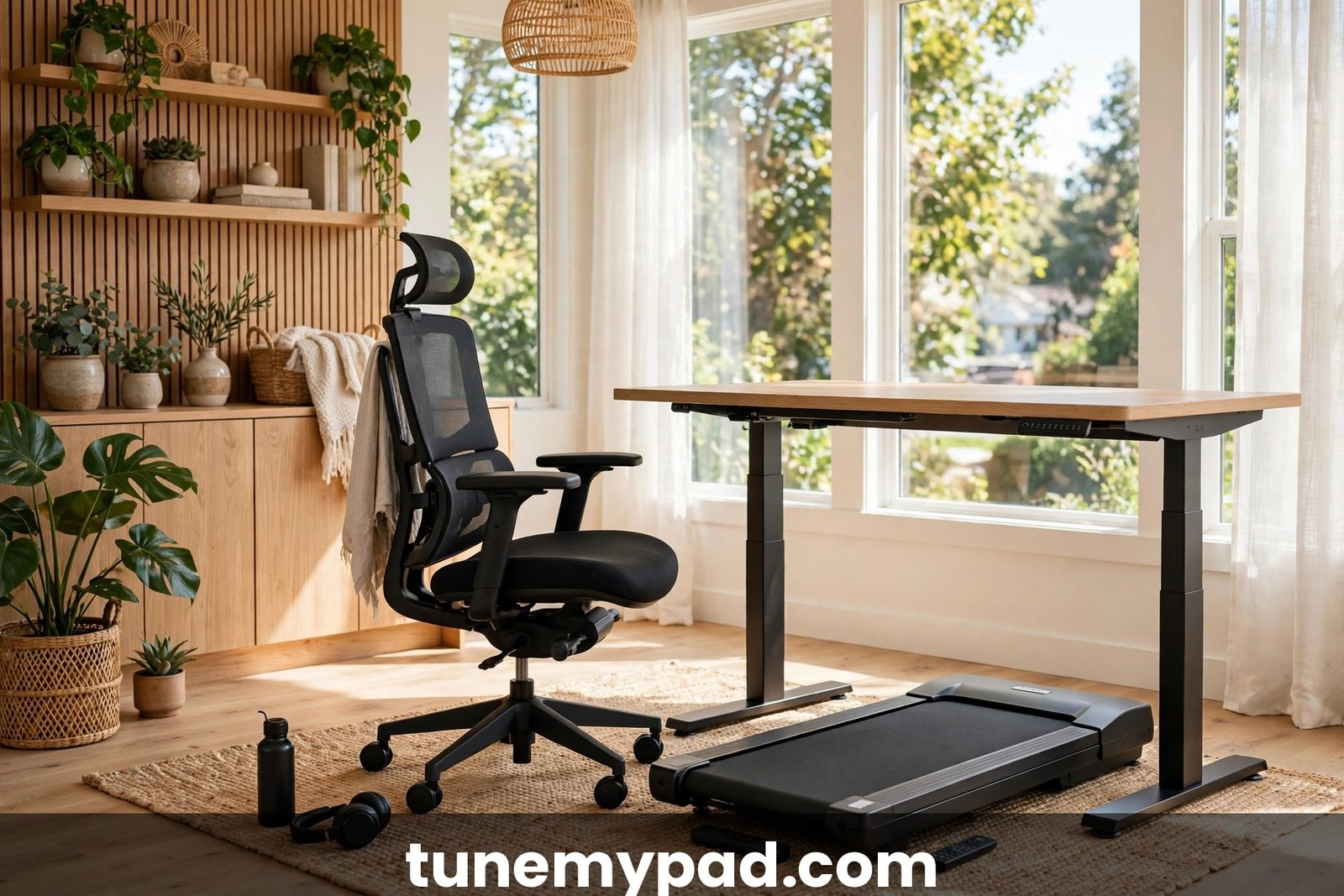
The gold standard: a height-adjustable desk with the walking pad underneath, and your office chair parked immediately beside or behind the station — close enough to grab in one motion. To switch: step off the pad (power it down or pause), roll the chair in, lower the desk to sitting height via the memory preset. Total transition time: under 30 seconds. If switching takes longer than that — chair in another room, desk height manual-cranked — you’ll stop switching, and then you’ll stop walking.
3. Should the chair live at the desk or nearby?
Nearby, not at. A chair parked at the treadmill desk blocks the pad, collects clutter, and psychologically invites sitting as the default. A chair parked beside the station (within arm’s reach, facing the desk) keeps sitting available without making it the path of least resistance. Some people use a compact stool or a drafting chair that tucks fully under the desk — same principle, smaller footprint.
4. What about a standing-only setup (no chair, no sitting)?
Some walking workers go chair-free and alternate walking with plain standing. This works if you have an anti-fatigue mat and genuinely enjoy standing. But standing still is the least comfortable of the three postures for most people — it’s static loading without the movement benefits of walking. The sit-stand-walk trio beats walk-stand duo for most bodies. If space forces a choice, keep the chair over the standing-only option.
5. Which tasks should I sit for?
A practical starting list (it shrinks as you adapt):
- Precision mouse work: detailed graphic design, video editing timelines, CAD
- High-stakes calls: job interviews, negotiations, difficult feedback — sit for presence and focus
- Intense writing sprints: many writers find first-draft flow better sitting (editing while walking is great, though)
- Long meetings where you’re mostly listening: sitting conserves energy for the walking blocks that matter
- Anything where you notice your quality dropping: the rule is the metric, not the category
Revisit the list monthly. Most people find the walking-compatible list grows steadily — see our guide to what tasks you can do on a treadmill desk for the full breakdown.
6. Will having a chair nearby sabotage the habit?
This is the real fear behind the chair question, and it’s legitimate — but the causality usually runs the other way. People don’t quit walking because a chair exists; they quit because walking is uncomfortable (bad ergonomics), inconvenient (slow transitions), or forced (all-day targets). Fix those, and the chair becomes a rest stop, not a trap. Two design choices protect the habit:
- Make walking the default: start every workday on the pad. Defaults are powerful — you’ll sit when you choose to, not by inertia.
- Make sitting slightly effortful: chair parked to the side (not at the desk), desk preset labeled “WALK” as position 1. Tiny frictions shape behavior.
7. What kind of chair works best alongside a treadmill desk?
You don’t need a special chair — your existing office chair is fine. But if you’re buying: prioritize quick adjustability (you’ll change desk height often, so the chair should adapt fast), easy rolling (you move it constantly), and a compact footprint (space is at a premium around a treadmill station). Armless or flip-up arms help the chair tuck beside the desk. And honestly? A simple, comfortable task chair beats an expensive ergonomic throne here — you’re sitting less, so the chair matters less.
The Sit-Stand-Walk Rotation: A Sample Day
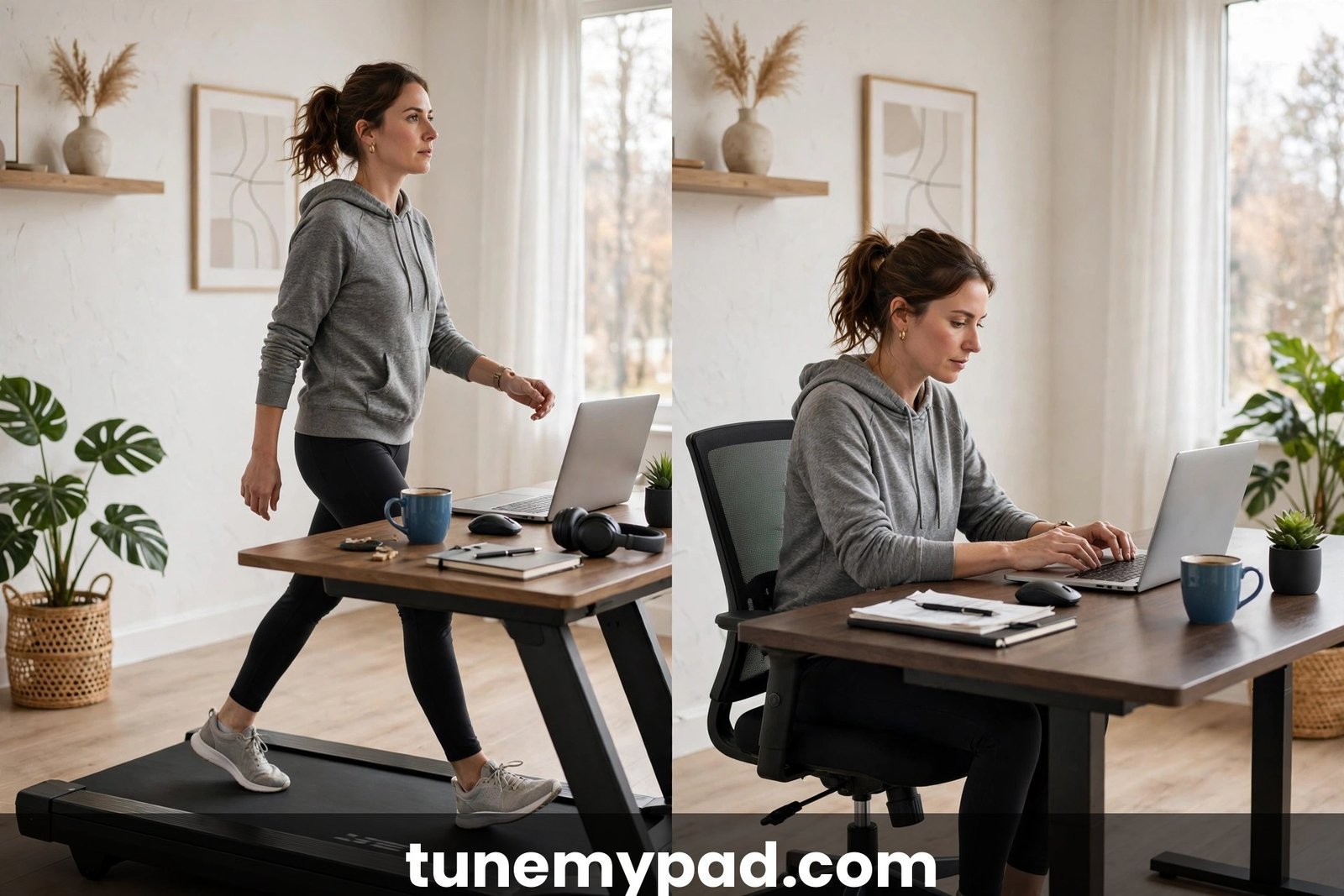
Here’s what a sustainable day looks like for an experienced walking worker. Adapt the ratios to your fitness and tasks:
| Time | Posture | Activity |
|---|---|---|
| 8:30–9:00 | Sit | Plan the day, triage email — ease in |
| 9:00–11:00 | Walk (2 mph) | Deep work block #1 — writing, analysis |
| 11:00–11:15 | Stand | Break, water, stretch |
| 11:15–12:30 | Walk (1.5 mph) | Calls and admin |
| 12:30–1:30 | Sit | Lunch away from the desk — real break |
| 1:30–3:00 | Sit or stand | Post-lunch dip: demanding work seated, or a slow walk to beat the afternoon slump |
| 3:00–4:30 | Walk (2 mph) | Deep work block #2 |
| 4:30–5:00 | Sit | Wrap-up, tomorrow’s plan |
Total walking: ~3.5 hours, ~7,000–8,000 steps, without ever feeling like “exercise.” Notice the structure: walking brackets the day’s deep work, sitting handles transitions and precision tasks, and nothing is all-or-nothing.
Setting Up the Space for Two Postures
The footprint
A dual-posture station needs roughly 7 × 5 feet: the desk + pad zone plus chair parking. In a small home office, this means the chair lives behind you while you walk (swivel around, sit, roll in) or beside the desk. Measure before you commit — a chair that doesn’t fit the room ends up in the hallway, and then it’s not really available.
Desk presets are mandatory
Label them clearly: 1 = SIT, 2 = WALK (and 3 = STAND if you use it). The 20 seconds of manual height adjustment is a habit-killer; one-button presets make transitions thoughtless. This is the highest-ROI feature of any treadmill-desk setup.
Flooring zones
Put the equipment mat under the pad, and consider a small rug or second mat where the chair parks — rolling a chair across hard floors all day is noisy, and across the pad’s mat edge is a trip hazard. Define the zones visually and your feet will learn them.
Keep walking shoes at the station
Barefoot-to-chair transitions are fine, but walking in socks then sitting is fine too — the point is to remove the “I need to go find my shoes” friction. A pair of slip-on walking shoes parked by the pad means zero excuses.
The Adaptation Curve: When You’ll Want the Chair Most
Week 1–2 is peak chair temptation: feet ache, calves tighten, and walking still takes conscious effort. This is normal adaptation, not a sign the setup is wrong. Plan for it:
- Weeks 1–2: 60–90 minutes of walking daily, chair for the rest. Sore feet are expected; sharp pain is not.
- Weeks 3–4: 2–3 hours walking. The chair becomes a genuine choice rather than a refuge.
- Month 2+: 3–5 hours walking for most enthusiasts. The chair handles precision tasks and rest breaks.
If you’re still chair-bound at week 4, the problem is usually ergonomics (desk height, footwear, pad position) rather than willpower — audit the setup before blaming yourself. Our treadmill desk setup guide is the diagnostic checklist.
Chair vs. Stool vs. Nothing: How the Options Compare
| Option | Footprint | Comfort for long sits | Transition speed | Best for |
|---|---|---|---|---|
| Full office chair (nearby) | Large | Excellent | Fast (roll in/out) | Most people; precision-task heavy roles |
| Drafting stool / perch seat | Small | Good for 30–60 min | Very fast | Small offices; active-sitting fans |
| Folding stool (stored) | Zero when stored | Basic | 30 seconds to deploy | Tiny rooms; occasional sitters |
| Standing only (mat, no seat) | Small | Poor beyond 30 min | Instant | Rare — only if you genuinely dislike sitting |
| Couch/bed in the same room | Zero extra | Good | Walk across room | Bedroom offices; informal setups |
The full office chair wins on pure comfort, the perch stool wins on space efficiency, and the folding stool wins when space is truly zero. All three beat the “no seating” option for sustainability. Notice what they share: each keeps sitting available without making it the default workstation state.
The perch stool: the underrated middle path
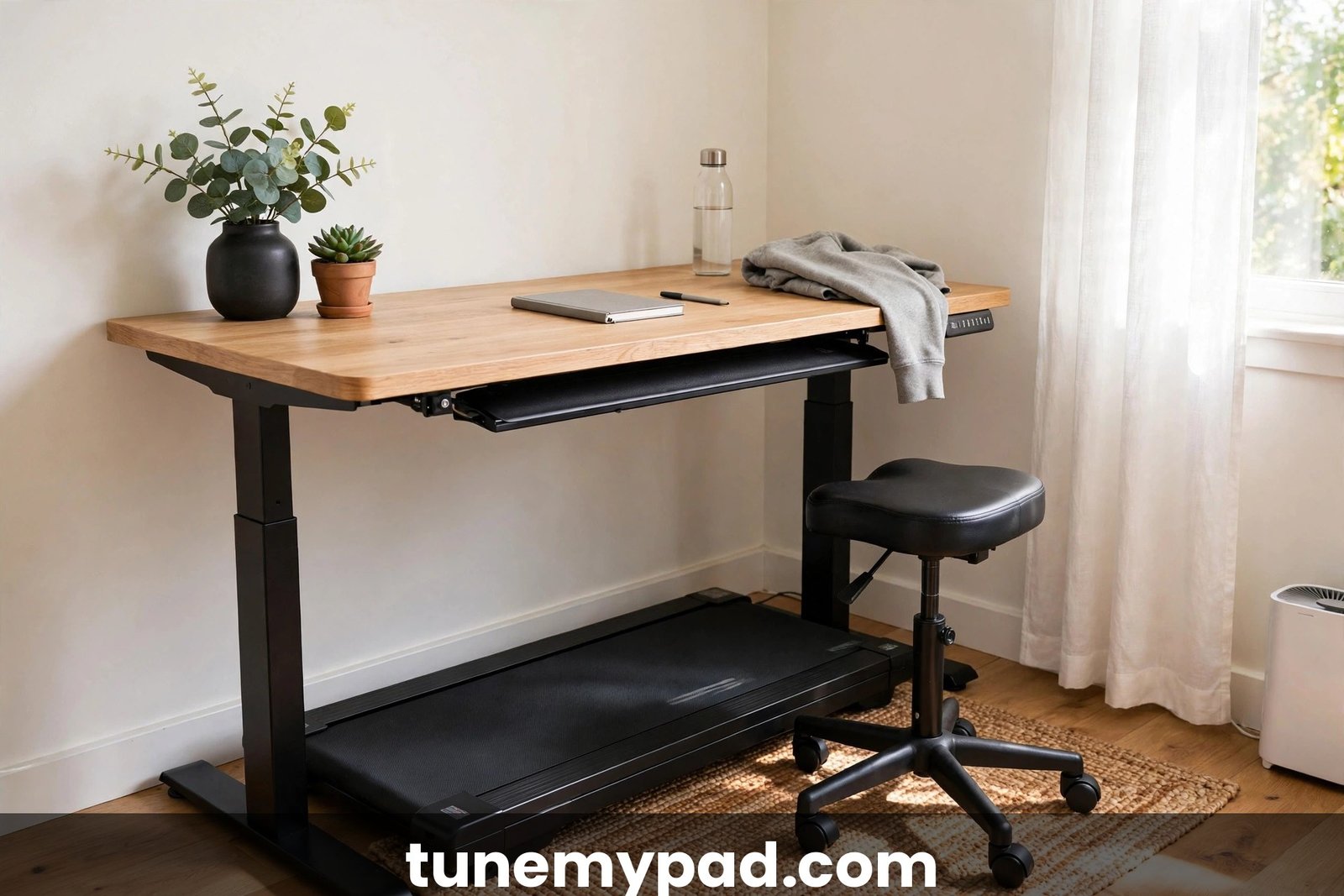
Sit-stand stools (leaning seats) deserve special mention. You half-sit, half-stand on them, which keeps your hip angle open and your core lightly engaged — a genuinely healthier sitting posture. They tuck under or beside the desk, deploy in seconds, and cost far less than an office chair. If you’re buying seating specifically for a treadmill station rather than repurposing an old chair, start here.
What If You Have No Room for a Chair?
Small-space reality check: if your home office genuinely fits only the treadmill station, you have options:
- A folding stool hung on the wall or tucked behind the desk — 30 seconds to deploy, zero footprint when stored.
- The bed/couch break: if the office is a bedroom corner, sitting on the bed for calls and precision work is a legitimate rotation.
- Scheduled walk-away breaks: step off the pad and sit elsewhere in your home for 15 minutes every 90 minutes. The break matters more than the chair’s location.
The principle survives the space constraint: somewhere to sit, reachable without friction, used deliberately.
Making the Switch Effortless: Transition Rituals
The difference between people who sustain the rotation and people who don’t often comes down to tiny rituals that make switching automatic:
- The shoe swap: walking shoes on = walking mode; shoes off = sitting mode. The physical act becomes the switch.
- The preset tap: always return the desk to the WALK preset when you step off, so the next session starts correctly. Future you is lazy — help them out.
- The task-sorted calendar: block walking-friendly tasks (email, reading, 1:1s) in walking blocks and precision work in sitting blocks. When the calendar decides, willpower doesn’t have to.
- The end-of-day reset: leave the station in walking configuration overnight. Mornings start on the pad by default.
Each ritual removes one micro-decision, and micro-decisions are where habits die. After a month, you won’t think about any of this — you’ll just walk, sit, and work, the way you once just sat.
FAQ
What if you work from home full-time?
The same logic applies at home: no strict need, but strong recommendation. Home workers actually face more temptation to over-walk (no commute breaks up the day, no colleagues to walk to), making the sitting pressure valve more important, not less. Keep the chair. So do you need a chair with a treadmill desk at home? Absolutely — keep one nearby.
Can I just use a standing desk chair (drafting stool)?
A drafting-height stool or leaning seat (like a sit-stand stool) is an excellent companion: smaller than a chair, encourages active sitting, and tucks away easily. It’s arguably the best single seating choice for a treadmill station. Just make sure it’s stable — perching stools with narrow bases can tip.
Is it bad to alternate between sitting and walking all day?
Quite the opposite — postural variety is the goal that the research actually supports. The evidence against prolonged sitting isn’t evidence for prolonged walking; it’s evidence for breaking up static postures. Alternating is the healthiest pattern, and it’s also the most productive one. When people ask do you need a chair with a treadmill desk, this alternating pattern is the reason the answer is ‘keep one nearby.’
How do I stop the chair from becoming my default again?
Three tactics: start each day walking (defaults win), keep the walking preset as desk position #1, and track walking hours visibly (a sticky note, a habit app). If you notice a full sitting day, treat it as data, not failure — ask what made walking unappeiving that day (fatigue? a hard task? bad ergonomics?) and fix that. When people ask do you need a chair with a treadmill desk, the real question is whether the chair supports or sabotages your walking habit.
Should I get rid of my old desk chair to commit?
Don’t — at least not in the first three months. Premature commitment is how equipment ends up on resale sites. Keep the chair until walking 3+ hours daily feels automatic and pleasant. Then, if space demands it, you can downsize to a stool with confidence. This patient approach is why do you need a chair with a treadmill desk has a nuanced answer: keep it until you truly don’t.
How do I handle video calls when alternating postures?
Match the posture to the call’s demands. Camera-on, high-stakes, or client-facing calls: sit, for steadiness and presence. Internal audio-only standups or casual 1:1s: walking is fine and often energizing. Keep a “call preset” habit — when a calendar invite with video appears, that’s your cue to roll the chair in. Nobody wants to watch you bob through a quarterly review. For those wondering do you need a chair with a treadmill desk for video calls, the answer is yes — keep one ready for important meetings.
Conclusion
Do you need a chair with a treadmill desk? Strictly, no — but the setups that last for years almost always include one nearby. The chair isn’t the enemy of the walking habit; it’s the rest stop that makes the long journey possible. Build the sit-stand-walk rotation, make transitions instant with desk presets, keep walking the default, and let the chair handle what chairs are good at: precision work, rest breaks, and the occasional long call. Check in with yourself monthly — as your walking stamina and coordination improve, you’ll naturally find the chair earning less of your day, which is exactly the trajectory you want. That’s not compromise — that’s the system working as designed.