
Day one on a treadmill desk is humbling. The belt feels fast at 1 mph, typing feels like a circus act, and you are winded after twenty minutes. Then, somehow, by week three you are walking through entire mornings without thinking about it. The difference between those two experiences is rarely talent — it is method. Knowing how to start using a treadmill desk for beginners the right way turns a wobbly first week into a lifelong habit.
This guide gives you how to start using a treadmill desk for beginners as 8 concrete steps: the setup that prevents week-one injuries, the speed ramp that builds stamina without soreness, the footwear and posture basics, the task progression that keeps you productive from day one, and the 2-week adaptation plan that takes you from shaky to fluent.
Table of Contents
Quick Answer: How to Start Using a Treadmill Desk for Beginners
| Question | Answer |
|---|---|
| How do beginners start using a treadmill desk? | Set desk height to elbow level, start at 0.5–1 mph for 15–30 minutes, wear supportive shoes, and add 15 minutes every couple of days. |
| What speed should a beginner walk on a treadmill desk? | 0.5–1 mph for the first week. Comfort before speed — you can raise it once walking feels boring. |
| How long should beginners walk on day one? | 15–30 minutes total, broken into short bouts. Soreness on day two means you did too much, not that walking desks are wrong for you. |
| Do beginners need special shoes for a treadmill desk? | Supportive walking shoes or cushioned sneakers, yes. Barefoot, socks, and flat fashion shoes cause foot and calf pain fast. |
| How long until a treadmill desk feels normal? | Most beginners feel functional within 1–2 weeks and fully fluent within 3–4 weeks of consistent daily use. |
Step 1: Set Up Your Ergonomics Before the First Step
How to start using a treadmill desk for beginners begins before the belt moves. Bad ergonomics on day one creates pain that beginners blame on walking itself.
- Desk height: elbows at 90 degrees. Stand on the (stopped) belt in your walking shoes and raise the desk until your elbows rest at roughly 90 degrees with shoulders relaxed. This is your walking height — mark it if your desk has memory presets. Most beginners set the desk too low, which forces hunching.
- Monitor at eye level, arm’s length away. The top of the screen should sit at or slightly below eye level. Looking down at a laptop screen while learning to walk is a fast track to neck pain — use a monitor riser or an external monitor from day one.
- Keyboard and mouse close. Keep input devices near your body so you are not reaching. Reaching while balancing on a moving belt is unstable and tiring.
- Safety key clipped on. Attach the treadmill’s safety clip to your clothing before every session. Beginners stumble more; the kill switch is not optional. The CPSC’s treadmill safety guidance exists because real injuries happen — respect the machine.
Spend 15 minutes on setup. It pays back every day for years.
Step 2: Start Absurdly Slow (0.5–1 mph)
The number-one beginner mistake in how to start using a treadmill desk for beginners is starting at “real” walking speed. Your body is learning two skills at once — walking and working — and the belt does not care about your pride.
- Day 1–3: 0.5–1 mph. This feels silly. That is the point. At 0.8 mph you can think clearly, type almost normally, and your body learns the rhythm without stress.
- Raise speed only when the current pace feels boring. Boredom is the signal your nervous system has automated the motion. Then add 0.2–0.3 mph.
- Never chase a step goal in week one. Goals create speed pressure. Walk for time, not distance, until the motion is automatic.
Most beginners who follow how to start using a treadmill desk for beginners properly reach 1.5–2 mph naturally by week three — without ever forcing it.
Step 3: Build Time Gradually — The 15-Minute Rule
Stamina, not speed, is the beginner’s real project. A realistic ramp for how to start using a treadmill desk for beginners:
| Day | Walking time | Notes |
|---|---|---|
| 1–2 | 15–30 min total | Split into 2–3 short bouts; stop before fatigue |
| 3–5 | 30–60 min total | One longer morning bout + short afternoon bouts |
| Week 2 | 1–2 hours total | Start stacking walking behind routine tasks |
| Week 3 | 2–3 hours total | Walking blocks feel normal; add speed cautiously |
| Week 4+ | 3–5 hours total | Full walking workdays within reach |
Rules of the ramp:
- Soreness is data, not failure. Calf and foot soreness in week one is normal — classic delayed onset muscle soreness from novel activity — you are using muscles that sitting deactivated. Sharp joint pain is not normal; stop and check shoes and posture.
- Alternate walking and standing. You do not need to walk every minute. Walk 20, stand 20 is a perfectly good beginner pattern.
- Take a rest day if you need one. Especially in week one, a day off lets adaptation catch up. Consistency over weeks beats heroics on day two.
Step 4: Wear Real Shoes From Day One
Footwear is the most underestimated part of how to start using a treadmill desk for beginners. The belt is firmer and less forgiving than outdoor ground, and hours of walking amplify every shoe flaw.
- Wear supportive walking shoes or cushioned running shoes. Good arch support and cushioning. This is non-negotiable for multi-hour days.
- Do not walk barefoot, in socks, or in flat dress shoes. Barefoot walking on a treadmill belt causes hot spots and blisters fast; unsupportive flats cause plantar fascia complaints. Save the nice shoes for the commute.
- Keep a dedicated pair at the desk. Desk shoes that never go outside stay clean and are always there — removing one more friction point from the habit.
- Replace them on schedule. Walking 3+ hours daily wears shoes out in months, not years. When the cushioning dies, mysterious foot and knee aches appear. Track roughly 300–500 miles per pair.
Beginners who ignore shoes account for a large share of “treadmill desks hurt my feet” complaints — and it is the easiest problem in how to start using a treadmill desk for beginners to prevent.
Step 5: Fix Your Posture Early (Before Bad Habits Set)
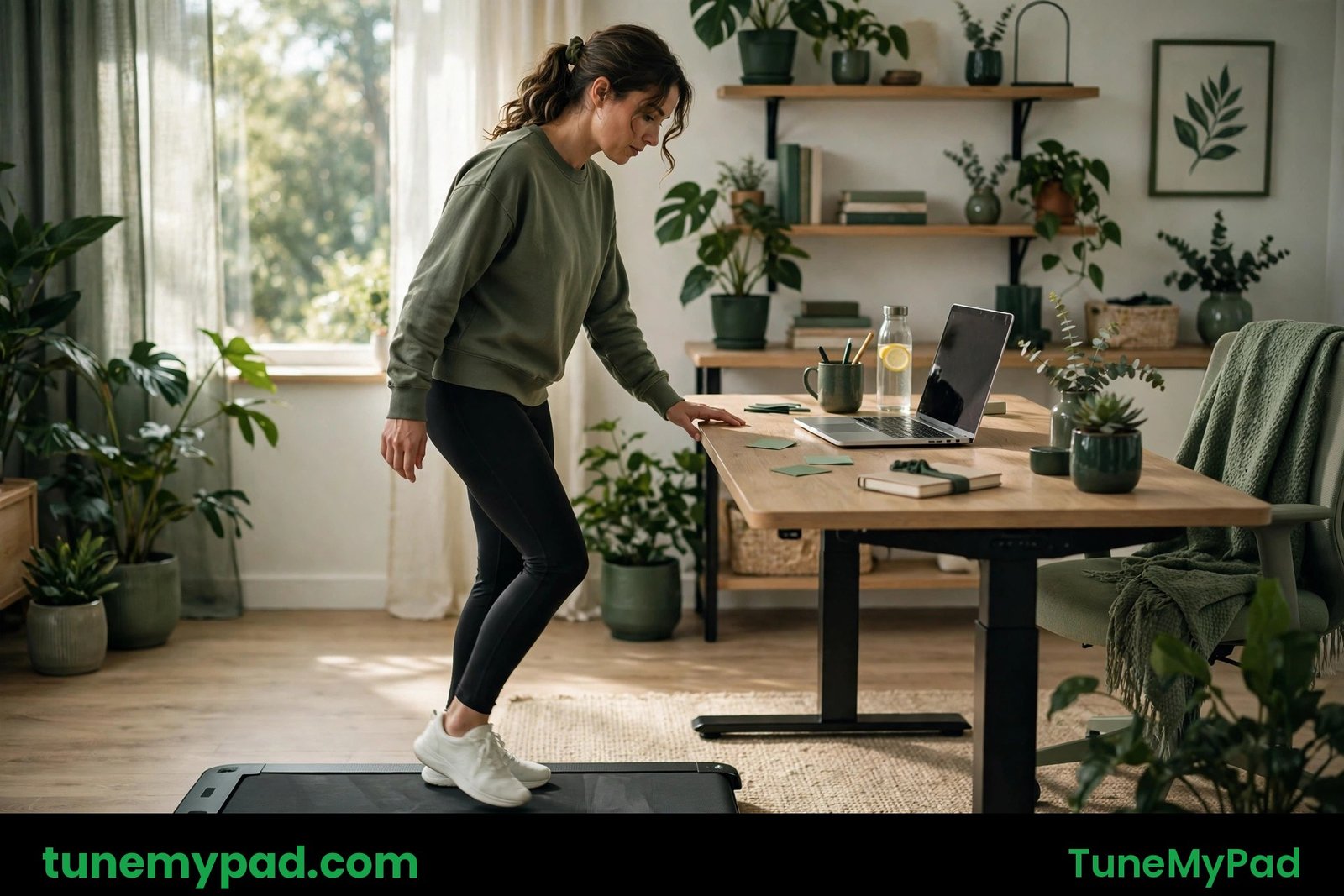
Walking with bad posture for hours daily compounds fast. The posture checklist for how to start using a treadmill desk for beginners:
- Stand tall, chin level. Imagine a string pulling the crown of your head upward. Walkers drift into a forward head poke within days if unchecked.
- Shoulders back and down. Not military rigid — just not rounded forward over the keyboard.
- Light core engagement. A gently braced core stabilizes the pelvis and reduces lower-back complaints. You do not need abs of steel; just avoid the swayback slump.
- Do not grip the desk. Beginners white-knuckle the desk edge for balance. Light fingertip contact is fine for the first days, but graduate off it — a death grip ruins arm ergonomics and transmits tension everywhere. (More on this: should you hold the desk while walking.)
- Land midfoot, not on your toes. Toe-walking on a treadmill fries the calves. Let the heel kiss the belt lightly with each step.
Check yourself in a mirror or phone video at the end of week one. What feels “normal” by then is often visibly slouched — correct it while the habit is young.
Step 6: Progress Your Tasks From Easy to Hard
Beginners who try to do their hardest work on day one conclude treadmill desks “don’t work.” The task ladder is central to how to start using a treadmill desk for beginners:
- Week 1: consume only. Calls where you listen, reading, training videos, webinars. Zero precision demand while your body learns.
- Week 2: add light production. Email replies, admin, organizing, commenting on documents. Typing at 1 mph once the rhythm is automatic.
- Week 3: add creation. First drafts, planning, brainstorming. The cognitive boost of walking starts paying off here.
- Week 4+: full task range. By now you know your personal limits. Keep precision work (design, complex spreadsheets, debugging) for paused-belt blocks — that never fully changes, and that is fine.
This progression is the heart of how to start using a treadmill desk for beginners without the frustration that derails most first attempts — it keeps you productive from day one instead of defeated. The full task framework lives in our guide to what you can do on a treadmill desk.
Step 7: Learn the Safety Basics
How to start using a treadmill desk for beginners must include safety — not to scare you, but because beginners have the least margin:
- Safety key, every time. Clip it to your waistband or shirt. If you stumble, the belt stops instantly.
- Clear the area. Nothing behind the treadmill you could hit falling backward — the most common treadmill injury direction. A wall 3+ feet behind the belt is the minimum.
- Keep cords and pets clear. Route power cables away from the belt path; keep pets and small children out of the room while walking. (Full guidance: children and pets around walking pads.)
- Step on and off carefully. Step onto the side rails first, start the belt, then step on. Reverse to stop. Never jump on a moving belt — beginners do this exactly once before learning.
- Stay hydrated. Walking all day is real exercise; keep water at the desk. Dehydration causes the afternoon headaches beginners blame on screens.
- Know the stop signals. Dizziness, chest pain, sharp joint pain, or unusual shortness of breath → stop the belt, sit down, and get checked if it recurs. Walking desks are gentle exercise, but listen to your body.
Step 8: Follow the 2-Week Adaptation Plan
Here is how to start using a treadmill desk for beginners as a day-by-day plan:
Days 1–2: Orientation. 15–30 minutes at 0.5–1 mph. Consume-only tasks. Focus on posture and setup. Expect to feel clumsy — that is normal.
Days 3–5: First ramp. 30–60 minutes total. Try 1–1.2 mph. Add email and light admin. Calves may ache — stretch them in the evening.
Days 6–7: Consolidation. Aim for an hour in one morning block. Notice which tasks feel fine and which do not. Adjust desk height if anything aches.
Week 2, days 8–10: Expansion. 1–2 hours daily. Push toward 1.5 mph when 1.2 feels boring. Add first-draft writing. The motion starts feeling automatic in stretches.
Week 2, days 11–14: Fluency check. 2–3 hours daily across 2–3 blocks. You should catch yourself walking without thinking about walking — that is the milestone. Plan your week-3 task mix.
After day 14, you are no longer a beginner — you are a walking worker tuning the system. Our guide to getting used to a treadmill desk maps the milestones from here to full fluency.
Beginner Mistakes That Derail the First Month
Watch for these classic errors in how to start using a treadmill desk for beginners:
- Too fast, too soon. The #1 killer in how to start using a treadmill desk for beginners. Speed is earned by boredom, not by ambition.
- Marathon day one. Walking 3 hours on day one guarantees day-two agony and day-three abandonment. Ramp.
- Bad shoes. Covered above — the cheapest fix with the biggest payoff.
- Hardest tasks first. Doing precision work while learning to walk teaches you that walking “doesn’t work.” It does — for the right tasks.
- Skipping the safety key. It feels fussy until the one time you need it.
- No water at the desk. Dehydration masquerades as fatigue and headaches.
- Comparing to veterans. The person walking 5 hours at 2 mph has months of adaptation. You will get there; week one is not the time.
- Quitting in week two. Week two is the soreness peak and the motivation trough. Push through with shorter sessions — week three is when it clicks.
Key Takeaways: How to Start Using a Treadmill Desk for Beginners
The complete beginner playbook for how to start using a treadmill desk for beginners:
- Set ergonomics first: desk at elbow height, monitor at eye level, safety key clipped on.
- Start at 0.5–1 mph — the golden rule of how to start using a treadmill desk for beginners — and raise speed only when the pace feels boring.
- Ramp time with the 15-minute rule: 15–30 min day one, adding ~15 minutes every couple of days toward 2–3 hours by week three.
- Wear real walking shoes from day one — the single easiest injury-prevention step.
- Fix posture early: tall stance, level chin, no desk-gripping, midfoot landing.
- Progress tasks: consume in week one, light production in week two, creation in week three, full range by week four.
- Learn safety basics: clear space behind the belt, cords and pets away, step on via side rails, hydrate, heed stop signals.
- Follow the 2-week plan for how to start using a treadmill desk for beginners and do not quit in week two — fluency arrives around week three for most beginners who ramp sensibly.
Frequently Asked Questions
How to start using a treadmill desk for beginners who are worried about looking silly at work?
The worry is universal and unfounded — and how to start using a treadmill desk for beginners in an office is mostly a logistics question. Start with camera-off calls and solo tasks, keep early sessions short, and let colleagues notice the results (your energy, your output) before they notice the method. Most coworkers react with curiosity, not judgment.
How to start using a treadmill desk for beginners who have never used a treadmill?
It is actually easier than gym treadmills — the speeds are lower and there is no incline to manage. Stand on the side rails, start the belt at 0.5 mph, step on, and hold the desk lightly for the first minute. Within a few sessions the motion feels as natural as walking down a hallway. The beginner guide above walks you through the full ramp.
What is the best walking speed for a beginner on a treadmill desk?
0.5–1 mph for the first week. It will feel too slow — that is intentional. Speed is the last variable to increase, after duration and task complexity feel easy. Most beginners settle at 1.5–2 mph by week three or four without ever forcing it.
How to start using a treadmill desk for beginners with knee problems?
Get clinician clearance first, then start even more conservatively: 10-minute bouts at 0.5 mph on a cushioned belt, supportive shoes, and stop at the first sign of joint pain (muscle fatigue is fine; joint pain is not). Many people with mild knee issues do well with walking desks because the pace is gentle and the surface is consistent — but “mild” and “cleared by a professional” are the operative conditions.
Do I need to change my desk setup to start a treadmill desk as a beginner?
Yes, at minimum: raise the desk to standing elbow height, get your monitor to eye level, and clear space around the treadmill. Beginners who skip setup get neck, shoulder, and wrist pain they blame on walking. Fifteen minutes of setup prevents weeks of aches.
How to start using a treadmill desk for beginners in a small apartment?
Choose a slim walking pad that stores under a bed or sofa, place it on a mat to dampen noise and vibration for neighbors, and start with short sessions to confirm the noise level is acceptable. Apartment-specific concerns — noise, space, downstairs neighbors — are covered in our small-space guides.
Can beginners lose weight with a treadmill desk?
Yes, over time — but treat the first month as skill-building, not a weight-loss program. Walking 2–3 hours daily at 1.5–2 mph burns roughly 300–500 extra calories a day, which compounds meaningfully across months. Beginners who chase calorie burn in week one overdo it and quit; build the habit first, and the burn follows.
How to start using a treadmill desk for beginners who work full-time on calls?
Walk the listening-heavy calls at 1 mph from day one — calls are the easiest beginner task. Pause the belt for presentations you deliver and high-stakes conversations. Meeting-heavy beginners often accumulate the most steps because calls fill the day; see our video call guide for camera and audio setup.
Is muscle soreness normal when starting a treadmill desk?
Calf, foot, and sometimes lower-back soreness in the first 1–2 weeks is completely normal — dormant muscles are waking up. It should feel like post-workout soreness, not injury pain, and it should fade as you adapt. Stretch calves and hip flexors in the evening, and do not increase time and speed in the same week.
How to start using a treadmill desk for beginners over 60?
Same method, gentler ramp: longer at each stage, handrail or desk contact for balance confidence, excellent shoes, and clinician clearance if you have cardiovascular or balance conditions. Older beginners often become the most consistent walking workers because they respect the ramp. There is no age limit — only a patience requirement.
When should a beginner increase treadmill desk speed?
When your current speed feels boring — that is the nervous system’s signal that the motion is automated. Increase by 0.2–0.3 mph at a time, and never increase speed and duration in the same week. If accuracy or comfort drops at the new speed, drop back for a few more days. How to start using a treadmill desk for beginners is a patient person’s game, and patience wins.
Conclusion
How to start using a treadmill desk for beginners is not complicated: set up ergonomics, start at 0.5–1 mph, ramp time before speed, wear real shoes, fix posture early, progress tasks from easy to hard, learn the safety basics, and follow the 2-week plan. The beginners who fail are almost never the ones who lack fitness — they are the ones who skip the ramp.
Give it three weeks of sensible progression and the belt stops being something you operate and becomes something you just… do. The clumsy day-one walker and the fluent month-two walker are the same person, separated only by method.
The method behind how to start using a treadmill desk for beginners works because it respects how humans actually learn motor skills: gradually, consistently, and without pressure. How to start using a treadmill desk for beginners is not a fitness challenge — it is a skill acquisition project, and skills reward patience above all. Now you have the method — step on, start slow, and let the habit build itself.