
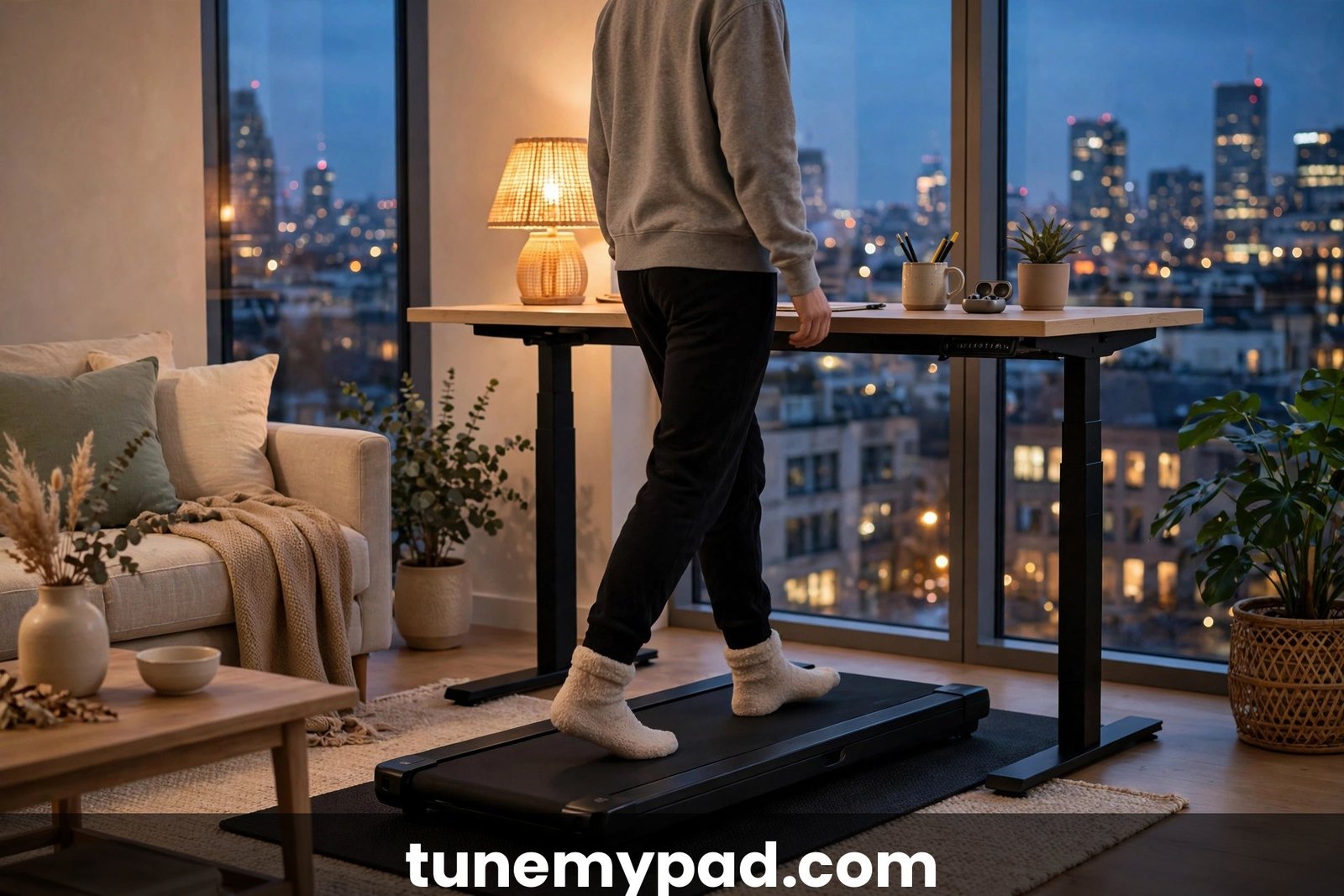
Finding the quietest walking pad for apartment living is harder than it looks. Every product page claims whisper-quiet operation and a sub-45 dB motor — yet apartment forums are full of people whose “silent” walking pad earned them a knock from the downstairs neighbor within a week. The gap between the marketing and your reality comes down to something most buying guides skip: the motor is only one of three sounds a walking pad makes, and it’s the one your neighbors hear least.
This guide cuts through the noise claims. You’ll learn what decibel ratings actually mean (and why independent tests rarely match them), which motor type is genuinely quieter, what features matter for thin walls, and the setup tricks that do more for apartment peace than any spec sheet.
Table of Contents
Quick Answer: Quietest Walking Pad for Apartment
| Question | Answer |
|---|---|
| What really determines quietness? | Footstep impact and vibration transfer — not the motor’s dB rating. |
| Brushless or brushed motor? | Brushless: smoother, quieter, longer-lasting. Make it a requirement. |
| What matters more than the model? | A dense treadmill mat, moderate speed, and socks or soft shoes. |
| Realistic noise level? | 50–60 dB in your room — even the quietest walking pad for apartment use sounds like conversation, not a whisper. |
| Will neighbors hear it? | With a mat and speeds under 2.5 mph, usually not. |
Why “Quiet” on the Box Means Almost Nothing
Nearly every walking pad listing advertises a noise figure like “<40 dB” or “under 45 dB.” Treat those numbers as marketing until proven otherwise. Tom’s Guide tested the popular KingSmith WalkingPad Z1 — a brushless model the manufacturer rates below 45 dB — and measured an average of 57.3 dB with a phone decibel meter app. That’s roughly the volume of a normal conversation, not a library whisper, and it’s about how most real walking pads actually sound under a walking human. In other words, even the quietest walking pad for apartment marketing is really promising “conversation-level” — not “silent.”
Why the gap? Manufacturers typically measure the motor running with no load — no 150-pound person thumping on the belt. Your real-world noise includes the motor hum plus belt friction plus the impact of your footsteps, which the spec sheet never accounts for. When shopping for the quietest walking pad for apartment use, treat the ratings as a rough tier indicator, then judge the features below.
Quietest Walking Pad for Apartment: The 3 Sounds Yours Makes
A walking pad produces three distinct sounds, and confusing them is why so many “quiet” purchases disappoint.
| Sound source | What it sounds like to you | What your downstairs neighbor hears |
|---|---|---|
| Motor hum | A low, steady whir that fades into background | Almost nothing — it’s airborne sound and stays in your room |
| Footfall thump | Soft, rhythmic tapping | The main complaint: a dull, repeating thud through the floor |
| Structure-borne vibration | A faint buzz in the frame you may not notice | A low rumble that travels through floor joists, worse on wooden floors |
The takeaway: your neighbor’s problem is almost never the motor. It’s the impact of your feet and the vibration traveling through the building structure. That’s why a pad with a “louder” motor on paper can be the better apartment choice if it has better shock absorption and you set it up on a proper mat. If a thump or rattle develops over time, check our guide to fixing squeaking noises before assuming the pad is dying.
Quietest Walking Pad for Apartment: Brushless vs. Brushed Motors
This is the one spec that genuinely predicts quietness. Most walking pads use one of two motor types:
- Brushless motors have no physical brushes rubbing inside, so they run smoother, cooler, and noticeably quieter — typically rated under 40–45 dB by manufacturers. They also last longer and need less maintenance. In KingSmith’s lineup, for example, the Z1, R2/R3, and X21 use brushless motors and are the brand’s quietest options.
- Brushed motors use carbon brushes that wear against the motor’s commutator. They’re cheaper and slightly louder, with a higher-pitched whir. KingSmith’s P1 and C2 use brushed motors — still acceptable for apartment use at walking speeds, but audibly noisier side by side.
If quiet is your top priority, filter for brushless first and treat it as a requirement for the quietest walking pad for apartment living — not a nice-to-have. It’s the single most reliable “quiet” signal on a spec sheet. One caveat: at slow desk-walking speeds (1.5–2 mph), your footsteps dominate, so the gap is modest — it grows at higher speeds and as brushed motors wear with age. For buyers prioritizing the quietest walking pad for apartment life, brushless plus a dense mat is the winning combination.
What to Look for in the Quietest Walking Pad for Apartment Use
Beyond the motor, here’s the feature checklist for the quietest walking pad for apartment use — the details that separate genuinely apartment-friendly pads from the rest:
- Multi-layer shock-absorbing belt. Look for 4–5 layer belts with EVA cushioning. These absorb footstep impact before it reaches the floor — the exact noise your neighbors hear. A pad that feels “soft” underfoot is doing your downstairs neighbor a favor.
- A heavier, sturdier frame. Light, flimsy pads rattle and flex, and flex becomes vibration. A 50+ lb pad with a solid deck transmits less energy into the floor than a 35 lb budget unit, all else equal. (Check how much walking pads weigh to see where models land.)
- A mute button on the remote. It sounds trivial until your pad beeps loudly every time you change speed at 11 pm. Several models (like the UREVO SpaceWalk E4) include one — a small but real apartment feature.
- Speed range capped around 3–4 mph for walking-only use. Pads designed for running have bigger motors and transmit more energy. If you only plan to walk, a walking-only pad is inherently quieter than a hybrid treadmill.
- Good belt quality and maintenance access. A dry, misaligned belt squeaks and drags — so pick a model with easy lubrication access and keep it maintained. A well-lubricated pad is measurably quieter than a dry one.
- Realistic weight capacity headroom. A motor straining near its limit runs louder and hotter. If you’re 200 lbs, a 220 lb capacity pad will work harder (and sound it) than a 300 lb one. Our heavy-person walking pad guide covers this in detail.
Quiet Treadmill for Apartment Under-Desk Use: What Changes
If you’re searching for the quietest walking pad for apartment under-desk use specifically — walking while you work — the priorities shift slightly. Desk walking happens at 1–2 mph for hours, so:
- Low-speed smoothness beats peak quietness. Some pads surge at very low speeds — distracting on calls and thumpy. Check reviews for “smooth at low speed” mentions.
- The beep problem is real. You’ll adjust speed dozens of times a day. A loud confirmation beep with no mute option will annoy you (and anyone on your calls) more than the motor ever will.
- App or wristband control lets you change speed without fumbling for a remote or bending down — less interruption, less clatter.
- Stability over slimness. Ultra-thin pads flex more; a slightly thicker deck with real shock absorption is the better desk companion.
Quietest Walking Pad for Apartment: Setup Tricks That Beat Specs
Here’s the honest truth from apartment dwellers: setup matters more than the model. Do these and even a mid-range pad stays neighbor-friendly:
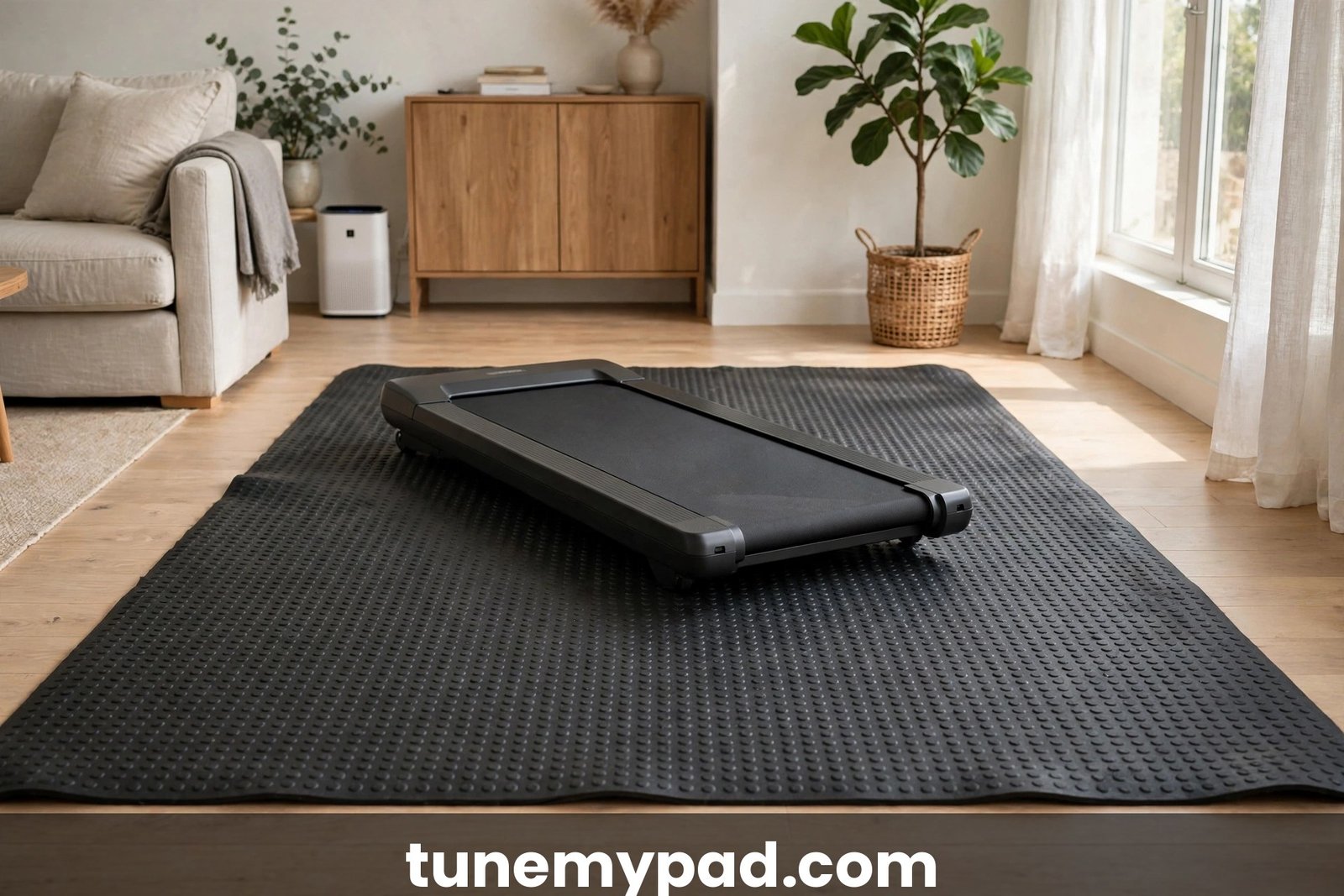
- Use a thick treadmill mat — not a yoga mat. Dense 1/4-inch-plus PVC or rubber absorbs impact and vibration far better than thin foam. On wooden floors, layer interlocking foam tiles under the mat.
- Place it thoughtfully. Keep it away from shared walls and, if possible, not directly over your downstairs neighbor’s bedroom. A corner of the living room over a load-bearing area transmits less than the middle of a span. Our guide on whether a walking pad bothers downstairs neighbors goes deeper on placement.
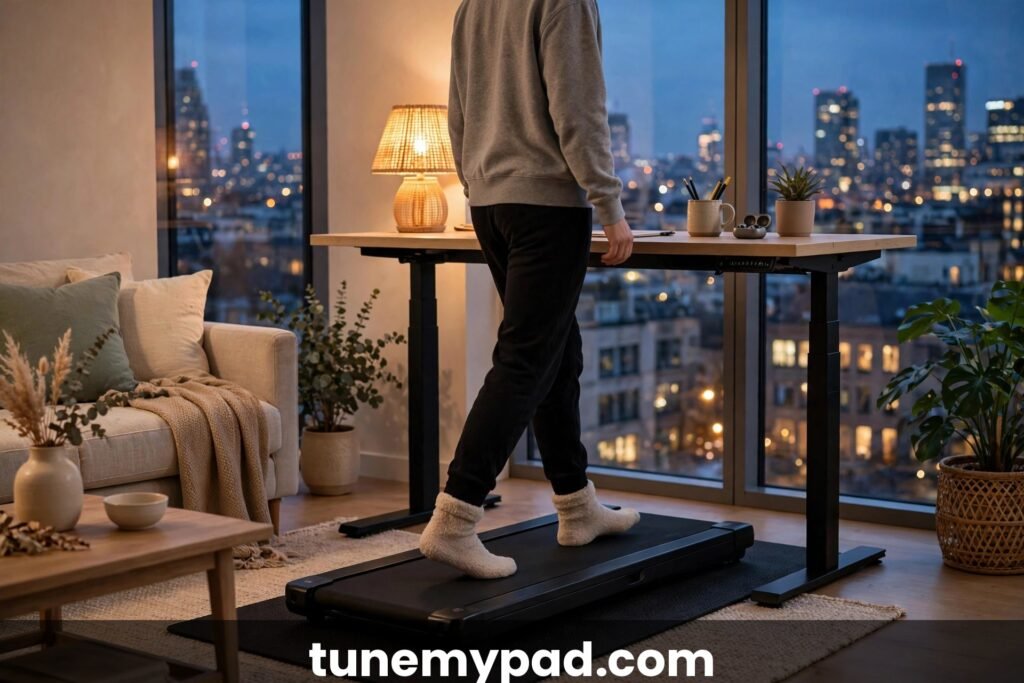
- Walk in socks or soft-soled shoes. Hard soles on the belt add a sharp slapping sound to every step. Socks or cushioned indoor shoes are noticeably quieter.
- Keep speeds moderate. The difference in transmitted thump between 2 mph and 4 mph is dramatic — roughly, impact energy rises with the square of your pace. Walk, don’t jog, if neighbors are a concern.
- Maintain the belt. A dry belt squeals; a dusty motor rattles. Follow a maintenance schedule and lubricate on time. Black dust under the pad means the belt is wearing and getting louder — address it.
- Talk to your neighbor once, early. A quick “hey, I got a walking pad — let me know if you ever hear it” prevents 90% of conflicts. People tolerate noise far better when they were warned and feel heard.
Quietest Walking Pad for Apartment: FAQs
What is a realistic noise level for a walking pad in an apartment?
Expect 50–60 dB in your room while walking — normal conversation level — even from pads marketed under 45 dB. For neighbors, impact and vibration matter far more than the motor spec, and a mat plus moderate speed controls both.
Are brushless walking pads really quieter?
Yes — brushless motors eliminate brush-friction noise and stay quieter as they age, which is why brushless is the defining trait of the quietest walking pad for apartment buyers. But at slow walking speeds your footsteps dominate, so treat brushless as the tiebreaker between similar pads, not a magic fix.
Will a treadmill mat actually stop noise for my downstairs neighbor?
A dense treadmill mat significantly reduces impact thump and vibration transfer — it’s the single highest-impact accessory you can buy for the quietest walking pad for apartment setups. It won’t make you silent on a bouncy wooden floor, but combined with moderate speed and socks, it takes most setups from “complaint risk” to “nobody notices.”
Is it better to walk or jog on a walking pad in an apartment?
Walk. Jogging roughly doubles the impact force per step and adds an airborne “pounding” quality that travels through floors far more than walking. If your building has thin floors or a sensitive downstairs neighbor, treat the pad as walking-only equipment.
Do I need to tell my landlord about a walking pad?
A walking pad is exercise equipment, not a renovation — most leases don’t require disclosure. But some buildings restrict fitness equipment on upper floors, so it’s worth a quick check of your lease or a casual question to management before you buy, especially in older wood-frame buildings.
What’s the quietest time of day to use a walking pad in an apartment?
Mid-morning to early evening is the safe window in most buildings. Sound carries further at night when ambient noise drops, so the same pad that’s inaudible at 2 pm can be noticeable at 11 pm. If you must walk late, drop to 1.5–2 mph, use the mat, and skip intervals — late-night discipline is part of owning the quietest walking pad for apartment life.
Quietest Walking Pad for Apartment: Decibel Cheat Sheet
Decibel numbers mean nothing without context. Here’s what the dB scale actually sounds like inside an apartment, so you can judge any “quietest walking pad for apartment” claim:
| Decibel level | Comparable sound | Apartment reality |
|---|---|---|
| 30 dB | Whisper, quiet library | No walking pad achieves this under load |
| 40 dB | Quiet library, bird calls | Marketing claims live here — real pads don’t |
| 50 dB | Quiet conversation, refrigerator hum | A good brushless pad at 2 mph, in your room |
| 55–60 dB | Normal conversation | Typical real-world walking pad under a walking adult |
| 65 dB | Loud conversation, laughter | Brushed motor at 3.5+ mph, or a dry belt |
| 70 dB | Shower, dishwasher | Something’s wrong — maintain or replace |
Two things most buyers miss. First, the decibel scale is logarithmic: 60 dB isn’t “a bit” louder than 50 dB — it’s roughly ten times the sound intensity. A pad measuring 57 dB (like the Tom’s Guide Z1 test) versus a claimed 45 dB is a massive real-world gap, which is why independent measurements matter more than spec sheets when hunting the quietest walking pad for apartment use.
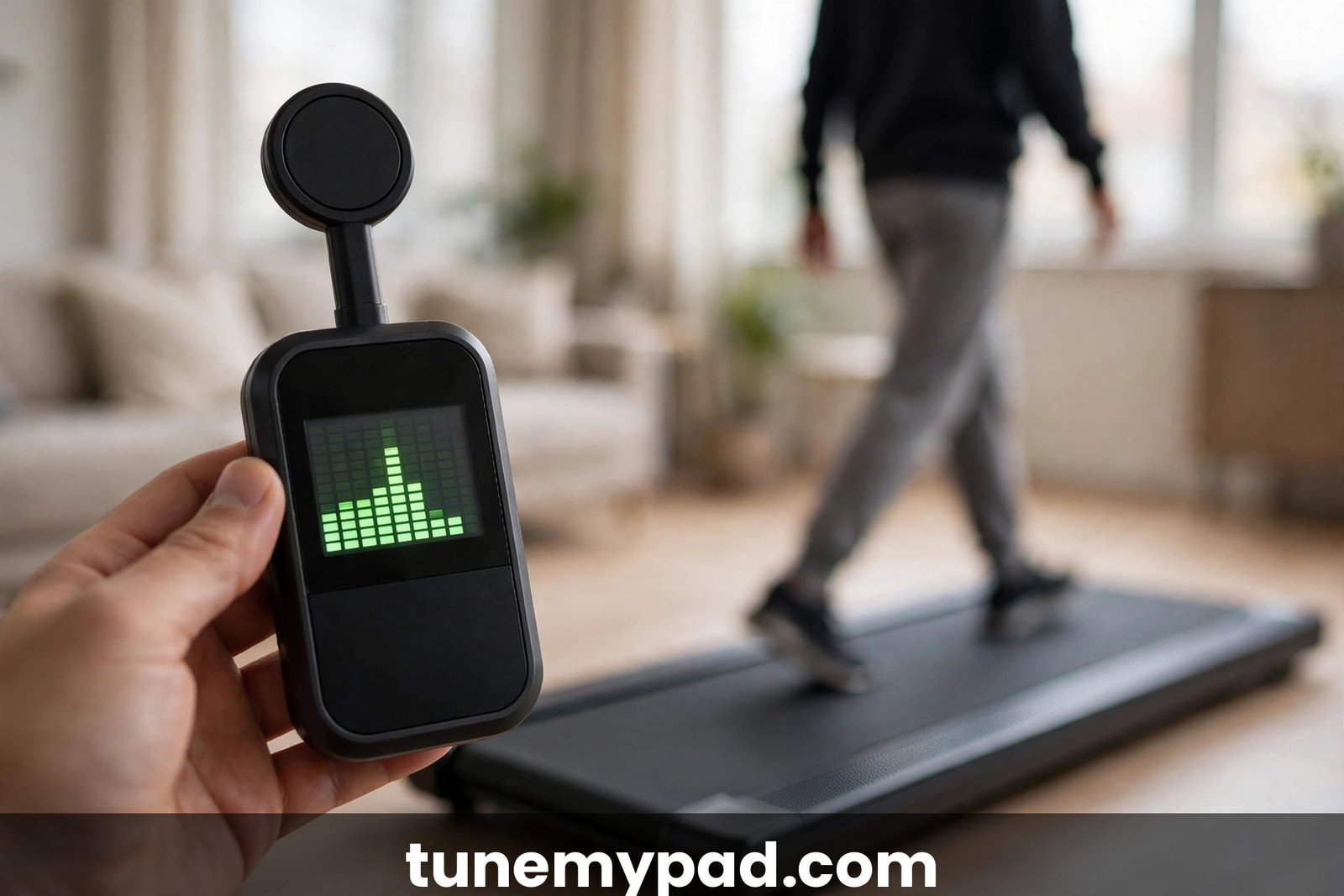
Second, phone dB apps are uncalibrated — they can be off by 5–10 dB between phone models. They’re fine for comparing your pad at different speeds (before/after lubrication, for example), but don’t treat the absolute number as lab truth. The most useful apartment test isn’t a number at all: have someone stand in the room below while you walk, and ask what they hear. That single experiment beats every spec sheet for the quietest walking pad for apartment decision.
Quietest Walking Pad for Apartment: Room-by-Room Placement Guide
Where the pad sits in your apartment changes what neighbors hear almost as much as the pad itself. The quietest walking pad for apartment living still needs smart placement:
Living room (best all-rounder). Usually the largest room, often over the building’s common areas or another living room rather than a bedroom. Place the pad in a corner — two walls absorb and block sound better than open floor. Keep it away from shared walls with neighbors; sound through a shared wall bothers more than sound through a floor.
Home office / spare bedroom. Great for desk walking, but check what’s below. If it’s the neighbor’s bedroom, restrict walking to daytime hours even with the quietest walking pad for apartment setups — impact thump at 7 am reads very differently from the same thump at 2 pm. A dense mat is non-negotiable here.
| Floor type | Noise risk | What to do |
|---|---|---|
| Concrete slab | Low | A standard treadmill mat is plenty |
| Wood/laminate over joists | High | Dense mat + interlocking foam tiles underneath; keep speed ≤2.5 mph |
| Carpet | Medium-low | Use a firm mat so the pad sits level — carpet alone muffles but destabilizes |
| Tile | Medium | Mat essential — tile transmits sharp impact sounds efficiently |
Bedroom (use with caution). Walking in a bedroom above someone else’s bedroom is the highest-conflict placement. If it’s your only option, treat the pad as a daytime-only, low-speed tool: mat, socks, under 2 mph, never late at night. Honestly assess whether the quietest walking pad for apartment marketing survives your building’s reality — in thin-floored pre-war buildings, even perfect setup has limits.
One placement trick few guides mention: position the pad over the building’s structural supports (load-bearing walls, columns) rather than mid-span. Floors flex least near supports, so footstep impact transfers less energy into the structure. You can sometimes feel this yourself — walk heavily across your room and notice where the floor feels most solid. That’s where the pad goes.
How can I test if my walking pad is quiet enough before my neighbor complains?
Do the downstairs test: ask a friend or your neighbor to stand in the room below while you walk at your normal speed. Try it with and without the mat, at 2 mph and 3.5 mph. You’ll learn more in five minutes than from any review. The quietest walking pad for apartment use passes this test at your real walking speed — not at the 1 mph crawl from a showroom demo.
Do rubber mats really make a walking pad quieter for neighbors?
Yes — measurably. A dense 1/4-inch-plus treadmill mat absorbs footstep impact before it reaches the floor, cutting the structure-borne thump that neighbors actually hear. It’s the highest-ROI noise accessory for any quietest walking pad for apartment setup, typically outperforming the difference between a mid-range and premium pad. Skip thin yoga mats; they compress to nothing underfoot.
Is it the motor or my footsteps making the noise?
Almost always the footsteps. Record your pad: first with the motor running and nobody on it, then while walking. The motor-only recording is what the dB spec measures — and it’s dramatically quieter than the walking recording. This is why the quietest walking pad for apartment buyers should obsess over mats, shoes, and speed rather than chasing a 2 dB motor difference between models.
Conclusion
The quietest walking pad for apartment living isn’t the one with the lowest dB number on its product page — it’s a brushless-motor pad with real shock absorption, set up on a dense mat, walked at moderate speeds, and maintained properly. Get those five things right and you’ll likely never hear from your downstairs neighbor. Get the “quietest” model on paper but skip the mat and jog at midnight, and no spec sheet will save you. Start with brushless, add the mat, keep the speed moderate — and the quietest walking pad for apartment living becomes a solved problem.
External References
- Tom’s Guide’s WalkingPad Z1 review — independent 57.3 dB measurement vs. the sub-45 dB claim.
- The official WalkingPad Z1 page — brushless motor and quiet home-exercise positioning.
- The Best Walking Pads’ KingSmith model guide — brushless vs. brushed breakdown across the lineup.
1 thought on “Quietest Walking Pad for Apartment: Best Quiet Picks (2026)”