
A 30 day walking pad challenge is the simplest commitment that actually changes your fitness: walk every day for 30 days, following a plan that gradually increases your time and intensity. No gym, no complicated programming, no excuses about weather. Thousands of people have used exactly this kind of challenge to lose their first 5 to 10 pounds, build an unbreakable daily habit, and discover that the walking pad gathering dust in the corner was the best purchase they ever made.
This guide gives you seven rules that make a 30 day walking pad challenge work, a complete day-by-day progression from 15 minutes to 60 minutes, tracking templates, and honest expectations for what 30 days can and cannot do. Whether you are a total beginner or a lapsed walker restarting, these 30 days will rebuild your relationship with daily movement. Check with your doctor before starting if you have heart disease, diabetes, or joint problems.
Quick Answer: 30 Day Walking Pad Challenge
The 30 day walking pad challenge works like this: walk every day for 30 days, starting at 15 to 20 minutes in week one and building to 45 to 60 minutes by week four, with two lighter recovery days per week. Most people lose 3 to 8 pounds, gain visibly better energy and sleep, and finish with a daily walking habit that sticks. The seven rules below are what separate successful challengers from people who quit on day nine.
Table of Contents
| Week | Daily target | Pace | Focus |
|---|---|---|---|
| Week 1 (days 1-7) | 15 – 25 min | 1.8 – 2.2 mph | Build the habit, adapt your feet |
| Week 2 (days 8-14) | 25 – 35 min | 2.0 – 2.5 mph | Extend duration, find your rhythm |
| Week 3 (days 15-21) | 35 – 50 min | 2.2 – 3.0 mph | Add one brisk session, push distance |
| Week 4 (days 22-30) | 45 – 60 min | 2.5 – 3.2 mph + intervals | Peak week, celebrate the streak |
The table is the skeleton of the 30 day walking pad challenge; the seven rules below are the muscle. Follow both and day 30 will feel less like a finish line and more like the start of something permanent.
Rule 1: Start Embarrassingly Easy
Rule one of a successful 30 day walking pad challenge is to begin at a level that feels almost too easy: 15 to 20 minutes at 1.8 to 2 mph. This feels wrong to motivated beginners who want to attack day one, but the data on habit formation is clear: the challenges that survive are the ones with the lowest barrier to day two. An easy day one guarantees a day two, and day two guarantees a day three.
Easy starts also protect your body. Feet, shins, and Achilles tendons need one to two weeks to adapt to daily walking, and starting at 45 minutes invites the overuse injuries that kill challenges in week two. The 30 day walking pad challenge is a 30-day game, not a 3-day game; every minute you “save” by starting easy is repaid in the final two weeks when you are walking an hour daily without pain.
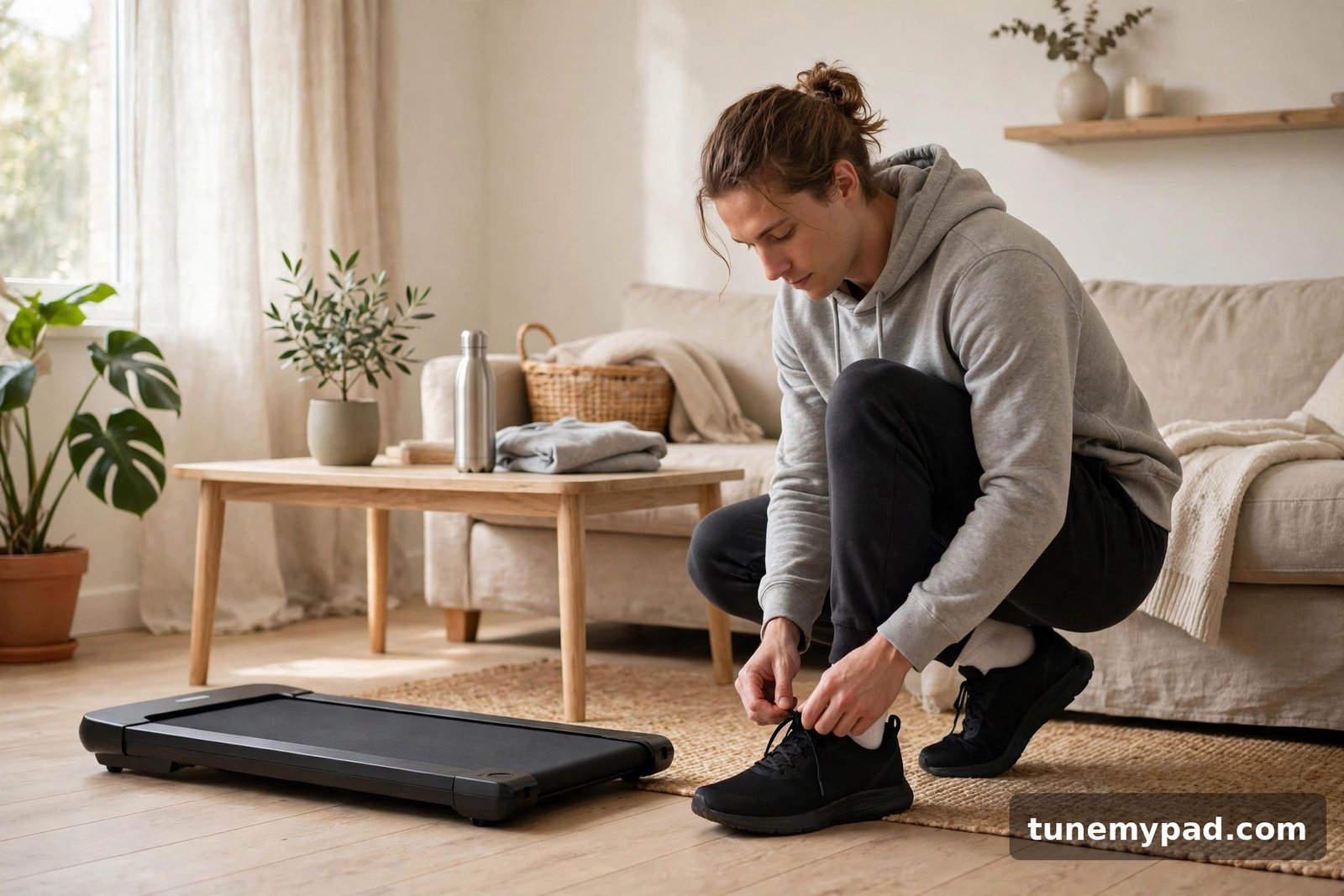
Set your day-one session right now: 15 minutes, 2 mph, no more. Write it down, do it, check the box. The psychological win of an effortless first checkmark is worth more than any heroic opening workout, because it teaches your brain that this challenge is something you do, not something you dread.
Rule 2: Never Miss Twice
You will miss a day during your 30 day walking pad challenge. Travel, illness, deadlines, life. Rule two is the entire recovery protocol: never miss twice. One missed day is a blip; two missed days is the start of a new habit called quitting. The research on habit streaks shows that a single lapse barely dents long-term adherence, but consecutive lapses collapse it.
Build the safety net in advance. Define your minimum viable session: 10 minutes at any speed. On chaotic days, the 30 day walking pad challenge does not ask for your planned 45 minutes; it asks for 10 minutes, which you can do while on a phone call or watching the news. Ten minutes keeps the streak alive, and the streak is the engine.
If you do miss a day, do not “make it up” with a double session. Just resume the plan where you left off. Doubling up after a missed day is how people get injured and then miss a week; the 30 day walking pad challenge rewards steady resumption, not dramatic compensation.
Rule 3: Increase Time Before Speed
Weeks one and two of the 30 day walking pad challenge should progress by adding minutes, not miles per hour. Go from 20 to 30 to 40 minutes at roughly the same comfortable pace before you touch the speed button. Duration builds the aerobic base and toughens connective tissue; speed builds intensity on top of that base. Base first, intensity second.
The practical progression looks like this: add 5 minutes to your daily session every two to three days through week two, holding pace at 2 to 2.5 mph. Only in week three, once 40-plus minutes feels routine, should you add a weekly brisk session or short intervals. This ordering is why the 30 day walking pad challenge produces so few injuries compared to programs that chase speed from day one.
A useful test: if you finish a session and could immediately do 10 more minutes, the duration is right. If you finish destroyed, you progressed too fast. The 30 day walking pad challenge is won by the tortoise; let the hares burn out on day twelve.
Related: How Long Should You Walk on a Walking Pad Per Day? 7 Answers
Rule 4: Track Three Numbers, Not Thirty
Tracking makes the 30 day walking pad challenge real, but over-tracking kills it. Record exactly three numbers daily: minutes walked, how you felt (1 to 10 energy), and your weight (weekly, not daily). Minutes prove consistency, energy proves the payoff, and weekly weight proves the trend. Everything else is noise for a 30-day window.
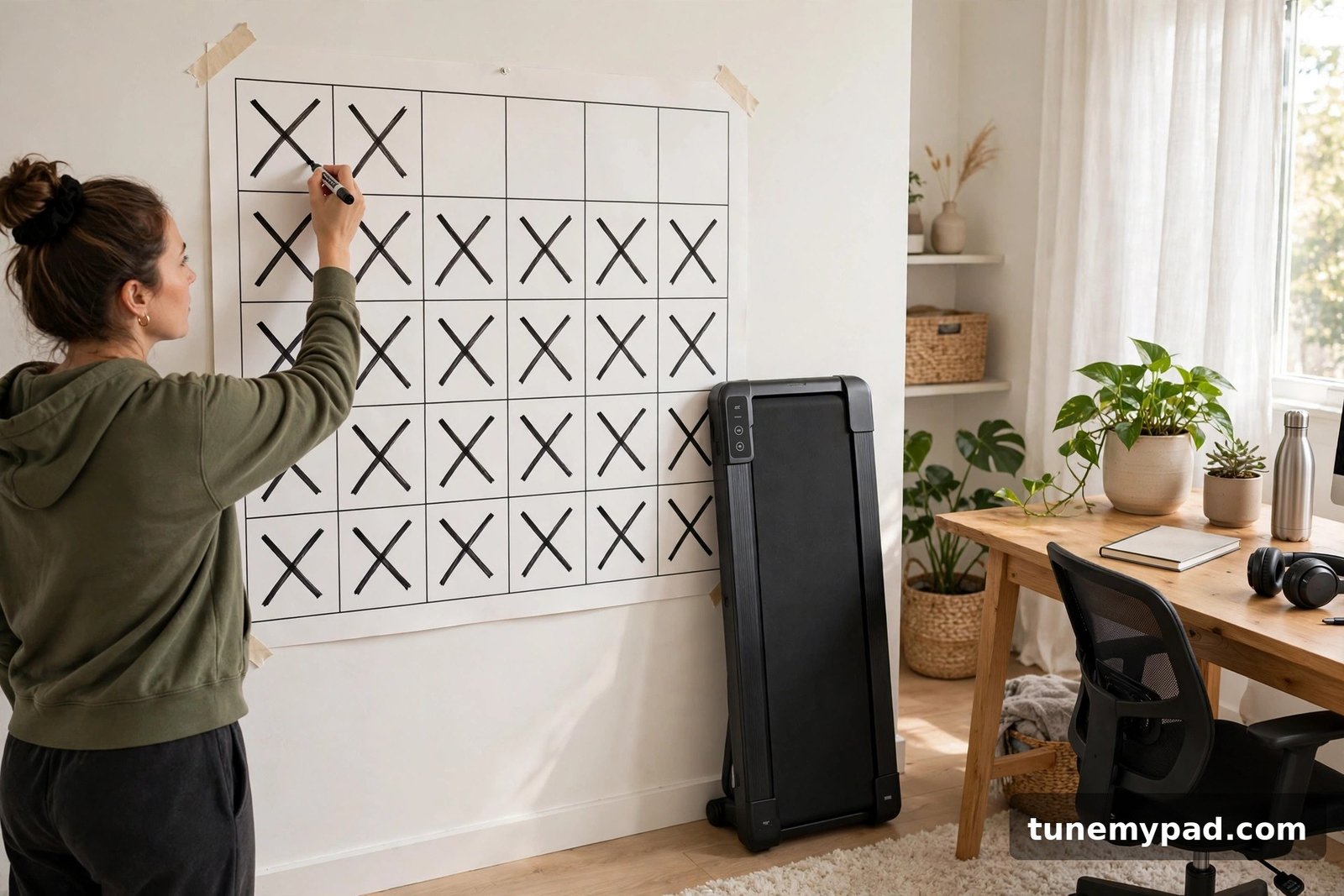
A paper calendar on the wall beats any app for this challenge. Draw a big X through each completed day; after a week, the chain of X’s becomes its own motivation, and breaking the chain feels worse than a 20-minute walk feels hard. This is the oldest habit trick in the book, and it works precisely because it is visible every time you sit at your desk.
Weigh yourself once a week, same day, same time, same clothes. Daily weigh-ins during a 30 day walking pad challenge produce mostly water-weight noise that demoralizes people; weekly weigh-ins reveal the true 1-to-2-pound-per-week trend. Take a day-one photo and measurements too; the mirror and tape measure often show changes the scale hides.
Rule 5: Fix Your Fuel, Not Just Your Feet
Walking burns calories, but the 30 day walking pad challenge only produces weight loss if eating stays steady. The cruel math: an hour of walking burns 250 to 350 calories, and a single large muffin erases it. You do not need a strict diet, but you need one rule: do not eat more because you walked. Keep meals normal, prioritize protein and vegetables, and let the walking create the deficit.
Hydration matters more than people expect. Walking an hour daily increases water needs noticeably, and thirst often masquerades as hunger, driving extra snacking. Keep a water bottle at your desk and drink a glass before each walking block. Many 30 day walking pad challenge participants report that fixing hydration alone stopped their evening snacking.
Sleep is the third fuel lever. The walking will improve your sleep within two weeks, which regulates the hunger hormones ghrelin and leptin in your favor; protect that virtuous cycle by keeping a consistent bedtime. A well-rested challenger eats less impulsively and walks more energetically, compounding the 30 day walking pad challenge results daily. The CDC’s activity guidelines pair well with these basics for a complete healthy-lifestyle reset.
Rule 6: Schedule Recovery Days, Not Rest Weeks
A 30 day walking pad challenge needs planned easy days, or your body will schedule them for you via injury. Twice a week, cut your session to 15 to 20 easy minutes at 1.8 mph. These recovery days maintain the streak and the habit while letting muscles, tendons, and joints absorb the training. They are not cheating; they are programming.
Place recovery days strategically: after your longest session of the week, and on your busiest workday. The 30 day walking pad challenge is designed around real life, and aligning easy days with hard days elsewhere in your schedule makes the whole month sustainable. Soreness that fades within a day is normal adaptation; soreness that worsens across days means add an extra easy day.
Use recovery days for maintenance too: wipe down the belt, check for debris under the pad, and confirm the belt is centered. Thirty consecutive days of use is a meaningful workload for a walking pad, and the machines that survive challenges are the ones that get basic care. A two-minute wipe-down twice a week prevents most belt issues.
Rule 7: Plan Day 31 on Day 1
The final rule of the 30 day walking pad challenge is the one nobody expects: decide before you start what happens on day 31. Challenges end; habits continue. Without a day-31 plan, most people celebrate, rest “for a few days,” and watch the habit evaporate within two weeks. With a plan, the challenge becomes a launchpad.
Good day-31 plans are boring: keep walking 30 to 45 minutes daily, or set a new 60-day step goal, or graduate to the interval plans for continued fat loss. The 30 day walking pad challenge proves you can do it; day 31 decides whether it mattered. Write your day-31 plan on the same calendar as your X’s, where you will see it all month.
Consider what the month taught you. Which time of day worked best? What speed felt sustainable? What got in the way? The 30 day walking pad challenge is a 30-day experiment on yourself, and the data is the real prize. Use it to design the next 90 days, and you will have built something no 30-day program alone can give you: a permanent practice.
Related: Walking Pad Interval Workout for Fat Loss: 7 Plans
Related: Walking Pad Beginner Workout Plan: Your Week 1, Day by Day
The Day-by-Day Plan: Weeks 1 to 4
Here is the complete daily structure for your 30 day walking pad challenge. Adjust paces to your fitness, but keep the progression shape: time first, speed later, easy days twice weekly.
Week 1 (days 1-7): 15 to 20 minutes daily at 1.8 to 2 mph. Days 3 and 6 are 15-minute easy days. Goal: seven checkmarks, zero pain. Total: about 2 hours.
Week 2 (days 8-14): 25 to 35 minutes daily at 2 to 2.5 mph. Days 10 and 13 are 20-minute easy days. Add 5 minutes every two to three days. Total: about 3.5 hours. By day 14 the 30 day walking pad challenge should feel routine rather than novel.
Week 3 (days 15-21): 35 to 50 minutes daily at 2.2 to 2.8 mph, with one 30-minute brisk session at 3 mph on day 18. Days 17 and 20 are easy days. Total: about 5 hours. This is the week most people see the scale move.
Week 4 (days 22-30): 45 to 60 minutes daily, mixing 2.5 to 3 mph steady walks with one interval session (day 25: 6 x 2 min at 3.2 mph / 2 min at 2 mph). Days 24 and 28 are easy days. Total: about 7.5 hours. Finish day 30 with your longest walk and take your after photo.
Nine days across the month are deliberately easy, which is why the 30 day walking pad challenge has such a high completion rate. The plan respects recovery, and respected bodies keep showing up.
Beating boredom: long walking sessions live or die on entertainment. Build a dedicated playlist or podcast queue reserved only for walking time; the exclusivity makes the walk something you look forward to. Audiobooks work brilliantly because a gripping chapter pulls you through the final 15 minutes. Alternatively, walk during TV episodes: a 45-minute episode equals a 45-minute session, and you will never notice the time passing.
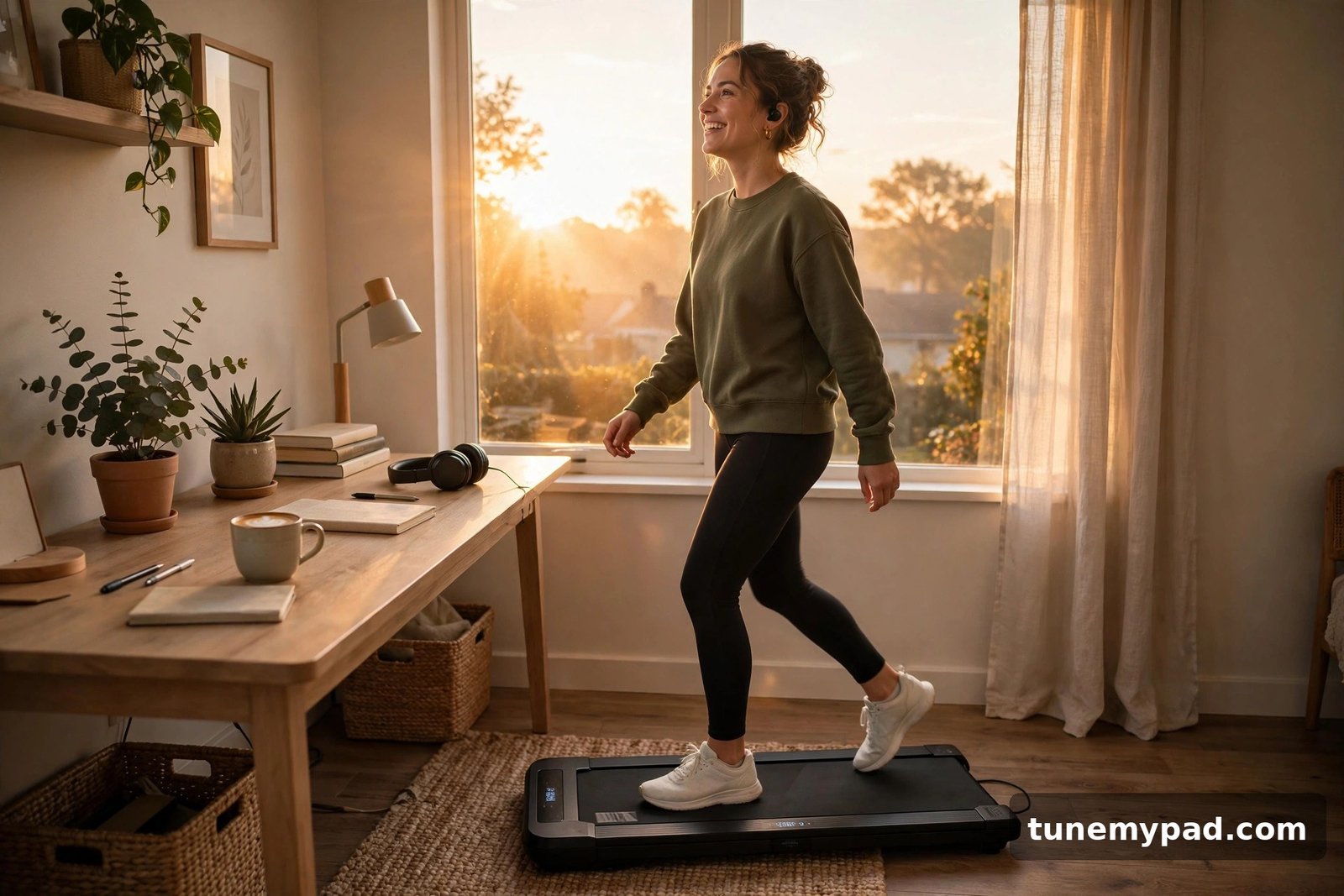
Desk-walking integration: from week two onward, move at least one daily session into work hours at 1.8 to 2 mph. Email triage, reading long documents, and listening-heavy meetings are all walk-compatible. This single change is how busy people complete the month without finding extra free time; the walking hides inside hours already spent at the desk.
What 30 Days Can Realistically Do
Honest expectations make or break a 30 day walking pad challenge. Realistic outcomes: 3 to 8 pounds of fat loss (more if heavier, less if already lean), noticeably better sleep and energy, lower resting heart rate by a few beats, looser clothes, and a genuine daily habit. Unrealistic: 20-pound transformations, visible abs, or “toned” muscles; those take months and dietary precision no 30-day walking plan provides.
The most valuable result is not measurable on day 30 at all: you will have proven to yourself that you are someone who walks daily. Identity-level change is what carries fitness through the next decade, and a 30 day walking pad challenge is one of the cheapest, most reliable ways to earn it. The documented benefits of daily walking compound over years, not weeks; think of day 30 as the down payment.
If the scale disappoints, audit honestly before quitting: did you walk all 30 days, did eating stay steady, did you progress duration as planned? In nine cases out of ten, a stalled 30 day walking pad challenge traces to extra snacking or skipped days, not to walking being ineffective. Fix the leak and run it back.
Frequently Asked Questions
Can beginners really finish a 30 day walking pad challenge?
Yes, if they follow Rule 1 and start embarrassingly easy. The 30 day walking pad challenge fails beginners only when they start at 45 minutes and get injured or exhausted. Fifteen minutes a day is a genuine start, and the progression plan above was designed for people starting from zero.
What if I miss multiple days during the 30 day walking pad challenge?
Do not restart from day one; just resume where you left off and extend the challenge by the missed days if you want a full 30 sessions. The 30 day walking pad challenge is about 30 days of walking, not 30 consecutive calendar days. Perfectionism is the enemy; resumption is the skill.
Should I do the 30 day walking pad challenge at the same time every day?
Same time helps enormously because it removes a daily decision. Morning walkers have the highest completion rates in most 30 day walking pad challenge communities, likely because willpower and schedule interference are lowest early. But the best time is the time you will actually do; consistency beats chronobiology.
Can I lose belly fat with a 30 day walking pad challenge?
You will lose fat overall, including belly fat, but no walking plan targets the belly specifically. A 30 day walking pad challenge typically trims 1 to 2 inches off the waist through general fat loss. Spot reduction is a myth; sustained calorie deficit is the mechanism, and walking plus steady eating provides it.
Do I need special gear for the 30 day walking pad challenge?
Supportive walking shoes are the one non-negotiable; everything else is optional. A water bottle, a phone stand for entertainment, and a simple wall calendar for tracking complete the kit. Do not buy gear as procrastination; the 30 day walking pad challenge starts with the pad and shoes you already own.
Is it safe to walk every day for 30 days straight?
For healthy adults, yes, provided you follow the easy-day structure and progress gradually. Daily walking is what humans evolved to do. The 30 day walking pad challenge becomes unsafe only when people ignore pain, skip recovery days, or ramp duration recklessly. Sharp or persistent pain is a stop signal, not a toughness test; see a clinician if it persists.
What should I do after finishing the 30 day walking pad challenge?
Execute the day-31 plan you wrote on day one. Good options: maintain 30 to 45 minutes daily indefinitely, start a second 30-day round at higher intensity, or add two weekly interval sessions for continued fat loss. The worst option is stopping entirely; fitness is rented, and the rent is daily movement.
Can I combine the challenge with a diet like keto or intermittent fasting?
You can, but keep it simple for the first 30 days. Adding a demanding diet on top of a new daily walking habit doubles the failure points. Most successful 30 day walking pad challenge finishers just eat normally without increasing portions. Layer in dietary changes in month two, once walking is automatic.
How do I stay motivated in week three when novelty wears off?
Week three is the motivation dip for almost everyone. Two fixes: first, review your tracking calendar and notice how far you have come; second, add one novel element, like a new podcast series or a slightly faster session, to break the monotony. Remind yourself that motivation follows action, not the reverse: step on the belt and the motivation usually arrives by minute ten.
Can I split sessions across morning and evening?
Absolutely. Two 25-minute sessions equal one 50-minute session for every outcome that matters: calories, cardiovascular benefit, and habit strength. Splitting is often easier on feet and schedule alike. Just record the total minutes so your tracking stays honest.
Conclusion: 30 Days From Now
Thirty days from now you can be 30 walks fitter, several pounds lighter, sleeping better, and owning a habit most people never build. Or you can be exactly where you are today. The 30 day walking pad challenge asks for 15 minutes tomorrow and a little more each week; that is the entire price of admission.
Print the plan, mark day one on your calendar, and step on the belt. Day 30 you is waiting, and the walk to meet them starts with a single embarrassingly easy session. The only bad 30 day walking pad challenge is the one you never start.