

If you have arthritis and are wondering whether a walking pad for arthritis is a good idea, you are asking exactly the right question, because gentle, regular movement is one of the most recommended strategies for arthritic joints, yet the wrong kind of exercise can flare symptoms. A walking pad for arthritis offers something valuable: low-impact walking in a controlled indoor environment, with no weather, no uneven sidewalks, and a handrail-free flat belt you can step off at any moment. But arthritis is a medical condition, and no article can replace your doctor’s advice. Talk to your doctor or rheumatologist before starting, especially if you have rheumatoid arthritis, are on joint injections or biologics, or have had joint surgery. For joint-specific concerns, also see our guide on whether a walking pad is bad for your knees.
This guide covers a walking pad for arthritis through seven proven safety tips: why low-impact walking helps arthritic joints, how to get medical clearance and set expectations, the right speed and duration to start, joint-friendly setup and footwear, warning signs that mean stop, how walking pads compare with other arthritis exercises, and building a sustainable routine. You will find a quick answer up front, comparison tables, and a FAQ section. Nothing here diagnoses or treats arthritis; it is practical safety information to discuss with your clinician.
Quick Answer: Is a Walking Pad for Arthritis a Good Idea?
For many people with mild to moderate osteoarthritis, a walking pad for arthritis can be a joint-friendly way to stay active, because walking is low-impact, the belt is flat and predictable, and you control the speed and duration precisely. The Arthritis Foundation consistently lists walking among the best exercises for arthritis, noting that movement lubricates joints and strengthens the muscles that support them. Start only with your doctor’s approval, begin at 1 to 1.5 mph for 10 to 15 minutes, and stop if you feel sharp pain, swelling that worsens, or joint locking. A walking pad for arthritis works best as part of a clinician-approved plan, not as a replacement for medical care.
Table of Contents
| Factor | Why it helps arthritis | Safety note | |
|---|---|---|---|
| Low-impact motion | Less joint stress than running or stairs | Keep speed at 1 – 2 mph to start | |
| Flat, predictable belt | No curbs, cracks, or weather surprises | Use side rails when stepping on/off | |
| Precise speed control | Stop or slow instantly if pain starts | Keep the remote or console within reach | |
| Indoor convenience | Easy to do short daily sessions | Consistency matters more than duration |
The short version is simple: a walking pad for arthritis is a reasonable, low-impact option for many people, provided your doctor agrees and you start gently. The seven tips below make it as safe and comfortable as possible.
Related: Is a Walking Pad Bad for Your Knees? 7 Best Answers
Tip 1: Understand Why Walking Helps Arthritic Joints
The science behind a walking pad for arthritis starts with what movement does inside a joint. Cartilage has no blood supply; it receives nutrients through the compression and release of walking, a process sometimes described as wringing out a sponge. Gentle walking also strengthens the quadriceps, glutes, and calf muscles that absorb shock before it reaches the joint, which is why clinicians recommend walking even though it seems counterintuitive to move a painful joint. The Arthritis Foundation’s physical activity guidance lists walking as a top recommended exercise for people with arthritis, emphasizing starting slowly and building gradually.
What walking does not do is repair damaged cartilage or reverse arthritis. A walking pad for arthritis manages symptoms, maintains mobility, supports a healthy weight (which reduces joint load), and improves mood and sleep; it does not cure the underlying condition. Setting that expectation honestly matters, because people who expect a cure get discouraged and quit, while people who expect gradual improvement in stiffness and function tend to stick with it. Discuss realistic goals with your doctor: less morning stiffness, easier stairs, and longer comfortable walking distances are the wins to track.
Tip 2: Get Medical Clearance and Set Your Baseline
Before buying or using a walking pad for arthritis, get explicit clearance from your doctor or rheumatologist. This is not a formality. Rheumatoid arthritis, psoriatic arthritis, and gout behave differently from osteoarthritis, and during flares, even gentle walking may be inadvisable. Your clinician can also flag medication considerations: some arthritis drugs affect balance or blood pressure, which changes how safely you can use a moving belt. Bring specifics to the appointment: the pad’s speed range, the fact that it has no incline, and your planned starting routine of 10 to 15 minutes at 1 mph.
Ask your doctor three questions: is walking safe for my type and stage of arthritis right now, are there movements or speeds I should avoid, and what symptoms should make me stop and call you. Write down the answers. A walking pad for arthritis used with clear medical boundaries is a wellness tool; used against medical advice, it is a risk. If you work with a physical therapist, even better: a PT can assess your gait and recommend speed, duration, and footwear tailored to your joints, which beats any generic guide.
Tip 3: Start at 1 mph for 10 to 15 Minutes
The most common mistake with a walking pad for arthritis is doing too much on day one. Enthusiasm is understandable, but arthritic joints respond best to gradual loading. Week one: 1 to 1.5 mph for 10 to 15 minutes, once a day, on flat with no incline. If the next morning brings only the usual stiffness, add five minutes the following week. Build toward 20 to 30 minutes before you touch the speed dial, and only then nudge up by 0.2 to 0.3 mph at a time. A walking pad for arthritis rewards patience; the goal is joints that feel better the morning after, not a workout that impresses anyone.
Time of day matters. Many people with arthritis are stiffest in the morning, so a gentle warm-up, ankle circles, knee bends, a warm shower, before stepping on the pad makes the first minutes far more comfortable. Late morning or early afternoon sessions often feel best. Track two numbers in a notebook: minutes walked and next-morning stiffness on a 1-to-5 scale. If stiffness trends down over three weeks, your walking pad for arthritis routine is working; if it trends up, scale back and talk to your clinician. Data beats guesswork.
| Week | Speed | Duration | How it should feel | |
|---|---|---|---|---|
| 1 – 2 | 1.0 – 1.5 mph | 10 – 15 min | Easy; mild warmth in joints | |
| 3 – 4 | 1.5 mph | 15 – 20 min | Comfortable; stiffness easing | |
| 5 – 6 | 1.5 – 2.0 mph | 20 – 25 min | Sustainable; next-morning stiffness stable or better | |
| 7+ | 2.0 mph | 25 – 30 min | Routine; discuss progression with clinician |
Tip 4: Set Up the Pad for Joint Comfort
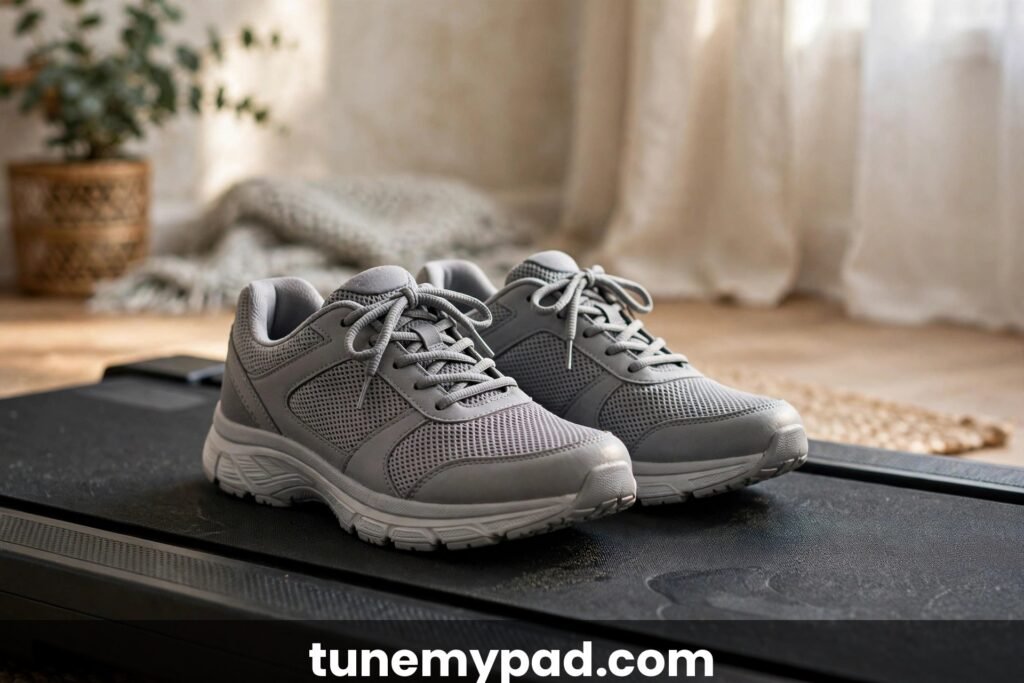
Setup details make a real difference for a walking pad for arthritis. Footwear first: cushioned walking shoes with good arch support reduce the impact each step sends through ankles, knees, and hips. Replace worn shoes promptly; dead cushioning is a hidden source of joint stress. Place the pad on a hard, level surface with a mat underneath for vibration damping, and position it where you can reach a sturdy support, a wall, a heavy desk, or a handrail, when stepping on and off. The belt start is the riskiest moment, so stand on the side rails, start the belt at 0.5 mph, then step on.
Consider the deck itself. Multi-layer cushioned decks absorb more shock than thin single-layer belts, which matters when every step counts. If you are choosing between models for a walking pad for arthritis, prioritize deck cushioning and a low step-up height over top speed or app features; you will never need 4 mph, but you will feel every bit of cushioning. Keep the belt clean and lubricated per the manual, because a dragging belt forces your joints to work against resistance they should not have to fight.
Related: Best Shoes for Walking Pad: 7 Proven Comfort Picks
Tip 5: Know the Red Flags That Mean Stop
This is the most important section for anyone using a walking pad for arthritis. Stop the session and step off if you feel sharp or sudden joint pain (as opposed to mild stiffness), visible swelling that increases during the walk, a joint that locks, catches, or gives way, numbness in the feet or legs, chest pain, or dizziness. These are not “walk it off” symptoms. Rest, ice the affected joint if your doctor has recommended it, and contact your clinician if sharp pain, swelling, or locking persists beyond a day or two. A walking pad for arthritis is safe when you respect these boundaries absolutely.
Learn the difference between acceptable and unacceptable sensations. Mild stiffness that eases after five minutes of walking is normal and often improves with consistency. Dull muscle fatigue after a session is normal. Sharp pain, pain that worsens as you walk, swelling that was not there before, and any feeling of instability are not normal. When in doubt, stop. You can always walk again tomorrow; you cannot undo a damaged joint. Keep your doctor’s phone number and your emergency contact accessible during sessions, especially when walking alone.

Tip 6: Compare Honestly With Other Arthritis Exercises
A walking pad for arthritis is one good option among several, and an honest comparison helps you choose. Swimming and water aerobics are the gold standard for severe arthritis because buoyancy unloads the joints almost completely; if you have pool access and significant pain, water exercise may suit you better. Stationary cycling is similarly low-impact and lets you sit, which helps people whose knees protest even gentle walking. Tai chi and gentle yoga improve balance and flexibility, which protect joints indirectly. The CDC notes that physical activity is one of the best non-drug strategies for managing arthritis symptoms.
Where the walking pad wins is convenience and consistency. The best exercise for arthritis is the one you actually do daily, and a pad under your desk removes every excuse: weather, travel, time, and gym anxiety. Many people combine approaches, walking pad on weekdays, a swim or gentle yoga class on weekends, which gives joints varied, low-impact loading. Discuss the mix with your clinician. A walking pad for arthritis does not have to be your only exercise; it is often the reliable daily foundation that other activities build on.
Related: Walking Pad for Seniors Over 60: 7 Best Safety Tips
Tip 7: Build a Routine You Will Keep for Years
Arthritis is a long-term condition, so a walking pad for arthritis should be set up as a long-term habit, not a 30-day challenge. Anchor walking to an existing routine: a morning session after stiffness eases, a midday break from desk work, or an evening wind-down. Keep sessions short enough that you look forward to them; 20 pleasant minutes beats 45 dreaded ones. Vary the routine slightly, different speeds within your safe range, occasional backward-glance posture checks, to keep it mentally fresh. And schedule a quarterly check-in with yourself: is stiffness better, same, or worse than three months ago?
Plan for flares. Arthritis flares happen, and the right response is to pause walking, follow your doctor’s flare plan, and resume gently when the flare passes, not to push through or to abandon the habit entirely. Having a written “flare protocol” from your clinician removes the in-the-moment decision stress. People who succeed with a walking pad for arthritis over years are not the ones who never miss a day; they are the ones who always come back after a flare. Consistency over months is what protects joints, and the pad’s convenience is what makes that consistency possible.
Walking Pad for Arthritis: Osteoarthritis vs Rheumatoid Arthritis
The two most common types deserve separate notes. In osteoarthritis, the wear-and-tear form, a walking pad for arthritis is most straightforwardly helpful: gentle walking lubricates the joint, strengthens supporting muscles, and helps manage weight, all of which reduce OA symptoms. Most OA patients with doctor clearance do well with the gradual program in Tip 3. In rheumatoid arthritis, an autoimmune condition, exercise during flares can be harmful, and the disease affects multiple joints plus overall energy. RA patients should only walk on non-flare days, keep sessions shorter, and coordinate closely with their rheumatologist.
Other forms, psoriatic arthritis, gout, ankylosing spondylitis, each have their own considerations, which is exactly why the blanket medical-clearance rule in Tip 2 exists. Never assume that advice written for osteoarthritis applies to your condition. A walking pad for arthritis is a flexible tool, but the settings, speed, duration, and even whether to use it at all, must be calibrated to your specific diagnosis by someone who knows your medical history.
Choosing the Right Walking Pad Model for Arthritis
Not every walking pad suits a walking pad for arthritis routine equally, and the features that matter here differ from what a fitness-focused buyer wants. Priority one is a low step-up height: the lower the deck, the easier and safer it is to step on with stiff joints. Slim models under 4.5 inches tall are meaningfully easier to mount than 6-inch decks. Priority two is deck cushioning: multi-layer belts with shock-absorbing layers reduce the impact transmitted to ankles and knees on every step. Priority three is a quiet, smooth motor: vibration and belt jerkiness aggravate sensitive joints, so a well-reviewed smooth drive matters more than raw power.
Priority four is control convenience. A simple remote with large buttons beats a fiddly app when your hands are stiff; make sure you can start, stop, and adjust speed without looking down for long. Priority five is the safety key or emergency stop: a clip that stops the belt if you stumble is cheap insurance and worth having. Priority six is weight capacity with headroom: choose a rating at least 50 pounds above your body weight so the motor never strains. Top speed is nearly irrelevant for a walking pad for arthritis buyer; anything reaching 3 mph is plenty, and paying extra for 7 mph hybrid speed is wasted money.
Before buying, check the return policy and warranty the way you would check a medical device purchase, because fit is personal. A 30-day home trial lets you confirm the deck height, cushioning, and noise level with your actual joints. Read reviews from older users and arthritis sufferers specifically; a pad loved by 25-year-old runners may still be wrong for you. The right model for a walking pad for arthritis is the boring, comfortable, easy-to-mount one, not the feature-packed one. Comfort is the feature.
| Feature | What to look for | Why it matters for arthritis | |
|---|---|---|---|
| Deck height | Under 4.5 inches | Easier, safer step-on with stiff joints | |
| Cushioning | Multi-layer shock-absorbing deck | Less impact per step | |
| Controls | Simple remote, large buttons | Usable with stiff hands | |
| Safety stop | Key clip or emergency button | Stops belt if you stumble | |
| Weight capacity | 50+ lb above your weight | Motor never strains; smoother belt | |
| Noise | Under ~55 dB at 2 mph | Less vibration transmitted to joints |
Frequently Asked Questions
Is a walking pad for arthritis safe?
For many people with mild to moderate osteoarthritis and doctor clearance, yes: walking is low-impact and the pad’s controlled environment is joint-friendly. Get medical approval first, start at 1 mph for 10 to 15 minutes, and stop for sharp pain, swelling, or locking. A walking pad for arthritis is not safe during RA flares or against your doctor’s advice.
What speed should I use on a walking pad for arthritis?
Start at 1 to 1.5 mph and progress slowly toward 2 mph over several weeks. Most arthritis walkers never need more than 2 to 2.5 mph. Speed is far less important than consistency; a daily gentle walk beats an occasional brisk one for a walking pad for arthritis routine.
Can a walking pad for arthritis replace physical therapy?
No. A walking pad is a complement to professional care, not a replacement. A physical therapist can assess your gait, prescribe targeted strengthening, and set safe parameters that a general guide cannot. Use the pad between PT visits, not instead of them.
Will walking on a pad make my arthritis worse?
Gentle, gradual walking typically improves arthritis symptoms rather than worsening them, according to arthritis organizations. But too much too soon, high speeds, or walking through sharp pain can aggravate joints. That is why a walking pad for arthritis works best with the slow progression in this guide and ongoing clinician input.
What shoes are best for a walking pad for arthritis?
Cushioned walking shoes with arch support and a roomy toe box. Replace them when the cushioning compresses. Good footwear is one of the highest-leverage upgrades for a walking pad for arthritis setup.
Should I use the handrail or walk hands-free?
Use nearby support when stepping on and off, and keep a hand lightly available during the walk if your balance is uncertain. Walking hands-free with natural arm swing is better for posture once you are stable, but never sacrifice safety for form. Discuss balance concerns with your doctor.
How long until I feel a difference with a walking pad for arthritis?
Most people notice less morning stiffness within two to four weeks of consistent gentle walking, though it varies widely by arthritis type and severity. Track stiffness and comfortable walking time weekly rather than judging day to day. If nothing improves after six weeks of steady use, discuss it with your clinician; the routine may need adjusting, or another exercise mix may suit you better.
The Bottom Line
A walking pad for arthritis can be a genuinely joint-friendly way to stay active: low-impact walking, a flat predictable surface, precise speed control, and the convenience that makes daily consistency possible. The non-negotiables are medical clearance, a slow start at 1 mph for 10 to 15 minutes, joint-friendly setup and footwear, absolute respect for red-flag symptoms, and honest expectations, symptom management and maintained mobility, not a cure. Talk to your doctor or rheumatologist, build the habit flare by flare and week by week, and let the pad become the quiet daily foundation your joints can count on. Thousands of people with arthritis already walk daily because gentle movement eases stiff joints, and a walking pad for arthritis simply brings that option into your living room, on your schedule, at exactly the pace your body needs today.