
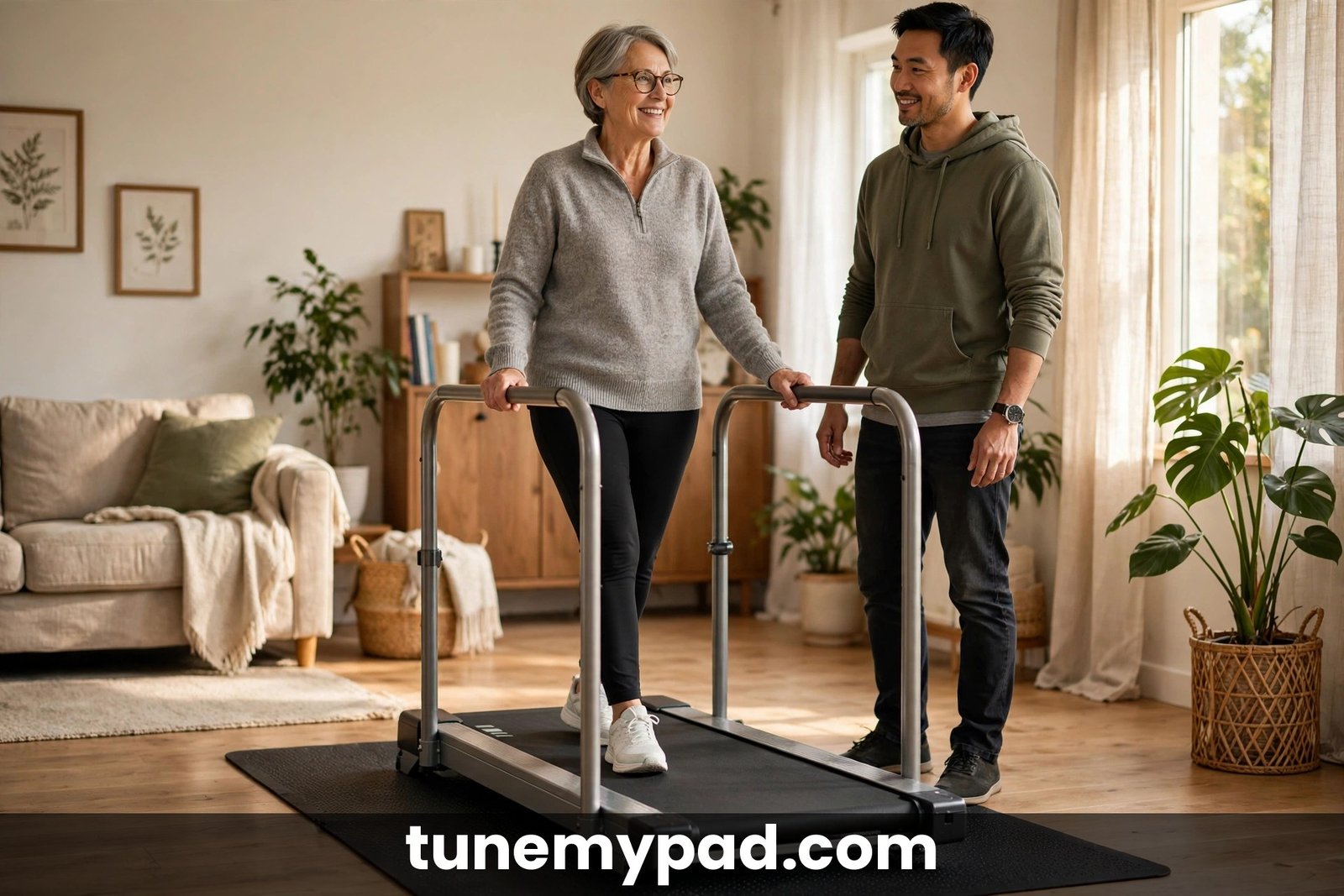
If you are over 60 and thinking about a walking pad, you are asking exactly the right question first: is this safe for me? A walking pad can be one of the best low-impact ways for older adults to stay active at home, but only with the right model, the right setup, and a few non-negotiable safety rules.
Important: this article is general information, not medical advice. Talk to your doctor or physical therapist before starting, especially if you have heart disease, balance problems, joint replacements, diabetes with neuropathy, or take medications that affect balance or blood pressure. Nothing here diagnoses or treats any condition.
The honest summary: a walking pad for seniors over 60 is safer than outdoor walking in one key way (no curbs, traffic, or uneven pavement) and riskier in one key way (a moving belt demands attention and balance). The seven safety facts below show how to keep the advantages and engineer away the risks.
Table of Contents
Quick Answer: Walking Pad for Seniors Over 60
| Question | Answer |
|---|---|
| Is a walking pad for seniors over 60 safe? | Yes, with handrails, slow speeds, a non-slip mat, and doctor clearance. Choose a model with side rails and an emergency stop. |
| What speed should seniors use? | Start at 0.5 to 1.0 mph. Most seniors settle at 1.0 to 1.8 mph for regular sessions. |
| Handrails or no handrails? | Handrails. For seniors, a model with sturdy side rails is strongly recommended. |
| How long should sessions be? | Start with 5 to 10 minutes, 2 to 3 times a day. Build to 20 to 30 minutes as fitness improves. |
| What is the biggest risk? | Falls, usually from stepping on or off a moving belt, or from dizziness. The setup below prevents most of these. |
A safe senior walking routine is built on medical clearance first, equipment second, and gradual progression third. Never skip the first step.
Safety Fact 1: Get Doctor Clearance Before the First Step
This is the least exciting and most important fact. A walking pad for seniors over 60 is exercise, and exercise interacts with medications and conditions. Blood-pressure drugs can cause dizziness when you step off a moving belt. Neuropathy reduces foot feedback. A recent joint replacement has surgeon-specific weight-bearing rules.
Your doctor visit can be short and specific: “I want to walk on a walking pad for seniors over 60 at home, 10 to 20 minutes at 1 mph to start. Is that safe with my conditions and medications?” Bring your medication list. Ask specifically about dizziness, balance, and any heart-rate limits. If your doctor suggests cardiac rehab or supervised exercise instead, follow that guidance: a walking pad for seniors over 60 is wonderful, but it is not a substitute for prescribed rehabilitation.
Safety Fact 2: Handrails Are Non-Negotiable
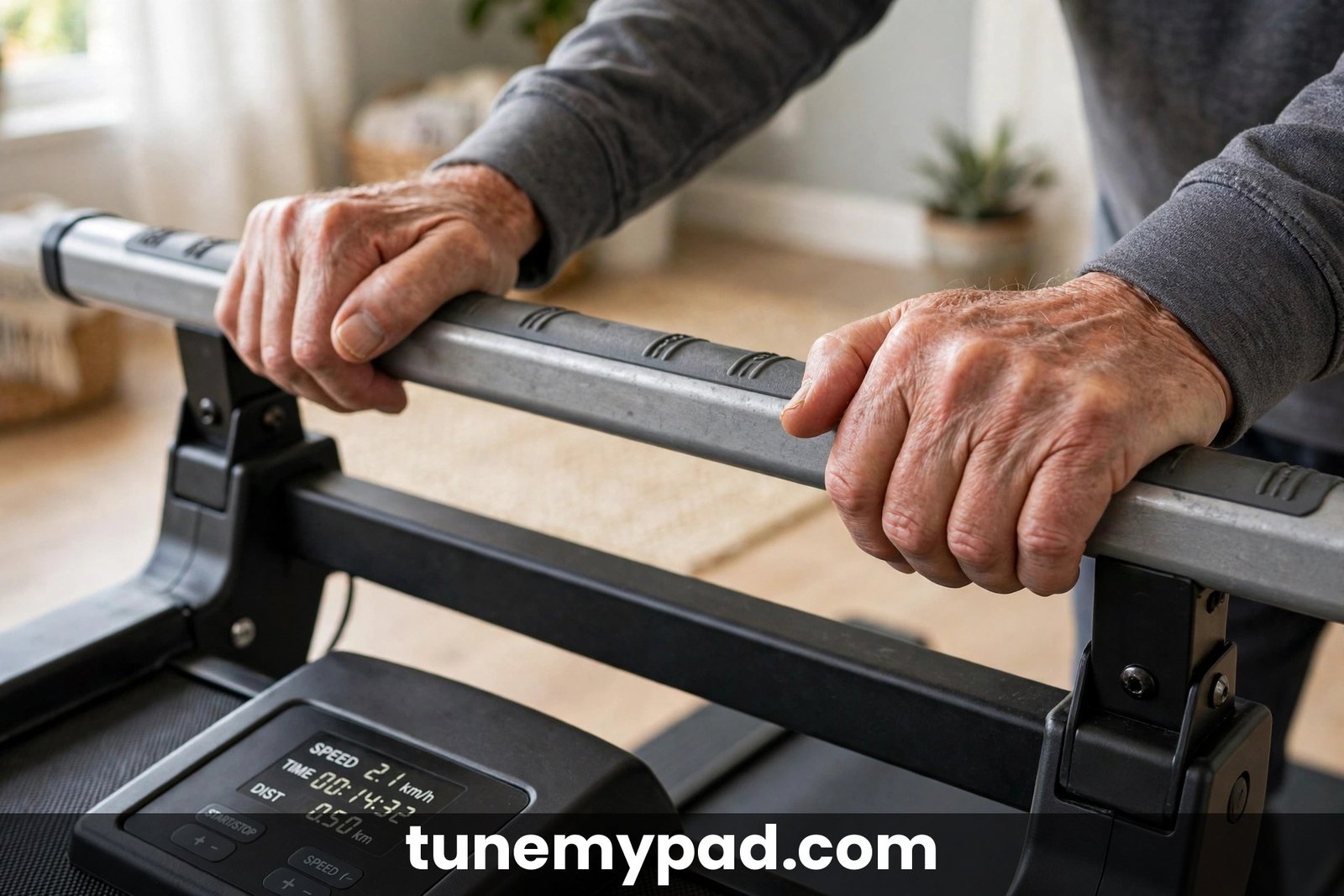
Many slim walking pads have no rails at all, and that is fine for a 30-year-old. For a walking pad for seniors over 60, sturdy side rails change the risk profile completely. They give you something to grab during the two most dangerous moments: stepping onto a moving belt and the wobble when you step off.
What to look for: rails at comfortable hand height that feel rock-solid when you lean on them, not decorative bars. Test in person if possible, or buy from a retailer with easy returns. Also confirm the emergency stop: a magnetic safety key that clips to your clothing and stops the belt instantly if you stumble. Every walking pad for seniors over 60 should have one, and you should actually wear it.
Related: Lost Your Walking Pad Safety Key? Replacement Options
Safety Fact 3: Start Absurdly Slow and Short
Pride injures more seniors than walking pads do. A safe walking pad for seniors over 60 program starts at speeds that feel silly: 0.5 to 0.8 mph for the first few sessions. Your goal in week one is not fitness; it is teaching your brain that the belt is predictable.
The progression that physical therapists recommend for a walking pad for seniors over 60: week 1, 5 to 10 minutes twice daily at 0.5 to 1.0 mph. Week 2, 10 to 15 minutes at 1.0 mph. Weeks 3 to 4, 15 to 20 minutes at 1.0 to 1.5 mph. Only after a full month of comfortable walking should most seniors try 2.0 mph, and many never need to: 1.5 mph for 30 minutes delivers real cardiovascular and mobility benefits.
Safety Fact 4: Set Up a Fall-Proof Zone
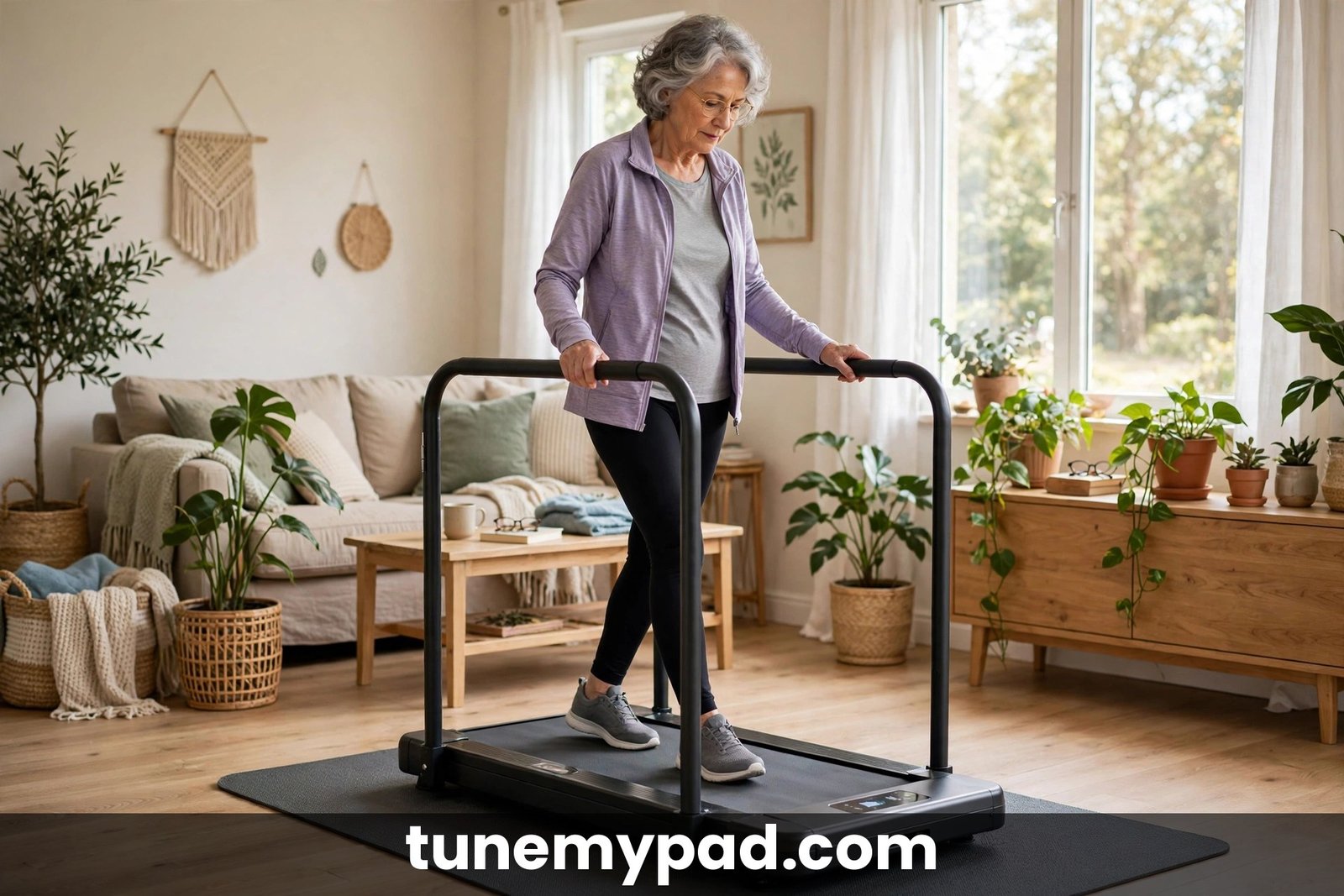
The area around a walking pad for seniors over 60 matters as much as the pad. Falls happen during mounting and dismounting, so engineer those moments: place the pad where you can hold a rail, a sturdy chair back, or a wall on at least one side while stepping on.
Checklist for a senior-safe zone around any walking pad for seniors over 60: a thick non-slip mat under and extending beyond the pad; no rugs, cords, or clutter within arm’s reach; good lighting (add a lamp if the corner is dim); a sturdy chair or bench right beside the pad for rest breaks; the remote control in a fixed, reachable spot, never loose on the belt; and a phone within reach in case you need help.
Safety Fact 5: Know the Red Flags That Mean Stop and Call Your Doctor
A walking pad for seniors over 60 should never cause chest pain, pressure, or tightness; unusual shortness of breath; dizziness, lightheadedness, or feeling faint; palpitations or an irregular heartbeat; or new joint pain that is sharp rather than achy. If any of these occur, stop the belt, sit down, and seek medical advice promptly. Call emergency services for chest pain or fainting.
Less urgent but worth a clinician visit: persistent knee or hip pain that worsens over sessions, swelling in feet or ankles after walking, numbness or tingling in feet, or balance that seems to be getting worse rather than better. These are signals to adjust the plan with professional guidance, not to push through. A walking pad for seniors over 60 is a long game; protecting your joints and heart today is what keeps you walking next year.
Safety Fact 6: Choose Senior-Friendly Features, Not Flashy Ones
Marketing pushes app connectivity and top speed. A walking pad for seniors over 60 needs different priorities: a low step-up height (the lower the deck, the easier and safer the mount), a wide belt (16 inches or more gives lateral margin), simple large-button controls or a basic remote, a clear display with big numbers, and quiet operation (you want to hear your surroundings and your body).
| Feature | Why it matters for seniors | What to look for |
|---|---|---|
| Side handrails | Fall prevention on mount/dismount | Sturdy, comfortable height |
| Safety key | Instant stop if you stumble | Magnetic clip you wear |
| Low deck height | Easier, safer step-up | Under 5 inches ideally |
| Wide belt | Room for natural stride wobble | 16+ inches wide |
| Simple controls | No fumbling at speed | Big buttons, basic remote |
| Slow minimum speed | Gentle starting pace | 0.5 mph or lower |
When comparing models for a walking pad for seniors over 60, score candidates on this table, not on maximum speed or app features. A 7.5 mph top speed is irrelevant if you will never exceed 2 mph; a rock-solid rail is priceless.
Safety Fact 7: Build the Habit With a Buddy System
The safest walking pad for seniors over 60 routine is one you actually keep, and adherence loves company. Walk while a family member is home during your first month. Tell someone your walking schedule. Keep sessions at consistent times so a missed session gets noticed.
Simple habit design for a walking pad for seniors over 60: same time daily (after breakfast works well), sessions short enough to never dread (start at 10 minutes), a visible log on the fridge (date, minutes, speed), and a weekly review with your walking buddy or family. If you use the pad while a spouse reads nearby, you get safety supervision and companionship for free.
FAQs
Is a walking pad for seniors over 60 better than walking outside?
Each has advantages. A walking pad for seniors over 60 eliminates curbs, traffic, ice, and uneven pavement, and lets you stop instantly. Outdoor walking gives fresh air, vitamin D, and varied terrain that challenges balance. Many seniors do both: pad on bad-weather days, outdoors when conditions are good. Discuss the mix with your clinician.
What is the safest speed on a walking pad for seniors over 60?
Start at 0.5 to 1.0 mph for the first week. Most seniors settle at 1.0 to 1.8 mph for regular exercise, which still delivers meaningful health benefits. Speed is far less important than consistency and safety: a daily 20-minute walk at 1.2 mph beats an occasional scary session at 3 mph.
Can a walking pad for seniors over 60 help with balance?
Walking itself maintains leg strength and coordination, which support balance, but a moving belt is not balance training. If balance is a concern, ask your physical therapist about dedicated balance exercises, and always use the handrails. Never try to “train” balance by letting go of the rails on a moving belt.
Should seniors use the incline feature on a walking pad for seniors over 60?
Gentle incline (1 to 3 percent) increases workout intensity without speed, which some clinicians recommend. But incline also changes balance demands, so only add it after a month of comfortable flat walking, and only with rails and medical clearance. Many seniors do perfectly well on flat.
How do I stop safely on a walking pad for seniors over 60?
Reduce speed gradually to the minimum, hold the rails, wait until the belt fully stops, then step off onto the side rails or floor. Never jump off a moving belt. Practice the stop sequence at very slow speed until it feels automatic. Your walking pad for seniors over 60 routine is only as safe as your dismount.
Are there walking pads designed specifically as a walking pad for seniors over 60?
Some models market senior-friendly features: low decks, full handrails, and simple controls. No certification defines a “senior walking pad,” so evaluate each model against the feature table above rather than trusting the label. The CDC’s physical activity guidance for older adults is a good reference for how much activity to target once cleared.
What should I do if I feel dizzy on a walking pad for seniors over 60?
Stop the belt immediately, hold the rails, sit down, and rest. Do not try to “walk through” dizziness. Mention it to your doctor, especially if you take blood-pressure or heart medications, since dosage timing can contribute. Dizziness that recurs means the plan needs professional adjustment before you continue.
Can I use a walking pad for seniors over 60 with a pacemaker or joint replacement?
Only with explicit clearance from your cardiologist or surgeon. Both situations have specific restrictions (electromagnetic interference precautions, weight-bearing timelines) that general articles cannot cover. Bring the pad’s manual to your appointment if the clinician wants specifications. This is general information, not medical advice.
The Bottom Line
A walking pad for seniors over 60 is one of the most practical fitness tools available to older adults: weather-proof, joint-friendly, and startlingly effective at building a daily walking habit. The formula is simple: doctor clearance, a railed model with a safety key, a fall-proof setup, slow progression, and respect for red flags. Do that, and a walking pad for seniors over 60 can keep you moving confidently for years. Talk to your clinician this week, and take your first slow, safe steps soon.
A Sample First Month on a Walking Pad for Seniors Over 60
Here is a concrete ramp showing how a walking pad for seniors over 60 program progresses safely. Adjust with your clinician’s input.
| Week | Sessions | Duration | Speed | Notes |
|---|---|---|---|---|
| 1 | 2x daily | 5-10 min | 0.5-1.0 mph | Hold rails, learn the belt |
| 2 | 2x daily | 10-15 min | 1.0 mph | Practice smooth stops |
| 3 | 1-2x daily | 15-20 min | 1.0-1.5 mph | Try light rail-only touch |
| 4 | 1x daily | 20-30 min | 1.2-1.8 mph | Settle into routine |
Notice the walking pad for seniors over 60 progression is deliberately slow: doubling time roughly every two weeks. If any week feels hard, repeat it. There is no deadline, and repeating a comfortable week always beats pushing into a scary one.
What to Wear and Bring
Proper gear makes a walking pad for seniors over 60 safer and more pleasant. Wear supportive, closed-toe walking shoes with non-slip soles, never socks or slippers on the belt. Comfortable, non-restrictive clothing that will not catch on rails. Keep water within reach, and keep the remote in a fixed holder rather than loose.
Nice extras for a walking pad for seniors over 60 setup: a small fan (overheating causes dizziness), a sturdy chair beside the pad for rest breaks, and a fall-alert device or phone in a pocket during solo sessions. These small preparations turn “exercise equipment” into a genuinely safe daily ritual.
Related: Best Shoes for Walking Pad: What to Wear for Comfortable Daily Walks
Related: Is a Walking Pad Bad for Your Knees? 7 Best Answers
Related: Walking Pad Beginner Workout Plan: Your Week 1, Day by Day
Talking to Family About Your Plan
Adult children sometimes worry when a parent starts a walking pad for seniors over 60 routine, and that worry is love. Bring them into the plan: show them the safety setup, demonstrate the emergency stop, share your schedule, and invite them to walk “with” you by phone during early sessions.
A family-approved walking pad for seniors over 60 plan has practical benefits too: someone knows your routine and will notice a missed session, and you gain a cheerleader for the weeks when motivation dips. If you live alone, consider a daily check-in arrangement with a friend or neighbor during your first month.
FAQs (continued)
How much does a good walking pad for seniors over 60 cost?
Senior-suitable models with rails typically run $350 to $800. Below that range, rails and safety features get flimsy. This is one category where spending more directly buys safety: a stable frame and reliable emergency stop are worth every dollar. Think of a walking pad for seniors over 60 as health equipment, not a gadget.
Can I watch TV while using a walking pad for seniors over 60?
Light entertainment is fine once walking feels automatic (usually week 3+), but keep eyes forward, not down at a phone. Looking down shifts balance forward and is a common fall contributor. Mount screens at eye level. During your first two weeks on a walking pad for seniors over 60, focus on the walking itself.
What maintenance does a walking pad for seniors over 60 need?
Vacuum dust from around the belt weekly, wipe the belt monthly, and lubricate per the manual (usually every 3 to 6 months). Check that the safety key clip still grips and the emergency stop works. A well-maintained walking pad for seniors over 60 is a safer one: a sticking belt or dead safety key is a fall waiting to happen.
Is it normal to feel wobbly at first on a walking pad for seniors over 60?
Completely normal. The belt moves your feet while the world stays still, which confuses the balance system for a few sessions. Hold the rails, keep speeds very low, and the wobble typically fades within one to two weeks. If dizziness or unsteadiness persists or worsens, stop and consult your clinician rather than pushing through.
Staying Motivated After Month One
The first month runs on novelty; month two runs on systems. Keep your senior walking routine alive with these: maintain the visible fridge log (streaks are powerful), set a modest monthly minute goal and beat it, vary entertainment (audiobooks, shows, calls), and schedule a quarterly “review” with your walking buddy or family member.
Plateaus are normal. If motivation dips, do not overhaul the routine: shrink it. A 10-minute walk kept is infinitely better than a 30-minute walk skipped. Many long-term senior walkers report that the habit became as automatic as morning coffee around week 8 to 10. Your only job until then is to keep showing up.
When to Upgrade Your Equipment
After a few months, you will know your needs precisely. Consider upgrading if: you consistently want speeds your pad cannot deliver smoothly, the belt feels unstable, or you wish for better rails. Do not upgrade for app features you will not use. For most senior walkers, the ideal second pad is simply a sturdier version of the first: better rails, quieter motor, larger display. Buy durability and safety, not gadgets.
Seasonal Adjustments for Year-Round Walking
A senior walking routine should flex with the seasons. In summer, walk during cooler morning hours, keep water close, and watch for overheating: age reduces heat tolerance, so a fan and a cool room matter more than they used to. In winter, the pad shines brightest: icy sidewalks keep many older adults indoors for months, and a home setup preserves the habit through the worst weather.
Daylight changes matter too. If your pad area gets dim in winter afternoons, add a bright lamp: good visibility prevents missteps during mounting and dismounting. These small seasonal tweaks keep the routine safe and pleasant all year, which is exactly what long-term joint and heart health requires.
A Final Word Before You Start
You have the clearance checklist, the equipment guide, the progression table, and the red flags. The last step is the simplest: pick a start date this week. Lay out your shoes the night before, and take your first slow 5-minute walk holding the rails. Every long-term walker started exactly there.
Keep Walking, Keep Smiling
The research is clear and the experience of thousands of older walkers confirms it: regular gentle walking supports heart health, mobility, mood, and independence. Your walking pad for seniors over 60 removes every excuse the weather ever gave you. Start slow, stay safe, and enjoy every step of the journey ahead.